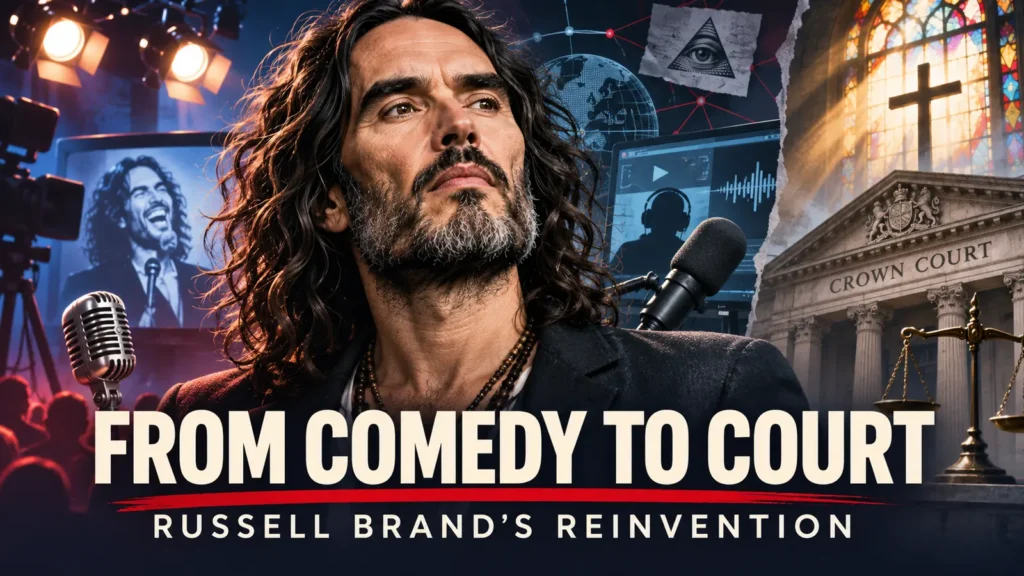
Russell Brand spent years becoming one of Britain’s best-known mainstream media personalities. He then became a broadcaster who encouraged millions to question the media that made him famous. When journalists investigated his own conduct, he placed the allegations inside that same story of institutional persecution.
The transformation was more complicated than a comedian suddenly becoming right-wing and finding God. It unfolded over more than a decade, moved through several political identities and developed into a substantial independent-media business. The chronology also offers a way to test a claim still circulating among his defenders: that Brand was targeted because he challenged powerful interests.
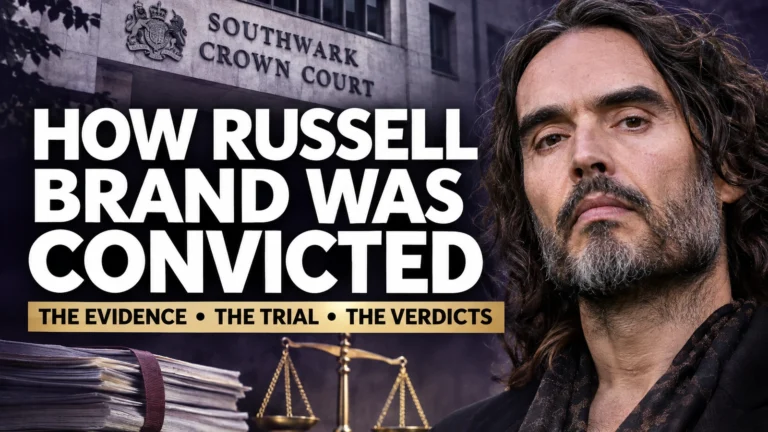
On 5 November 2026, a jury at Southwark Crown Court convicted Brand of one rape and three sexual assaults against four women. It acquitted him of two further rape charges and one attempted indecent assault. On 9 November, he was sentenced to 10 years and six months in prison. These are the outcomes of criminal proceedings, not findings made by a broadcaster or social-media platform. The Metropolitan Police confirmed the sentence.
This analysis examines Brand’s changing public persona, the business behind it and the role of religion without claiming to know what he privately believed or why he converted.
The television star who became a critic of television
For much of the 2000s, Brand was a fixture of the British entertainment industry. He fronted Big Brother’s Big Mouth for Channel 4’s E4, worked in BBC radio, appeared on television and became a Hollywood film star. His fame, influence and access to media organisations were central to his career.
This background matters because Brand did not begin as a marginalised outsider unable to get his views heard. He learned how major broadcasters worked, benefited from their platforms and cultivated the celebrity that later enabled him to reach an audience directly.
But criticism of mainstream media was not something he invented after the 2023 investigation.
2013 and 2014: the radical-left anti-establishment years
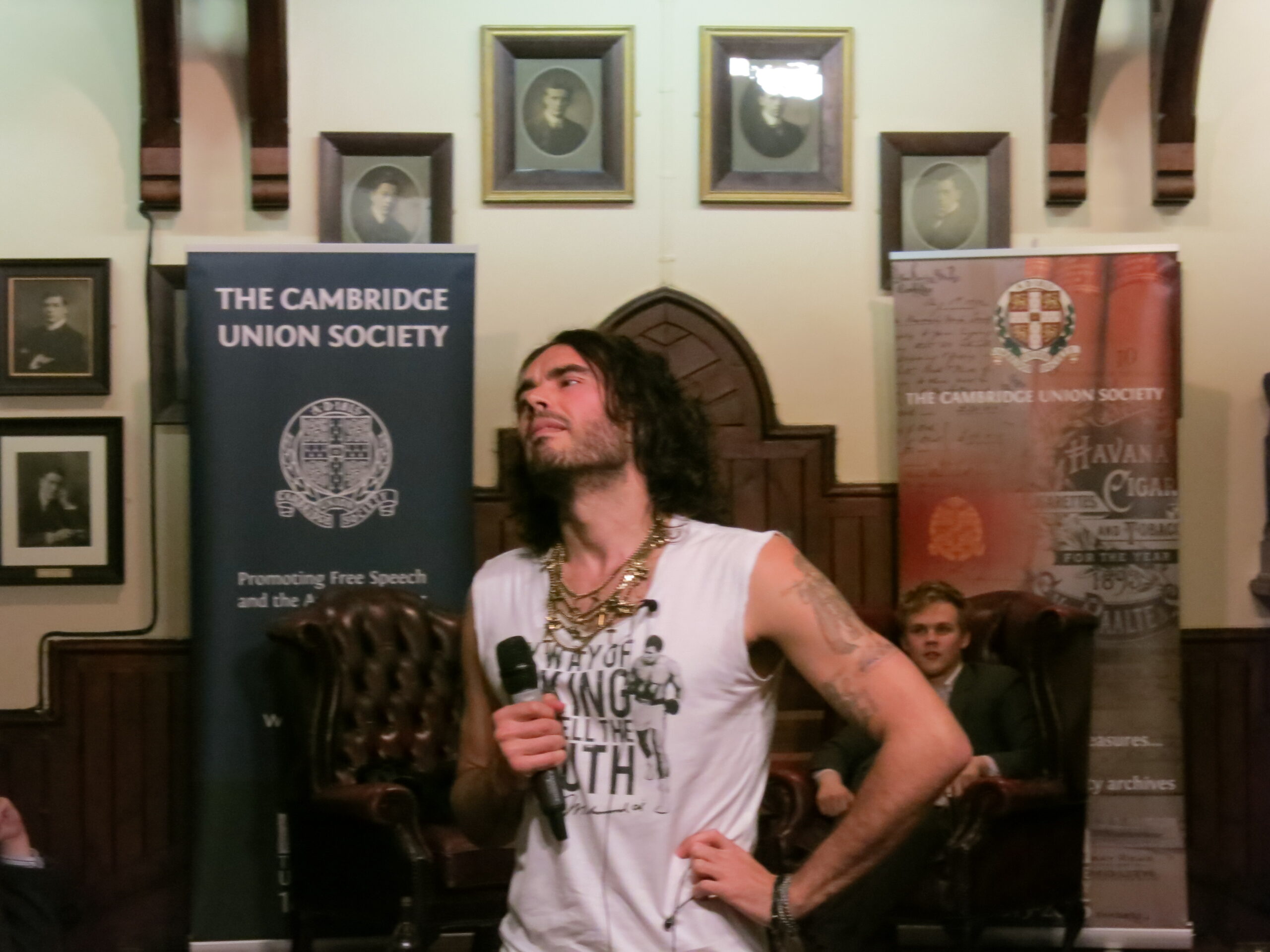
On 23 October 2013, Brand sat opposite Jeremy Paxman on BBC Newsnight and called for political change. He criticised inequality, entrenched power and conventional party politics. At this stage he was widely associated with radical-left and anti-capitalist ideas, not with the contemporary American conservative movement.
In February 2014 he launched The Trews, a YouTube series dissecting press headlines and television reporting. The programme allowed him to challenge media narratives through a channel he controlled. It was a direct-to-audience model long before the later criminal allegations became public.
His arguments were not automatically wrong because he was a celebrity. News organisations can make mistakes, corporate influence deserves scrutiny and powerful institutions should be questioned. The significant issue is how the emphasis, evidence and audience of his commentary changed over time.
2021 to 2022: a measurable change
The pandemic period provides the clearest research-based turning point. Brand increasingly devoted videos to Covid restrictions, vaccines, pharmaceutical companies, alleged censorship and claims of collusion between government, technology firms and established media.
Researcher Robert Topinka analysed 217,157 comments under Brand’s YouTube videos for a peer-reviewed paper in New Media & Society. The study examined the shift around 16 January 2022: one of the ten videos immediately before that date focused on Covid, compared with eight of the next ten. The comments became more right-leaning, more focused on conspiracies and more expressive of loyalty to Brand. Read the research.
The study does not prove that every viewer shared one political outlook or that Brand deliberately engineered a political conversion. It does provide independently analysed evidence of a change in subject matter and audience response well before Dispatches aired.
Brand’s position also moved closer to personalities he had once criticised. In a July 2023 conversation with Tucker Carlson, he discussed mainstream media, government agendas and corporate power. The interview took place almost two months before the sexual-misconduct investigation was published.
The business of telling audiences not to trust the media
As his political output expanded, Brand was not simply expressing opinions online. He was building an independent-media operation, with direct access to subscribers and multiple ways of earning money.
On 12 September 2022, Rumble announced that Stay Free with Russell Brand would become an exclusive weekday livestream on its platform. Its official statement explicitly positioned the programme as a challenge to corporate media, and said paying Locals members would receive additional Q&As, interviews, podcasts and comedy. Read Rumble’s original announcement.
By March 2023, Rumble said he had passed one million followers on its service. It also used his Brandemic special for a pay-per-view launch. Alongside subscriptions were advertising, sponsorships, merchandise and other entertainment work. Rumble’s follower announcement and pay-per-view announcement describe those arrangements.
Publicly reported accounts for Brand’s production company, Pablo Diablo’s Legitimate Business Firm Ltd, showed turnover of approximately £4.88 million and profit of about £2.9 million for 2022. Those figures concern the company as a whole, not profits attributable solely to political videos or conspiracy-related content. The company’s filing history is available at Companies House.
The commercial incentive is straightforward: if an audience believes mainstream information sources are unreliable, a personality offering an alternative can attract repeat viewers, paying subscribers and advertisers. But financial success cannot establish that Brand adopted particular beliefs only to make money. That question concerns motive, and the available records do not prove it.
September 2023: when the persecution argument became personal
The key before-and-after moment arrived on 15 September 2023, immediately before a joint investigation by The Times, The Sunday Times and Channel 4’s Dispatches was broadcast and published the following day.
Brand denied the serious allegations in a video. Rather than focusing only on the individual claims, he also suggested there could be another agenda and referred to coordinated attacks on independent voices. Contemporaneous reporting documented his response.
This is the important distinction. His suspicions about corporate media and censorship were well established by 2022. What changed in September 2023 was their application to an investigation of his own alleged conduct.
On 19 September, YouTube suspended his ability to earn advertising revenue from its platform. That was a genuine commercial sanction, imposed before criminal conviction. It was not an order preventing Brand from speaking or uploading elsewhere. Rumble continued to carry him. Read the report on YouTube’s action.
The House of Commons Culture, Media and Sport Committee also wrote to Rumble asking questions about Brand’s ability to earn money following the allegations. Rumble objected. The letter raises a legitimate debate about commercial pressure before trial, but the parliamentary document does not show MPs directing the platform to delete his speech, let alone establishing that the allegations were invented.
On 22 September 2023, Brand linked his treatment to claims about government, big technology companies and legacy media, and asked supporters to fund him directly through Rumble. His explanation of why the establishment supposedly wanted to silence alternative voices and his request for financial support now appeared together. ITV News reported the video at the time.
That is significant evidence of how the narrative worked in public. It does not prove he anticipated prosecution when building his audience. Nor does it establish that criticism of the media is inherently dishonest. It shows that an existing message about institutional mistrust became a way of explaining accusations against the person delivering that message.
April 2024: religion and the promise of a new life
The next major turn came approximately seven months later. On 26 April 2024, Brand announced that he planned to be baptised as a Christian. He was baptised in the River Thames that weekend, with Bear Grylls later confirming that he had participated.
Brand described baptism as a way to leave the past behind and be reborn. He went on to discuss prayer, repentance and surrender to Christ, and became increasingly visible at conservative Christian events, including an appearance alongside Tucker Carlson in September 2024. Read coverage of the baptism announcement and his Carlson appearance.
There is an essential qualification: Brand was spiritually interested long before 2024. His earlier public life included meditation, recovery programmes and engagement with Hare Krishna traditions. It would be inaccurate to portray him as a man with no previous religious or spiritual interests who suddenly discovered faith only after the media investigation.
Nor can a journalist determine whether a conversion is sincere simply from its timing. Brand has publicly discussed repentance. The more useful questions are what he said he was repenting for, how religious language was presented to his followers and whether it was used to address the specific offences he continued to deny.
During his criminal trial in autumn 2026, Brand spoke publicly about God, truth and justice, and appeared at court with Christian symbols. Religious language remained part of his public presentation, but it had no role in deciding whether the prosecution had proved its charges. The Irish Times documented his comments during the trial.
Is there a wider pattern among online personalities?
Brand is not the only public figure whose platform combines hostility towards established institutions, a direct financial relationship with supporters and prominent religious messaging. Similarities are worth examining, but the individual histories are different. They do not prove that people share a coordinated strategy or that their faith is insincere.
Tommy Robinson
Stephen Yaxley-Lennon, known as Tommy Robinson, had spent years on the far right before reportedly embracing Christianity while imprisoned for contempt of court in 2024–25. Christian symbolism became increasingly prominent at later events. Unlike Brand, he was already politically on the right; his legal history and offences are also entirely different. Reporting on Robinson’s Christianity also records disagreement among church leaders about its political use.
Danny Tommo
Anti-migrant activist Daniel Thomas, better known as Danny Tommo, has likewise adopted increasingly explicit Christian language, including claims of repentance and personal renewal. His religious identity and fundraising have attracted scrutiny. The timing and nature of his legal cases must be reported separately from Brand’s convictions. Sky News reported his 2026 remand on contested charges.
Alex Jones: a commercial comparison, not a conversion timeline
Alex Jones offers a more concrete parallel in the business model than in the timing of religious conversion. Jones used religious and apocalyptic language for years before his major Sandy Hook defamation defeats. But Infowars also combined sweeping distrust of official institutions with direct sales of products to its audience.
In April 2020, the US Food and Drug Administration warned the company that it was marketing silver products using claims connecting them to Covid-19 prevention or treatment. The agency said these were unapproved and misbranded drug products. Read the FDA’s original warning letter.
This is not proof that Brand made equivalent health-product claims or committed Jones’s civil wrongs. The relevant comparison is structural: cultivate a direct audience by questioning the authorities, then offer that audience a commercially supported alternative.
Andrew Tate: another distinction
Andrew Tate publicly converted to Islam in October 2022, before his arrest in Romania that December, although an investigation was already under way. His supporters later used references to the ‘Matrix’ to frame criminal scrutiny as systemic persecution. Tate has disputed criminal allegations against him. His legal situation is not equivalent to Brand’s convictions, and a change of religion before an arrest does not prove anything about sincerity. ITV examined reactions to Tate’s conversion.
What the courts actually established
Brand was not convicted by Pfizer, Channel 4, YouTube or his political opponents. After the 2023 investigation, women independently contacted police. Officers examined testimony and extensive corroborating material, and the Crown Prosecution Service authorised charges. Brand contested the allegations and gave evidence at a four-week trial.
A jury convicted him unanimously of four offences and acquitted him of three others. The judge sentenced him for the offences proved, not for every allegation aired about him. The Met’s detailed account explains how detectives gathered more than 400 witness statements and reviewed more than 1,400 documents. For the evidence behind the verdicts, read our companion report: How Russell Brand Was Convicted.
The criminal outcome does not mean every complaint about government, media ownership, pharmaceutical lobbying or technology platforms is invalid. It means those wider political debates did not disprove the specific crimes a jury found Brand had committed.
Questions the timeline answers
Did Russell Brand become anti-establishment only after allegations surfaced?
No. His 2013 political interventions, 2014 Trews videos and 2021–22 Covid and media commentary all predated the September 2023 investigation. What changed afterwards was that he used this established worldview to discuss his own situation.
Did he become right-wing because he knew he was under investigation?
The public record does not establish that motive. It documents a move from predominantly left-wing anti-establishment commentary into a media environment with more right-wing and conspiratorial themes before the allegations were published.
Was he silenced by the mainstream media?
YouTube suspended his monetisation, and other organisations ended or reconsidered commercial relationships. Those were real consequences. They did not prevent him from continuing to publish content, including on Rumble.
Does his baptism prove either innocence or a cynical cover-up?
Neither. A person’s religious commitment may be genuine, but its sincerity cannot settle historical facts. His baptism took place in 2024; the offences proved by the jury happened between 2004 and 2009.
Did anyone prove that Big Pharma or powerful elites orchestrated his prosecution?
No evidence reviewed for this article supports that claim. It should not be confused with the documented questions about platform monetisation or legitimate criticism of pharmaceutical companies.
The distinction that matters
Brand’s reinvention offers a case study in what happens when criticism of institutions becomes a broadcaster’s public identity and a commercially valuable relationship with followers. By September 2023, he had already spent years telling audiences to question the accounts given by major media organisations. When those organisations reported allegations about him, that distrust provided an existing explanation for supporters willing to reject the story.
The sequence is observable. Its private purpose is not. There is no sound basis to claim that Brand constructed his political or religious identities knowing in advance that a jury would convict him, or to declare his Christian faith false.
But the outcome is clear. The claims of persecution, the subscriptions, the political alliances and the public language of spiritual rebirth did not determine the criminal case. The evidence did. Three charges ended in acquittal; four ended in conviction. The sentence was handed down not by a media company or political faction, but by Southwark Crown Court.
Sources and further reading
- Metropolitan Police: Brand conviction and investigation evidence
- Crown Prosecution Service: verdict statement and Met: sentencing update
- Robert Topinka, New Media & Society: analysis of Brand’s YouTube audience
- Rumble: 2022 launch of Stay Free
- Companies House: production company filing history
- House of Commons committee: letter to Rumble, September 2023
- The Independent: Brand’s April 2024 baptism announcement
- US Food and Drug Administration: 2020 Infowars warning
- Fish 4 News: How Russell Brand Was Convicted