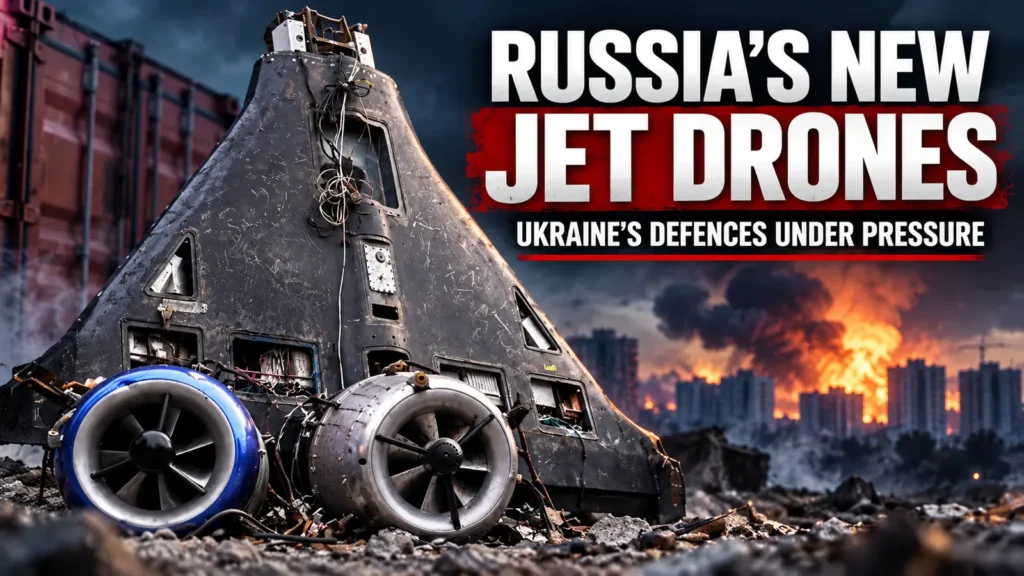
Ukraine faces a growing threat from Russia’s new generation of jet-powered attack drones, capable of travelling at approximately 375 mph (603 km/h), while restrictions affecting Starlink satellite communications are complicating efforts to intercept them. On Friday, 23 October, Ukrainian officials said the restrictions remained in place, contradicting US President Donald Trump’s announcement that Elon Musk had restored the service.
A CNN investigation has also revealed the internal components of a recovered Russian Geran-4 drone, including electronics identified by Ukrainian intelligence as originating from China and Western manufacturers.
Together, the developments highlight two significant challenges for Ukraine: defending its population against rapidly evolving Russian weapons and maintaining access to foreign technology increasingly essential to its military operations.
Russia’s Geran-4: A faster and more dangerous drone
Russian forces have increasingly deployed jet-powered drones capable of reaching speeds far beyond those of the slower, propeller-driven aircraft previously used in large-scale attacks against Ukraine.
CNN’s chief international security correspondent, Nick Paton Walsh, was given access to footage of a Geran-4 recovered by Ukrainian defence intelligence after it was brought down without exploding.
The footage showed the aircraft’s distinctive triangular body, jet propulsion system and internal electronic equipment.
According to the Ukrainian experts interviewed, the Geran-4 can travel at speeds of up to 375 mph.
That speed presents a serious challenge for Ukrainian air defence teams.
Many of Ukraine’s lower-cost interceptor drones have been developed to destroy slower Russian aircraft before they reach populated areas or critical infrastructure.
A jet-powered drone travelling at approximately 600 km/h requires significantly faster interceptors, more effective detection and a much shorter response time.
Russia’s technological improvements mean that defensive equipment effective against one generation of drones may become less useful against the next.
CNN reported that military technology on the battlefield can evolve in cycles of just four to six weeks, forcing both sides to continually adapt their systems and tactics.
Starlink restrictions are complicating Ukraine’s response
The challenge has become more serious because of restrictions affecting some Ukrainian military uses of SpaceX’s Starlink satellite communications technology.
On 14 October, Reuters reported that Ukrainian forces had experienced disruptions after restrictions were introduced on equipment travelling faster than approximately 160 km/h (100 mph).
Serhiy Beskrestnov, an adviser to Ukrainian President Volodymyr Zelenskyy, said military units had not been warned in advance and that operations had been disrupted.
Ukraine’s 7th Rapid Reaction Corps also reported having to cancel missions because of connection problems.
Starlink-equipped interceptor drones depend on reliable communications to receive instructions and, where required, transmit information to operators.
If connectivity is interrupted during a high-speed interception, the aircraft may be unable to complete its mission as intended.
The restrictions do not physically limit every Ukrainian drone to 100 mph. Rather, they affect connectivity for equipment operating above the reported threshold.
This distinction is important because Ukraine uses a range of drone systems, guidance methods and communication networks.
Nevertheless, Ukrainian defence sources have said the restrictions significantly hamper efforts to intercept Russia’s fastest drones.
On 14 October, RBC-Ukraine reported that Ukrainian officials were already investigating alternative solutions while continuing discussions with SpaceX.
Trump says Starlink has been restored, but Ukraine disputes the claim
The controversy intensified on Thursday, 22 October, when President Donald Trump said Elon Musk had restored Ukraine’s Starlink access.
The Wall Street Journal reported that Trump had contacted Musk and asked him to remove the restrictions, citing US officials.
According to that report, some Ukrainian equipment began operating more normally following the conversation, although officials cautioned that full functionality had not returned.
Asked whether he had personally spoken to Musk, Trump declined to confirm the conversation, saying:
“The bottom line – he put it back.”
However, Ukrainian President Volodymyr Zelenskyy said on Thursday that the necessary operating speeds had not been fully restored.
By Friday, 23 October, the disagreement remained unresolved.
Later that day, Trump told reporters he had not spoken to Musk about Starlink but said he would contact him if the restrictions remained. His statement differed from the Wall Street Journal’s account of a conversation between the two men.
Reuters reported that five Ukrainian officials familiar with the situation said restrictions affecting drones travelling faster than 160 km/h were still operating.
Beskrestnov said:
“We are currently not observing any lifting of speed limits on Starlink.”
He acknowledged isolated cases where equipment had operated slightly above the threshold but said these did not demonstrate that the restrictions had been removed.
The latest Ukrainian assessments therefore directly contradict Trump’s suggestion that the problem had been resolved.
Who is responsible for the restrictions?
Questions remain about precisely who authorised the restrictions and why they were imposed.
On 20 October, Reuters reported that the Wall Street Journal had attributed the original decision to Elon Musk, citing US officials and other people familiar with the matter.
Reuters said it could not independently verify that account at the time.
The issue is complicated by the distinction between Starlink, SpaceX’s commercial satellite communications service, and Starshield, a related service designed for government and national security applications.
Musk has previously stated that US government-controlled Starshield systems are subject to military and presidential decisions, while commercial Starlink services remain under SpaceX’s control.
US Secretary of State Marco Rubio said on 21 October that decisions about Ukraine’s Starlink access were a matter for SpaceX and Musk, rather than the White House.
Ukrainian officials have expressed concerns that the restrictions could be connected to wider political disagreements between Kyiv and Washington.
However, there is insufficient independently verified evidence to establish that the restrictions were deliberately introduced to help Russia or increase Ukraine’s vulnerability to attack.
The immediate operational consequences are clearer: Ukrainian forces report that they have lost capabilities at a time when Russia is deploying increasingly sophisticated high-speed weapons.
What Ukrainian intelligence found inside the Geran-4
CNN’s investigation revealed another dimension of Russia’s drone programme: its continued use of foreign technology.
Ukrainian intelligence specialists demonstrated components recovered from a Geran-4 aircraft, including its jet propulsion system and electronic control equipment.
According to a Ukrainian defence intelligence representative interviewed by CNN, the engine design is associated with Chinese manufacturer Telefly.
The official said Russia had also developed the ability to manufacture its own version.
Other components were reportedly identified as Chinese-made electronics, with some manufacturer markings apparently removed.
CNN also showed networking equipment described as a mesh modem, allowing drones to exchange signals and potentially relay information between aircraft.
Such networking capabilities could enable operators to receive live video and other information, improving the ability to navigate towards specific targets.
These claims were presented by Ukrainian intelligence during CNN’s examination and have not all been independently verified through a publicly available technical assessment.
Western electronics found inside Russian weapons
Perhaps the most significant finding was the presence of components identified as originating from Western technology manufacturers.
During the examination, a Ukrainian intelligence specialist showed CNN an electronic flight-control unit containing parts attributed to American semiconductor manufacturer Texas Instruments.
The specialist explained that some parts could still be identified by their physical characteristics or remaining markings, despite attempts to remove their branding.
Their apparent presence illustrates a continuing problem with international restrictions on Russia’s access to advanced technology.
Many electronic components used in drones are dual-use products, meaning they have legitimate applications in commercial equipment as well as military systems.
Because such parts are widely traded internationally, preventing their eventual acquisition by Russian manufacturers can be extremely difficult.
The discovery of Western-made components does not establish that their manufacturers knowingly supplied Russia or violated sanctions.
CNN specifically stated that there was no suggestion Texas Instruments had been involved in supplying the Russian drone programme.
The company told CNN that it strongly opposed the Russian use of its technology and that shipments to Russia were unauthorised and illicit.
The wider question is how internationally traded components continue reaching Russian weapons manufacturers despite sanctions and export restrictions.
The human cost of faster Russian weapons
Beyond the technological and diplomatic arguments, the consequences for Ukrainian civilians remain severe.
CNN’s report included footage of explosions in Kyiv and civilians attempting to escape attacks.
Nick Paton Walsh also described the deaths of a one-year-old girl, Angelina, and her mother, Ina, who he reported had been killed by a jet-powered drone near a residential play area.
The account underlines the devastating consequences when attacking aircraft reach civilian areas.
The precise weapon involved in individual incidents requires verification, and footage of an explosion alone cannot conclusively identify the type of drone responsible.
Nevertheless, the increasing speed of Russian attack drones presents an additional challenge to Ukraine’s already stretched air defences.
For Ukrainian families, the issue is not merely whether the country can develop better military technology.
It is whether warning systems and interceptors can respond quickly enough to prevent further deaths.
A technological race with no easy solution
Ukraine has developed increasingly sophisticated domestic drone systems throughout the war, including interceptor aircraft intended to provide a cheaper alternative to conventional air defence missiles.
But Russia is also adapting.
Faster propulsion, improved onboard electronics and the ability to communicate between multiple aircraft are changing the threats Ukrainian defenders face.
The Starlink restrictions introduce another complication by potentially reducing the operational effectiveness of some remotely controlled systems.
Ukraine is therefore confronting two problems simultaneously: developing equipment capable of reaching Russia’s latest drones and ensuring that equipment can remain connected while operating at the necessary speed.
The situation also exposes a wider strategic vulnerability.
When essential military capabilities depend on technology operated by private companies or foreign governments, decisions made far from the battlefield can have immediate consequences for military operations.
What happens next?
Ukrainian officials are continuing discussions about restoring Starlink functionality while pursuing alternative technical solutions.
The key questions are whether the existing restrictions will be fully removed, whether Ukraine can field sufficient numbers of faster interceptors and whether international efforts can restrict the flow of foreign components into Russian weapons production.
For now, Friday’s statements show that the Starlink dispute remains unresolved, despite the US president’s public assurances.
Meanwhile, the Geran-4 represents another stage in a rapidly evolving drone war, one in which the ability to adapt quickly is becoming increasingly important.
For the people living beneath Ukraine’s skies, that technological race carries potentially life-or-death consequences.
Sources
- Reuters: Ukraine disputes Trump’s Starlink restoration claim (23 October 2026)
- Reuters: Trump says he has not spoken to Musk about Starlink (23 October 2026)
- CNN: What Ukrainians found inside a new Russian jet-powered drone (22 October 2026)
- Reuters: Starlink restrictions disrupt Ukrainian military operations (14 October 2026)
- Reuters: Report on decision to restrict Starlink connections (20 October 2026)
Watch: CNN investigates Russia’s Geran-4 drone
CNN’s Nick Paton Walsh examines a recovered Russian jet-powered drone, including its engine, networking technology and electronic components identified by Ukrainian intelligence.