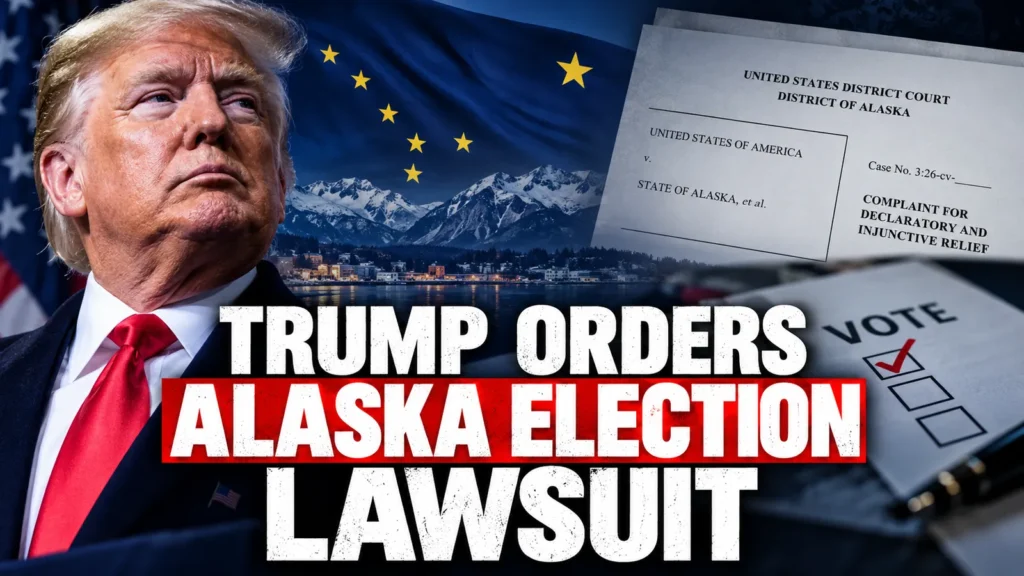
President Donald Trump has confirmed that he directed the US Department of Justice to file a federal lawsuit that could prevent Alaska from certifying the result of its Senate election if Republican incumbent Dan Sullivan loses under specified circumstances. The legal action, filed on 22 October 2026, comes ahead of the 3 November midterm elections, with early voting already underway in the Republican-led state.
The lawsuit was filed in federal court in Anchorage on Thursday, 22 October. On Friday, Trump acknowledged his personal involvement in directing the legal challenge.
“I’m the one that said do it,” he told reporters, according to ABC News.
The Department of Justice argues that the presence of two Senate candidates with similar names could confuse voters and potentially affect the outcome of the election.
However, the case has attracted criticism from election-law specialists and even a Republican senator from Alaska, who says the state has already addressed the ballot issue.
The dispute raises two separate questions: whether voters could genuinely be confused by the ballot, and whether the federal government has the legal authority to delay certification of an election result on that basis.
What is happening in Alaska?
The central contest is between Republican Senator Dan S. Sullivan, who has held the seat since 2015, and Democratic challenger Mary Peltola, a former member of the US House of Representatives.
But another candidate, Daniel J. Sullivan Jr., is also standing.
The second Sullivan is a retired teacher from Petersburg, Alaska, who entered the contest earlier this year.
Republicans allege that his candidacy was designed to confuse voters and draw support away from the incumbent.
The Justice Department’s complaint goes further, alleging that the second Sullivan’s sole purpose in standing is to benefit Peltola by reducing votes for the Republican senator.
Those are allegations, not established findings of wrongdoing.
Daniel J. Sullivan Jr. denies that his candidacy is intended to deceive voters and has maintained that he decided to stand independently.
There is no established evidence that Peltola or her campaign recruited him to manipulate the election.
What exactly is Trump’s Justice Department asking for?
This is the most important part of the story.
The federal government is not asking a judge to cancel every Alaska election result, nor is it demanding that the Republican candidate be declared the winner.
Instead, the 14-page federal complaint sets out a particular scenario.
The Department of Justice wants certification delayed if:
- Republican Senator Dan S. Sullivan loses the election.
- The votes cast for Daniel J. Sullivan Jr., if hypothetically counted for the incumbent and processed through Alaska’s ranked-choice voting system, would have been sufficient to change the winner.
Under those circumstances, federal lawyers are asking for an investigation into whether voters who selected Daniel J. Sullivan Jr. had actually intended to vote for Senator Sullivan.
The government argues that certifying a result affected by such confusion could breach federal requirements to protect electoral integrity.
However, the lawsuit does not establish that the alleged confusion has occurred, or that any ballot has been incorrectly cast.
There is also an obvious practical difficulty: American elections use secret ballots.
Once a voter has cast a ballot, determining whether that person intended to select somebody else is not straightforward. Similar names alone cannot establish the intentions of individual voters.
Didn’t Alaska already deal with the two candidates?
Yes. And this is where the background becomes particularly relevant.
In June, Alaska’s Division of Elections attempted to remove Daniel J. Sullivan Jr. from the ballot.
Election Director Carol Beecher concluded that his candidacy was intended to confuse voters, citing concerns about his requested ballot name, political affiliation and other aspects of his campaign.
Sullivan challenged that decision.
An Alaska Superior Court judge ruled that the state had applied a good-faith candidacy requirement that was not established by the relevant election laws.
On 29 June, the Alaska Supreme Court upheld the decision allowing Sullivan to remain on the ballot.
The ruling concerned his legal eligibility to stand. It did not establish that every allegation about his motivations was false.
Election officials subsequently arranged for the two men to be clearly distinguished on the ballot.
The official ballot identifies them as:
- Sullivan, Daniel J. Jr. – without a party designation.
- Sullivan, Dan S. – identified as a registered Republican and incumbent.
Voters are therefore presented with different full names, and the sitting senator’s Republican affiliation and incumbent status are specifically identified.
Alaska also uses ranked-choice voting, which allows voters to rank candidates in order of preference.
That system means the effects of voting for one candidate cannot necessarily be established simply by adding all of their votes to another candidate’s total.
The ballot arrangement and voting rules are explained in the Alaska Division of Elections guidance.
Who is actually responsible for Alaska’s elections?
Alaska is currently governed by Republican Governor Mike Dunleavy.
Its Lieutenant Governor, Nancy Dahlstrom, is also a Republican and serves as the state’s chief election official, with the Division of Elections responsible for administering the election.
This creates an important distinction.
The federal lawsuit is being brought by a Republican president’s Justice Department against election arrangements administered under a Republican-led state government.
That does not mean Republican officials ignored potential confusion.
On the contrary, the Division of Elections originally attempted to disqualify the second Sullivan. The courts subsequently ruled against that decision.
The federal government is now seeking a remedy beyond those already determined under Alaska’s election procedures.
In the United States, elections are primarily administered by state and local authorities rather than the president or the White House.
The federal government can enforce applicable election laws, but its powers are subject to constitutional and statutory limits.
The distinction is explained by the US Election Assistance Commission.
Republican Senator criticises the lawsuit
The intervention has not received unanimous Republican support.
Alaska’s other US senator, Lisa Murkowski, has publicly criticised the action despite supporting incumbent Senator Sullivan.
In comments reported by the Associated Press, Murkowski argued that Alaska’s voters were capable of identifying their preferred candidates and that election officials had already made the ballot sufficiently clear.
She concluded:
“The Department of Justice should never have filed this lawsuit.”
Meanwhile, Peltola’s campaign has condemned the legal action as an attempt to undermine voters’ choices.
A spokesperson for Senator Sullivan’s campaign said it would allow the Justice Department’s case to proceed through the legal system.
The competing responses demonstrate that the dispute is not simply a disagreement between the Republican and Democratic parties. It also concerns the role of federal courts in elections administered by individual states.
Does the Justice Department have a legal case?
The complaint relies principally on the National Voter Registration Act, legislation intended to improve access to voter registration while protecting electoral integrity.
The Justice Department argues that the law provides a basis for intervention when an election result could be affected by deliberate voter confusion.
However, legal specialists have questioned whether the statute authorises a federal court to prevent certification of an election on those grounds.
Derek Muller, an election-law professor at the University of Notre Dame, has argued that the law does not give the Justice Department the power it is seeking.
As reported by Alaska Beacon, Muller strongly criticised the legal reasoning behind the lawsuit.
The court must now determine whether the federal government has identified a valid legal basis for the relief requested.
The fact that a lawsuit has been filed does not mean that its claims have been proven or that a judge has agreed to block certification.
Why the timing matters
The lawsuit was filed on 22 October, 12 days before Election Day on 3 November.
Early voting in Alaska had already begun on 19 October.
According to Alaska Public Media, more than 30,000 Alaskans had already cast early or absentee ballots by 23 October.
The administration is therefore asking a court to establish a possible restriction on certification while voting is underway, before the final result is known.
There is no evidence at this stage that the final outcome will meet the conditions set out in the complaint.
That uncertainty is central to the case.
The court is being asked to consider what should happen if a particular result occurs, rather than addressing an established case of miscounted or fraudulent votes.
Analysis: Trump’s election claims and the question of consistency
The Alaska dispute also brings renewed attention to Trump’s longer history of challenging American election results.
His record across the past three presidential elections provides useful context.
In 2016, Trump won the presidency while Democrat Barack Obama occupied the White House.
In 2020, Trump lost his re-election campaign to Joe Biden while Trump himself was president.
Following that defeat, Trump repeatedly alleged that widespread electoral fraud had deprived him of victory.
Those claims were not substantiated by evidence sufficient to overturn the result.
Even Trump’s own attorney general at the time, William Barr, said in December 2020 that the Justice Department had not uncovered widespread fraud capable of changing the election outcome.
In 2024, Trump returned to the presidency by defeating Democratic candidate Kamala Harris while Joe Biden was in office.
These are established results documented by the US National Archives.
The pattern raises questions about how Trump has responded to elections he wins and those he loses.
However, one qualification is essential.
Neither a Democratic nor a Republican president directly administers elections across the United States.
It would therefore be inaccurate to argue that Trump personally controlled the 2020 voting process simply because he occupied the White House.
Likewise, the fact that he won elections while Democrats occupied the presidency does not establish anything about those administrations’ willingness or ability to manipulate voting.
Nevertheless, the public statements surrounding these elections can reasonably be examined for consistency.
If fraud or voter confusion is alleged, the relevant question should be whether credible evidence supports the allegation and whether the law permits the proposed remedy, irrespective of which party benefits.
In Alaska, that question is especially relevant because Republican-led state authorities already attempted to resolve the ballot dispute, and the courts ruled that the second Sullivan could stand.
The federal government is now attempting to intervene before the election has produced a final result.
What happens next?
The federal court will have to consider the Justice Department’s complaint and any legal challenges raised by Alaska and the other defendants.
Even if the Republican incumbent loses, the conditions identified in the lawsuit would still have to be examined.
The court has not established that ballot confusion will occur or that the government is entitled to delay certification.
The outcome could have implications beyond Alaska, particularly if it clarifies when federal authorities may intervene in a state election’s certification process.
For now, the essential facts are these: Alaska has an approved ballot, early voting is underway, the state courts have allowed both Sullivan candidates to stand, and the federal government is seeking a conditional remedy if the incumbent loses.
The central issue is not which candidate should win. It is what evidence and legal authority should be required before the government can stop an election result from being certified.
That question applies regardless of whether the eventual winner is a Republican or a Democrat.
Sources
- US Department of Justice – federal complaint (22 October 2026)
- Alaska Division of Elections – official election information
- Associated Press – Alaska lawsuit and reactions
- Alaska Beacon – legal analysis (23 October 2026)
- Alaska Public Media – local reporting (23 October 2026)
- US Election Assistance Commission – who runs elections
- US National Archives – electoral college results
Watch: Reaction to the Alaska election lawsuit
The following video, which prompted this Fish 4 News investigation, discusses the Justice Department’s legal challenge.