South Korea’s former president is serving a prison sentence for attempting to overturn the country’s constitutional order. As the United States prepares for its midterm elections, campaigners are asking whether its own safeguards could withstand a comparable crisis.
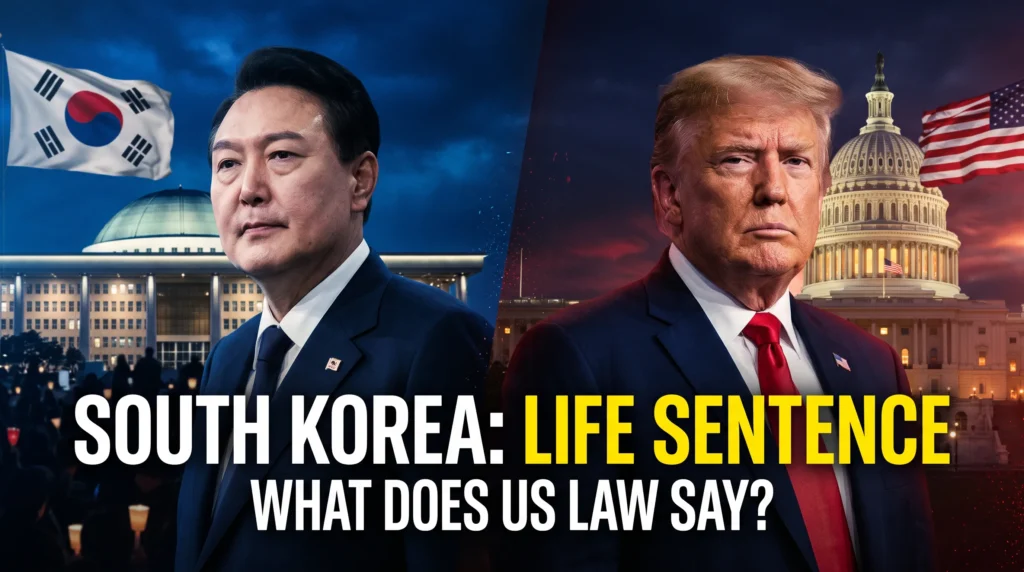
Yoon Suk Yeol was sentenced to life imprisonment by a South Korean court on 19 February 2026 for leading an insurrection after declaring martial law in December 2024. His appeal against that conviction is ongoing. The case has prompted comparisons with President Donald Trump, but the two countries have different legal systems, and no equivalent conviction or pending midterm-election insurrection case against Trump has been established.
What happened in South Korea?
On 3 December 2024, Yoon declared emergency martial law amid a political confrontation with the opposition-controlled National Assembly. Armed personnel were sent to parliament, but lawmakers were able to vote to overturn the decree. Yoon lifted martial law roughly six hours after it was declared.
He was subsequently impeached, removed from office by South Korea’s Constitutional Court in April 2025 and prosecuted. In February 2026, the Seoul Central District Court ruled that sending troops to obstruct the National Assembly amounted to insurrection. It imposed a life sentence, while Yoon rejected the judgment as politically motivated.
The life sentence was a first-instance ruling, not the end of the judicial process. Both Yoon and prosecutors appealed. According to South Korean reporting published on 15 October, the appeal court expected to hear final arguments in early November, with a possible ruling later in 2026.
Why are Americans being asked to look at the case?
In an article published on 22 October 2026, writers Paul Rogat Loeb and Jungmin Choi argued that South Korea offers lessons in how elected representatives, civil society and peaceful demonstrators can resist attempts to bypass constitutional government. Their argument concerns what might happen if an American administration tried to interfere with the 3 November midterm elections.
That is an opinion and a warning about a potential scenario. It is not evidence that Trump has already attempted a new coup connected to the 2026 vote, nor is it a formal legal warning that he is about to be imprisoned.
Could the US president use the military to interfere with voting?
US elections are administered primarily by state and local authorities. The Brennan Center for Justice says a president has no emergency power to take federal control of elections, seize voting machines or send troops to polling places merely by declaring an emergency or invoking the Insurrection Act.
A specific federal statute, 18 US Code Section 592, generally prohibits federal military or civil officers from stationing troops or armed personnel at election locations, with a narrow exception for repelling armed enemies of the United States. A violation can carry a prison sentence of up to five years. Whether the law could be applied to particular conduct, and against whom, would depend on the facts and legal arguments.
In August 2026, General Dan Caine, chairman of the US Joint Chiefs of Staff, said in a letter reported by Reuters that the military had no plans to deploy troops at midterm polling places or seize ballots or voting machinery.
Could Trump be prosecuted?
The short answer is that a president is not immune from every criminal law, but prosecution is legally complicated. The US Supreme Court’s July 2024 decision in Trump v United States recognised absolute immunity for acts within a president’s exclusive constitutional authority, presumptive immunity for other official acts and no immunity for unofficial conduct.
That means an allegation would have to be assessed against actual evidence, the conduct involved, the relevant offence and the immunity rules. It would be misleading to suggest that South Korea’s judgment against Yoon automatically establishes criminal liability for Trump, or that the same sentence would follow in the United States.
What we know and what we do not know
- Confirmed: Yoon received a life sentence in February 2026 for leading an insurrection, and he is appealing.
- Confirmed: US federal law restricts the use of troops and armed federal personnel at election locations.
- Confirmed: US presidential immunity distinguishes official from unofficial acts.
- Not established: That Trump has committed a new criminal offence in relation to the November 2026 midterms.
- Unknown: How courts would rule on any hypothetical future conduct, including questions of immunity and enforcement.
South Korea’s experience demonstrates that an attempted seizure of constitutional power can be resisted and its organisers held to account. It does not prove that the United States is facing an identical set of events. The central question ahead of the midterms is whether existing legal and institutional protections would be enforced if seriously tested.
Sources
- Republic of Korea government: Yoon’s life sentence, 20 February 2026
- Aju Press: status of Yoon’s insurrection appeal, 15 October 2026
- Paul Rogat Loeb and Jungmin Choi: How to Stop Trump’s Coup, 22 October 2026 (opinion)
- Brennan Center for Justice: Trump Can’t Use Emergency Powers to Interfere with Elections, 16 October 2026
- US House of Representatives: 18 USC Section 592
- US Supreme Court: Trump v United States, 1 July 2024
- Reuters: senior US general says no plans to deploy troops to midterm polling sites, 31 August 2026