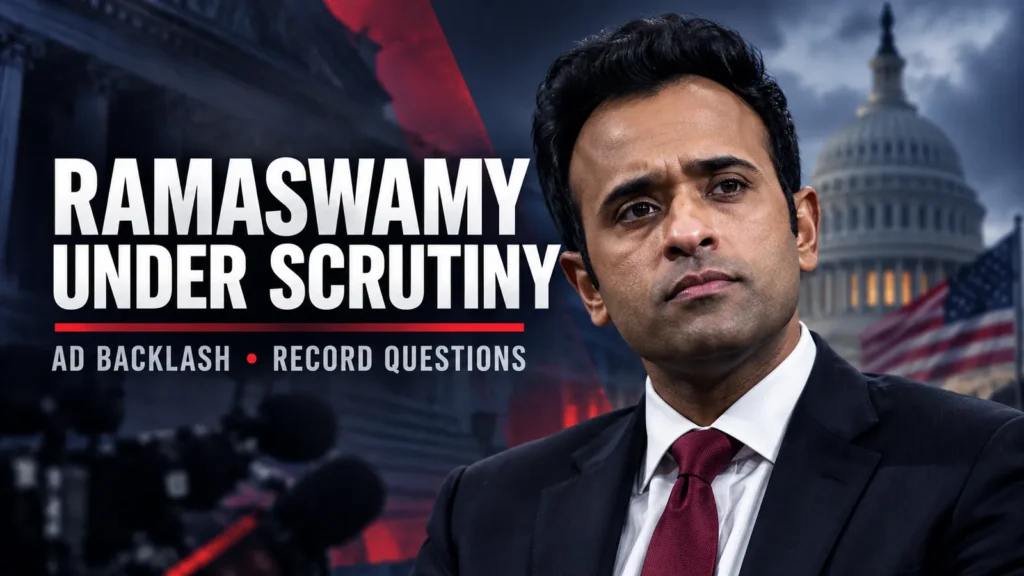
Republican Ohio governor candidate Vivek Ramaswamy is facing renewed scrutiny over his political judgement and public record after his campaign used the estranged mother of Democratic opponent Dr Amy Acton in an advertisement challenging her account of childhood hardship. Historical court records support key elements of Acton’s account of abuse, while other questions concern Ramaswamy’s earlier promises to release Jeffrey Epstein records, political donations and past campaign controversies.
An advertisement that reopened a childhood abuse case
The immediate controversy began on 19 October 2026, when a political advertisement circulated featuring Donna Arthur, the mother of Ramaswamy’s Democratic opponent, Dr Amy Acton.
Arthur accused her daughter of dishonesty, disputed her account of childhood homelessness and questioned her suitability for public office.
What the advertisement failed to disclose was the history behind their estrangement.
Acton says she experienced sexual abuse by her stepfather, Cledith Arthur, during her childhood. She and her younger brother were removed from their mother’s custody following allegations that Cledith had raped Acton when she was 12.
Donna Arthur remained married to him until his death in 2004.
Acton says she has not seen her mother since 1978.
Court records released by Mahoning County authorities confirm that Cledith Arthur was arrested and subsequently indicted on a rape charge involving his stepdaughter. He pleaded not guilty but disappeared before trial, and authorities issued warrants seeking his arrest.
He died without standing trial. There was therefore no criminal conviction, a distinction that must be maintained when reporting the case.
The records nevertheless establish that Acton’s account of a serious criminal investigation involving her stepfather was not invented for political purposes.
They also refer to Terrace Lake Park, a campground associated with the family, supporting an important element of Acton’s account of childhood instability. They do not independently establish every detail of her recollection of living in a tent.
Independent examinations by FactCheck.org and Signal Ohio document the historical evidence.
Acton’s brother, Philip Stearns, has publicly supported her account and criticised the campaign’s decision to involve their estranged mother.
Ramaswamy defends the advertisement
Ramaswamy subsequently acknowledged that his campaign was responsible for the commercial and announced a planned $4 million advertising campaign to promote it.
He maintained that the advertisement concerned Acton’s honesty rather than her history of abuse.
However, the campaign’s choice to feature a mother who had not seen her daughter for nearly five decades raised questions about the reliability and context of the testimony being presented to voters.
The advertisement did not inform viewers of the criminal case, the custody arrangements or the reasons Acton says she became estranged from her mother.
Ohio’s Republican Governor Mike DeWine, who previously appointed Acton as state health director and has endorsed Ramaswamy, urged the campaign to withdraw the advertisement.
President Donald Trump took a different position, defending Ramaswamy and encouraging him to continue using it. Vice President JD Vance also criticised Republicans who objected.
The disagreement created an unusually public division within the Republican Party during the final weeks before Ohio’s 3 November election.
Fish4News previously reported the Republican backlash and the historical court evidence.
Did the campaign know the advertisement would raise questions about sexual abuse?
An investigation published by National Journal on 21 October added another dimension.
The publication reported obtaining details of voter research distributed through the market research company Dynata before the advertisement became public.
According to the report, respondents were asked about Acton’s history of childhood sexual abuse and whether they believed she had lived in a tent. They were subsequently shown the advertisement and asked about its effectiveness.
The research is significant because Ramaswamy later insisted that the commercial had nothing to do with childhood sexual abuse.
The survey suggests that Acton’s abuse history was explicitly considered in the testing surrounding the advertisement.
However, the publicly reported evidence does not conclusively identify everyone responsible for commissioning or designing that research, and the campaign’s complete internal polling results have not been released.
Separately, political journalists and commentators have reported accounts from Republican sources alleging Ramaswamy personally pushed the advertisement despite objections from campaign advisers.
Those accounts remain attributed reporting rather than independently established evidence of the internal decision-making process.
The campaign changes the advertisement
By 24 October, Ramaswamy’s campaign had begun using a shortened, 30-second version of the original minute-long advertisement.
The revised version removed some of Donna Arthur’s most disputed claims, including her explicit rejection of Acton’s account of living in a tent and language suggesting her daughter needed personal help.
The changes followed publication of historical records supporting the family’s connection with the campground.
The campaign had not publicly established that the court records caused the changes, and Ramaswamy had not withdrawn the broader attack.
Nevertheless, the removal of those claims leaves a significant question: why were allegations previously defended by the campaign omitted from the revised advertisement?
An earlier campaign advertisement featured a convicted child sex offender
A separate controversy emerged earlier in October involving a Ramaswamy advertisement about property taxes.
The commercial featured an Ohio woman discussing her financial concerns, with her husband, Vernon Edwards, appearing in accompanying footage.
Reporting by The Bulwark, subsequently covered by The New Republic, identified Edwards as a registered sex offender.
Edwards pleaded guilty in 2006 to offences involving sexual contact with a minor and was sentenced to eight years in prison.
The reports also identified footage of Ramaswamy meeting and shaking hands with Edwards at an earlier public event.
Ramaswamy’s campaign stated that it had no previous knowledge of Edwards’ criminal history and removed him from the advertisement after being informed.
There is no established evidence that Ramaswamy knowingly recruited a convicted child sex offender or was aware of Edwards’ conviction when the footage was recorded.
The incident does, however, raise legitimate questions about the background checks carried out before members of the public appear in political advertisements.
The Jeffrey Epstein files: what happened to Ramaswamy’s demands for transparency?
The questions surrounding Ramaswamy’s political record extend beyond the Ohio campaign.
During his unsuccessful bid for the 2024 Republican presidential nomination, he repeatedly called for the disclosure of records connected with convicted sex offender Jeffrey Epstein.
On 9 December 2023, he publicly promised that, if elected president, he would release the complete Epstein client list.
His argument centred on government transparency and the need to expose wrongdoing involving powerful individuals.
But after Donald Trump returned to the White House in January 2025, Ramaswamy’s public emphasis on the issue became noticeably less prominent.
In September 2025, Cincinnati public radio station WVXU examined his changing approach, noting that requests for an interview about his earlier demands had gone unanswered.
Acton subsequently challenged Ramaswamy to renew his calls for disclosure.
His campaign later responded that he continued to support maximum transparency but was concentrating on Ohio issues rather than the federal questions he had addressed during his presidential campaign.
After congressional action towards releasing the records, his spokesperson also welcomed progress.
That subsequent position matters. It would be inaccurate to claim Ramaswamy had explicitly abandoned support for disclosure.
The documented change concerns the intensity and prominence of his public advocacy.
What was ultimately released?
President Trump signed the Epstein Files Transparency Act into law on 19 November 2025.
On 30 January 2026, the US Department of Justice announced the release of additional material, bringing its published collection to approximately 3.5 million pages.
The department described the publication as compliance with the legislation, although public debate over the extent of disclosure and redactions continued.
The existence of Epstein-related documents does not establish that everyone named in them committed wrongdoing. Being associated with Epstein, appearing in records or donating money to a politician is not proof of involvement in sexual abuse.
The relevant question for Ramaswamy is one of political consistency: why was complete disclosure a prominent demand during his presidential campaign but a less visible priority after his political ally returned to power?
The $100,000 donation from an Epstein associate
Ramaswamy’s presidential campaign also received financial support connected with Glenn Dubin, a wealthy hedge fund manager who had known Epstein.
According to campaign finance reporting, Dubin donated approximately $100,000 to American Exceptionalism PAC, an independent political committee supporting Ramaswamy, in 2023.
He also made direct donations to Ramaswamy’s presidential campaign.
Dubin had been named in allegations made by Epstein victim Virginia Giuffre. He denied wrongdoing and was not criminally charged in connection with those allegations.
Following reporting about the contributions, Ramaswamy’s campaign said it redirected Dubin’s direct donations to an organisation helping vulnerable women.
However, a December 2025 investigation by The Plain Dealer and Cleveland.com established that American Exceptionalism PAC dissolved without donating or refunding the separate $100,000 contribution.
Ramaswamy’s spokesperson stressed that the candidate and his campaign were legally prohibited from coordinating with the independent committee and that Ramaswamy did not know what the PAC had done with the money.
This distinction is crucial.
The campaign’s direct contributions and the independent committee’s finances were separate matters. There is no evidence establishing that Ramaswamy personally controlled the PAC’s decision.
Nevertheless, the different outcomes of the contributions raise questions about how political organisations handle controversial donations and communicate their decisions publicly.
Questions over his business record
Before becoming a prominent Republican political figure, Ramaswamy made his fortune in biotechnology and investment management.
His business history has also become a subject of political argument.
The Alzheimer’s drug that failed
In 2014, Ramaswamy founded Roivant Sciences. A subsidiary, Axovant, acquired an experimental Alzheimer’s drug called intepirdine from GlaxoSmithKline.
Ramaswamy subsequently promoted its development prospects.
The drug later failed a major Phase 3 clinical trial, and Axovant’s stock price fell dramatically.
Political opponents have argued that Ramaswamy benefited financially from investor enthusiasm surrounding a treatment that ultimately proved unsuccessful.
But the distinction between commercial failure and deliberate fraud is essential.
An October 2026 PolitiFact investigation found that the stronger accusation, that he knowingly promoted a drug he knew would fail and deliberately scammed investors, was not supported by sufficient evidence.
The failed trial is a documented business outcome. It does not, by itself, establish fraudulent intent.
A whistleblower case involving his investment firm
Ramaswamy also co-founded Strive Asset Management.
Former Strive executive Joyce Rosely brought legal proceedings alleging that senior figures pressured employees to engage in conduct she believed violated securities laws and retaliated against her when she objected.
In August 2026, US District Judge Julien Xavier Neals refused to dismiss a whistleblower-retaliation claim against Ramaswamy personally.
The judge concluded that the allegations, if proven, were sufficient for that claim to proceed.
That was a procedural decision, not a finding that Ramaswamy had violated securities law or unlawfully retaliated against an employee.
Strive has denied wrongdoing and indicated that it would defend the litigation.
Rosely also alleged that she had raised concerns about possible sexual harassment involving another company executive. The harassment-related retaliation claim was dismissed without prejudice, while separate whistleblower claims continued.
The alleged harassment was not attributed to Ramaswamy personally.
The surviving litigation nonetheless forms part of the documented legal scrutiny surrounding his former business operations.
Campaign advertising has previously been challenged over accuracy
The Acton family advertisement was not the first time factual questions had arisen over advertising produced by Ramaswamy’s Ohio campaign.
In August 2026, a commercial featured Republican activist Linda Caudill, who blamed Acton’s pandemic-era decisions for the isolation and death of her mother.
However, reporting by The Columbus Dispatch and other outlets established that Caudill’s mother had lived in Kentucky and died there in July 2020.
Her death also occurred after Acton had left her position as Ohio’s health director.
The advertisement did not disclose those geographical and chronological details.
The findings substantially weakened the attempt to attribute the circumstances of the woman’s death directly to Acton’s actions as Ohio’s health director.
The episode raises a broader issue about political advertising: emotionally compelling testimony is not necessarily reliable evidence of responsibility for a particular event.
Forged signatures during the 2024 presidential campaign
Ramaswamy’s earlier presidential operation faced a separate problem involving ballot-access petitions in Rhode Island.
Election officials identified signatures belonging to deceased voters among petitions submitted on behalf of his campaign.
The campaign acknowledged that a worker employed by an outside political organising contractor had deliberately forged signatures.
The worker was dismissed.
There was no established evidence that Ramaswamy personally forged the signatures or directed the misconduct.
Nevertheless, the incident is relevant to questions about campaign oversight, particularly given his public emphasis on election integrity and accurate electoral administration.
What the latest political reaction reveals
The controversy surrounding the Amy Acton advertisement has moved beyond the original commercial.
On 24 October, former President Barack Obama criticised Ramaswamy’s campaign during a rally in Cleveland.
In an interview conducted on 24 October and published by ABC News the following day, Acton said she hoped Trump and Vance would examine the evidence concerning her childhood.
On 25 October, the editorial board of The Plain Dealer and Cleveland.com took the unusual step of reversing its earlier decision not to endorse a candidate in the Ohio governor’s race.
Its published editorial endorsed Acton and condemned the campaign’s use of her childhood history.
The newspaper also raised wider questions about Ramaswamy’s engagement with policy issues affecting Ohio residents.
Ramaswamy’s campaign rejected the significance of the endorsement and challenged the newspaper’s independence.
The decision was an editorial judgement by the publication, not a finding by a court or independent investigative authority.
Meanwhile, Ramaswamy continued campaigning with support from Trump and Vance, who have defended his approach to the controversial advertisement.
What the evidence does, and does not, establish
The available record supports several conclusions about Ramaswamy’s actions.
His campaign produced and promoted an advertisement featuring a woman estranged from her daughter following a serious childhood abuse case. It omitted relevant family history, and historical records support significant elements of the childhood account it challenged.
He defended the advertisement despite criticism from senior Republicans, and his campaign subsequently released a shorter version removing some disputed claims.
His earlier demands for the disclosure of Epstein records were considerably more prominent during his presidential campaign than during parts of his subsequent campaign for governor.
His presidential operation also received contributions from an Epstein associate, although the candidate’s campaign and an independent supporting committee handled those contributions differently.
Other controversies include a campaign advert featuring a convicted sex offender without the campaign’s reported prior knowledge, disputed advertising claims, forged signatures collected by a contractor and unresolved civil litigation connected to his former investment business.
None of this establishes that Ramaswamy personally committed sexual offences, knowingly protected child sexual abusers or participated in Epstein’s crimes.
It is important not to turn separate events and associations into allegations unsupported by evidence.
What the record does establish is that Ramaswamy has repeatedly faced questions over the factual basis of political messaging, the management of his campaigns and the consistency between public promises and subsequent priorities.
The questions that remain
Ramaswamy’s defenders argue that political campaigns have a right to question an opponent’s honesty, that he has been subjected to personal attacks himself and that criticism of his business history sometimes overlooks evidence favourable to him.
Those arguments form part of the public debate and deserve to be represented accurately.
But the Amy Acton advertisement raises a particular question about political responsibility.
Campaigns choose the sources they present, the context they include and the information they leave out.
When an advertisement uses an estranged parent to discredit someone’s account of childhood hardship, the history of that estrangement is not an incidental detail.
It is central to assessing the reliability of the claims.
The same standard applies to allegations against Ramaswamy. His political opponents’ accusations should be tested against evidence, just as his campaign’s accusations against Acton should be.
As Ohio prepares to vote on 3 November, the scrutiny surrounding Ramaswamy is therefore about more than one controversial advertisement.
It concerns the standards of evidence, transparency and accountability that should apply to anyone seeking political power.
Sources and further reading
- Associated Press: Trump backs Ramaswamy over Amy Acton advertisement
- FactCheck.org: Historical records support Acton’s childhood account
- Signal Ohio: The 1978 court records and the family’s estrangement
- National Journal: The campaign advertisement testing
- WVXU: Ramaswamy’s earlier demands concerning Epstein records
- Cleveland.com: Epstein-related political donations and responses
- US Department of Justice: January 2026 Epstein document release
- The New Republic: Convicted sex offender featured in campaign footage
- PolitiFact: Ramaswamy’s Alzheimer’s drug business record
- TiffinOhio.net: Federal whistleblower lawsuit
- ABC News: Acton’s response and the 25 October developments
- The Plain Dealer: 25 October editorial
- Cleveland.com: The shortened Amy Acton advertisement, 26 October 2026
- WOSU: Reporting on the earlier Linda Caudill campaign advertisement
- Rhode Island Current: Election officials examine forged petition signatures
- US District Court: Rosely v Strive Asset Management, August 2026 opinion