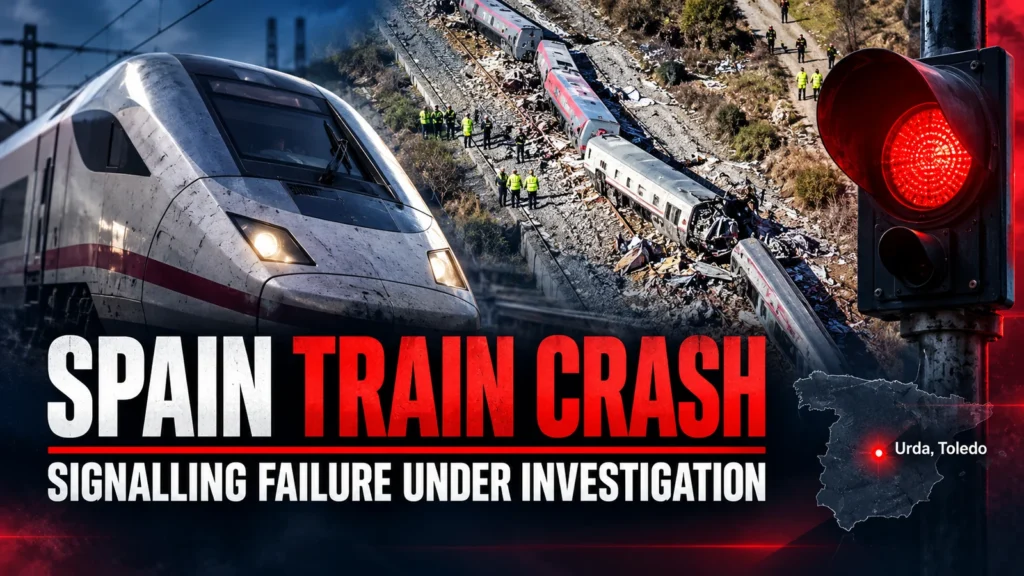
Investigators examining Spain’s deadly high-speed rail collision are focusing on a signalling-system failure and a decision by the railway control centre to allow a train to resume its journey. At least 68 people were reported dead after a Renfe AVE service struck the rear of a stationary Iryo train near Urda, in Toledo province, on Wednesday 28 October.
Transport minister Óscar Puente has described the decision to permit the Renfe train to continue as “inexplicable”. The investigation remains open, and the precise chain of responsibility has not been established.
What happened near Urda?
The collision occurred on the Madrid–Seville high-speed line shortly before 9am local time. The Renfe AVE train ran into an Iryo service that had stopped ahead of it, derailing carriages and prompting a major emergency response. The regional government of Castilla-La Mancha activated its emergency plan at 9.15am.
What investigators are examining
According to the transport minister’s account, an outage of the LZB train-protection system at approximately 8.30am affected a 63-kilometre stretch of line, stopping six trains. Traffic control then assumed responsibility for issuing instructions while normal automatic protection was unavailable.
Puente said the control centre authorised the Renfe train to resume normal movement despite indications requiring it to stop and the presence of a stationary train ahead. The authorisation, rather than any established error by the train drivers, is now central to the investigation.
Spanish broadcaster Cadena SER has published recordings that it says capture communications between the control centre and the train drivers. In one, a train is instructed to resume at normal speed. Investigators must still determine how the instructions were given, whether procedures were followed and why the original safety-system outage occurred.
Casualties and emergency response
By the evening of 28 October, regional authorities had reported at least 68 fatalities. Dozens more people were injured, and the official figures may change as rescue and identification work continues. Spain’s prime minister, Pedro Sánchez, announced three days of national mourning.
What is not yet known
- The technical cause of the initial LZB system failure.
- Why the instruction to resume normal movement was issued.
- The full circumstances of the control-centre decision and whether any individual or organisation bears legal responsibility.
- Whether the provisional death and injury totals will change.
Spain’s Guardia Civil has questioned a control-centre operator as part of the investigation, working alongside the rail accident investigation commission, CIAF. Questioning is not evidence of wrongdoing or a finding of fault.
ITV News report
The following ITV News video examines the collision and shows footage from the emergency response. The video is externally produced and is included for context.