The Russian cargo ship Sparta II has been towed out of Finnish waters after a drone strike triggered a fire in the Gulf of Finland, forcing its 16 crew members to abandon ship and prompting a multinational rescue operation.
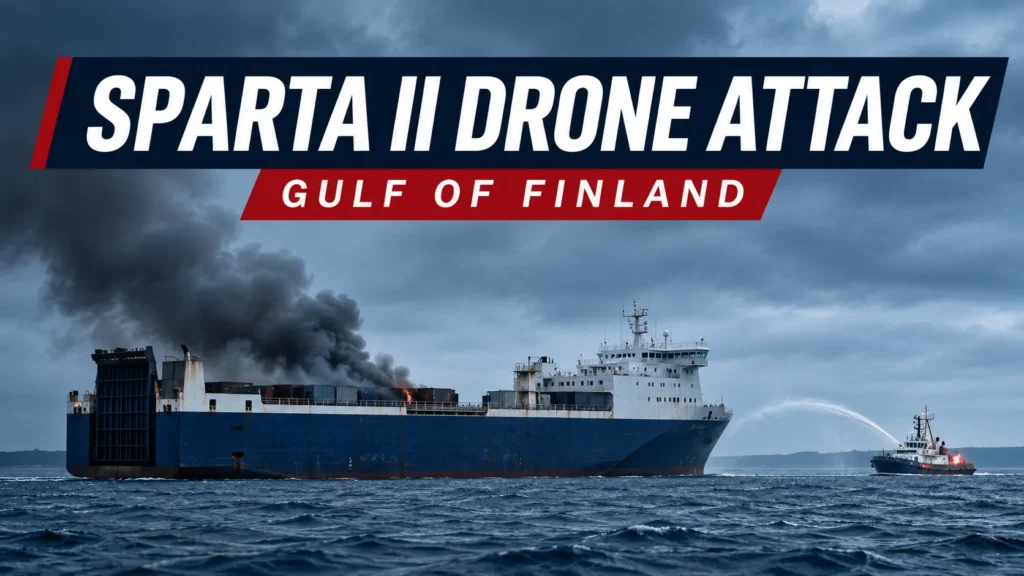
The vessel was struck on Saturday 21 November 2026 while travelling from St Petersburg towards Russia’s Kaliningrad exclave. It drifted into Finnish territorial waters near Loviisa, where Finnish, Estonian and Russian rescue vessels spent the weekend tackling the blaze and preventing pollution. Finnish President Alexander Stubb confirmed on Sunday that the damaged ship had left Finland’s waters.
Finland’s military assessed that Ukraine was probably behind the attack, but Kyiv had not publicly confirmed responsibility. On Monday 23 November, the Kremlin accused Ukraine of what it called “terrorist activity” in the Baltic Sea. That is Moscow’s allegation, not an independently established legal finding. The incident raises a broader question: how far can strikes on Russia’s military-linked shipping affect the security of neighbouring NATO countries?
What happened to the Russian cargo ship Sparta II?
The attack took place west of the Russian island of Gogland, also known as Suursaari, in the eastern Gulf of Finland. Russian regional officials said two drones struck the ship, though that precise number comes from the Russian account. The damage caused a fire and left the vessel unable to continue its voyage normally.
The ship’s 16 crew members escaped in lifesaving craft before being transferred to another Russian vessel. Reuters reported that one person suffered minor injuries. Finnish authorities imposed temporary restrictions on nearby airspace and shipping while rescue teams worked to bring the situation under control.
By Sunday, thermal cameras showed that some containers remained hot even though no flames were visible from outside. Sparta II was listing slightly, but rescue officials assessed it was stable enough to tow. The Russian rescue ship Murman took it away, supported by vessels from Finland and Estonia. Authorities reported no detected fuel or hazardous-substance leaks during the operation.
Why was Sparta II a possible target?
Sparta II is not an ordinary cargo ship in a purely commercial context. The 121-metre Russian-flagged roll-on/roll-off vessel, identified as IMO 9160994, is linked to Oboronlogistika, a logistics company that serves Russia’s Ministry of Defence. The United States sanctioned the vessel in May 2022.
Those links make its movements relevant to the war, but the contents of its cargo during this voyage have not been confirmed publicly. Finnish Border Guard officials said military materiel could not be ruled out. It would be misleading to state that this particular shipment contained weapons or to treat the ship’s military connections as proof of who launched the drones.
The vessel was reportedly bound for Baltiysk in Kaliningrad, the Russian territory between Poland and Lithuania. Maritime access to the exclave is strategically important because it allows Russia to move supplies along routes through the Baltic Sea. Read our earlier coverage of military activity near Kaliningrad for wider context.
Why did Finland and Estonia become involved?
Although the strike occurred outside Finnish territorial waters, the disabled ship subsequently drifted into them. That transformed a military-security incident into a maritime safety emergency for Finland, with the potential for fire, dangerous cargo or spilled fuel to affect nearby shipping and the marine environment.
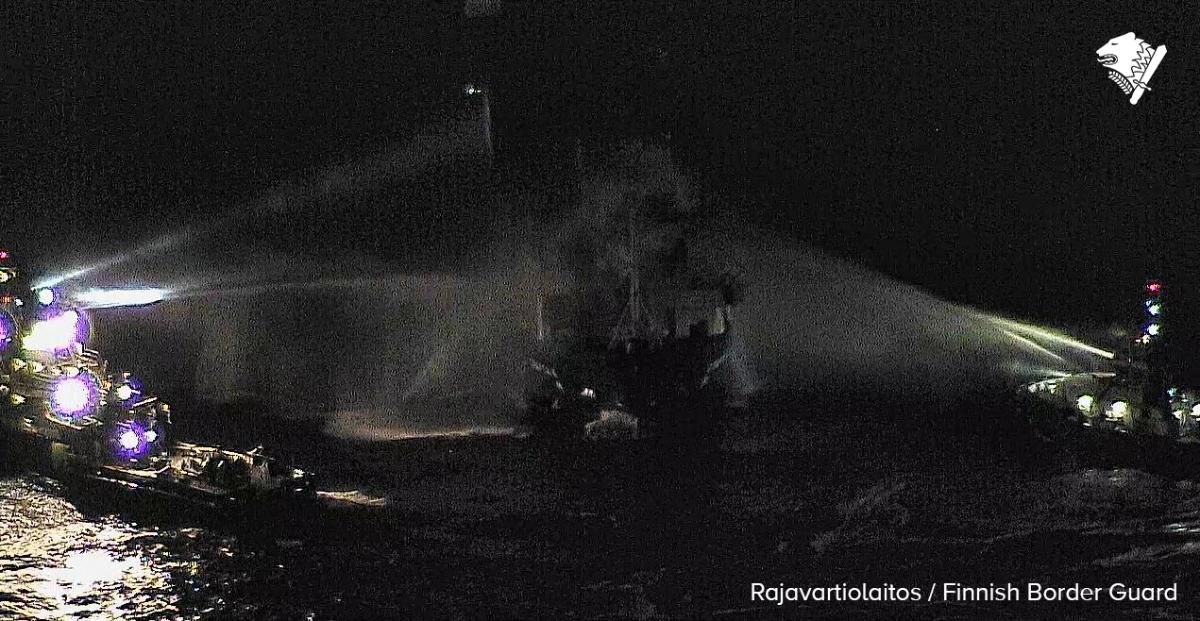
The Finnish Border Guard directed rescue and pollution-prevention work. Its patrol vessel Uisko, Finnish tugs, Estonia’s Kindral Kurvits and Russian rescue vessels assisted. Despite their wider political tensions, the participating authorities had a practical reason to cooperate: a burning cargo ship in a busy sea lane threatened more than the vessel itself.
Finland also investigated a suspected Russian helicopter incursion into its airspace during the incident. Defence Minister Antti Häkkänen said the incursion might have been connected with rescue or surveillance activity. That possible explanation has not been established as fact.
What has Finland said about the attack?
Finnish Prime Minister Petteri Orpo warned that the war was reaching Finland’s immediate neighbourhood while also recognising Ukraine’s right to defend itself against Russia’s invasion. President Stubb said the damaged vessel posed a serious danger in the gulf and thanked those who managed the rescue.
On Monday, the Kremlin called the attack “terrorist activity” and urged Baltic states to press Kyiv to avoid similar operations. Finland’s initial assessment of likely Ukrainian responsibility is not the same as a public Ukrainian admission, and the motive and operational details remain unclear.
A further complication emerged on Monday when Finland’s National Enforcement Authority said it had imposed a temporary restriction linked to EU sanctions on the ship’s owner. It allowed the vessel to depart because maritime rescue and environmental safety took precedence. That distinction matters: the tow did not necessarily amount to an unrestricted commercial release.
What does the drone attack mean for Baltic Sea security?
The Gulf of Finland is a narrow, heavily used route serving ports including St Petersburg, Helsinki and Tallinn. Even a strike directed at a vessel associated with Russia’s war effort may create consequences for commercial shipping, rescue services and neighbouring states.
Estonia’s navy has warned that further attacks cannot be ruled out. The Sparta II episode also followed another reported Ukrainian strike on a Russian naval vessel in the area earlier in November. Such operations, when confirmed, point to a changing geography of the war, but the precise type, route and launch point of the drones used against Sparta II have not been publicly established.
The immediate danger was contained without a reported pollution leak. The strategic problem remains: governments bordering the Baltic may have to respond to more incidents involving disabled or burning vessels, disputed drone activity and the possibility of military operations spilling towards NATO territory. None of this, by itself, means NATO has entered the war.
Watch: DW News examines the implications for Baltic security
Questions that remain unanswered
- Did Ukraine order or carry out the strike, and where were the drones launched?
- What cargo was Sparta II carrying when it was hit?
- What is the full extent of the damage and where will the vessel be repaired?
- Will the incident lead to changes in Baltic maritime patrols or rescue planning?
Sources
- Finnish Border Guard: rescue operation statement, 21 November 2026
- Reuters: initial attack and crew evacuation, 21 November
- Reuters: Russian rescue vessel begins towing, 22 November
- Reuters: Kremlin response, 23 November
- gCaptain: Finland’s sanctions decision and the vessel’s departure, 23 November
- US Treasury: sanctions designation, May 2022