The arrival of a third US aircraft carrier strike group in the Middle East has given President Donald Trump additional military options as tensions with Iran rise again. But the deployment does not establish that Washington has decided to launch a new large-scale offensive.
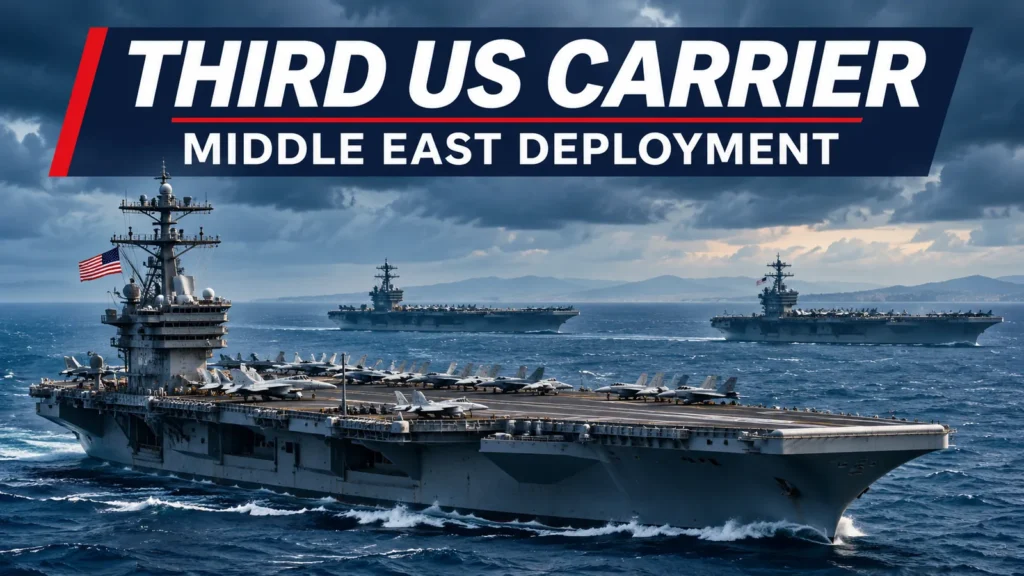
Featured image: Fish 4 News illustration. The three carriers are not pictured together in a documentary photograph.
The USS Theodore Roosevelt entered the US Central Command (CENTCOM) area of responsibility on Sunday 15 November 2026, a US official told The National. It joined the USS George Washington and USS George H.W. Bush, putting three American aircraft carrier strike groups in the wider region at the same time.
The arrival coincided with fresh Iranian drone attacks targeting Bahrain, where the United States maintains a major naval presence. It also followed reports that Trump was considering avoiding further strikes on Iran unless Tehran or the Iran-backed Houthis carried out new provocations.
Which US aircraft carriers are in the Middle East?
- USS Theodore Roosevelt (CVN-71): Arrived in the CENTCOM area on 15 November after moving west from the Indo-Pacific.
- USS George Washington (CVN-73): Already operating in the region and originally expected to be relieved by the Roosevelt.
- USS George H.W. Bush (CVN-77): Another carrier strike group already present in the CENTCOM theatre.
The Institute for National Security Studies (INSS), in an assessment covering 8–15 November, identified the George Washington and George H.W. Bush on station, with the Theodore Roosevelt approaching from the Indian Ocean. The assessment also reported destroyers, a cruiser and other American naval assets in the region.
A carrier strike group consists of considerably more than the aircraft carrier itself. Supporting warships and embarked aircraft provide air operations, air defence, reconnaissance and other capabilities. This makes the simultaneous presence of three groups significant, even without an order for further strikes.
It is important not to confuse the CENTCOM area with a single location. Confirmation that all three ships are in the command’s area does not mean they are operating next to one another or that their precise positions have been publicly disclosed.
Reinforcement or routine carrier rotation?
The Theodore Roosevelt was initially expected to take over from the George Washington. That distinction matters: a replacement deployment can temporarily produce three carriers in theatre without a decision to maintain a three-carrier force for an extended campaign. The National’s 16 November report says the Washington remained in the region at the time of the Roosevelt’s arrival.
A Reuters report published on 14 November reported that although one carrier had been expected to replace another, all three could remain if required. It did not establish that a prolonged three-carrier deployment had been ordered.
The practical question is therefore what happens next. If a carrier departs after the handover, the buildup may largely reflect a scheduled transition. If all three remain, it would provide Washington with a larger sustained naval air presence and additional operational flexibility.
What has Trump said about further attacks on Iran?
Reuters reported on 14 November, citing three people familiar with discussions, that Trump had told senior advisers he might hold off on further strikes if the US faced no new provocations from Iran or the Houthis in Yemen. The report described a president weighing further military action against continuing pressure through sanctions and a naval blockade, rather than one who had made a final decision.
Saudi Crown Prince Mohammed bin Salman and Turkish President Recep Tayyip Erdogan had urged restraint, according to the Reuters account. Israeli officials, meanwhile, continued to argue for renewed military action against Iran. These are competing diplomatic pressures, not proof of which course Trump will choose.
American naval deployments can be used both to prepare military options and to strengthen a negotiating position. Having the ability to escalate is different from deciding to use it.
Why the new attacks in Bahrain matter
On Sunday 15 November, Bahrain said its air defences had intercepted and destroyed several Iranian aerial attacks. The Islamic Revolutionary Guard Corps (IRGC) said it had launched six drones towards an American air-defence radar system at the Al-Rifaa helicopter base in Bahrain. Reuters reported that the claimed successful strike had not been independently confirmed by US or Bahraini authorities.
Bahrain is home to the US Navy’s Fifth Fleet. The incident followed another reported Iranian attempt two days earlier. The US military said it had intercepted two drones without damage in that earlier incident, according to Reuters.
The timing creates an obvious question. If Trump was considering refraining from further action only in the absence of new provocations, how will Washington interpret these attacks? That is a question for US decision-makers, and the carrier deployment itself does not answer it.
What would indicate a larger US offensive is being prepared?
A third aircraft carrier increases the range of possible military responses, but analysts look for several indicators together before judging that a sustained new offensive is imminent.
- Carrier movements: whether the Roosevelt remains alongside the other two groups after the expected handover period.
- Air power: whether additional land-based strike aircraft, bombers or support units are moved into the region.
- Logistics: whether munitions and other support arrangements visibly expand beyond routine operations.
- Official warnings: whether Washington issues evacuation instructions or publicly changes its stated objectives.
- Diplomacy: whether negotiations are abandoned or a new arrangement is announced.
The INSS assessment of 15 November reported no additional combat aircraft or bomber arrivals during the preceding week and said that no US decision to resume major operations had been reported. Its assessment preceded the confirmation of the Roosevelt’s arrival. These observations limit what can responsibly be inferred from the naval movement alone.
How does this fit into the wider Iran war?
The conflict began with US and Israeli strikes on Iran on 28 February 2026 and has expanded into a prolonged regional confrontation. The United States has maintained a naval blockade and has also conducted more limited strikes. Iran has sought leverage around the Strait of Hormuz and threatened US-linked targets across the Gulf.
That background explains why a carrier movement which might otherwise be described as a routine deployment has drawn particular attention. The combination of continued military pressure, unresolved negotiations and fresh drone attacks creates opportunities for miscalculation on several sides.
Related F4N coverage: US aircraft moved from RAF Mildenhall amid reported Iran threat and Iran’s announcement on its ballistic missile range policy.
What we know, and what remains unknown
Confirmed: Three US carrier strike groups were reported within the CENTCOM area following the Theodore Roosevelt’s arrival on 15 November. Bahrain said it intercepted Iranian aerial attacks. Trump is considering his options over further strikes, according to Reuters reporting.
Not confirmed: That all three carriers will stay for an extended period; that an order for a major new offensive has been issued; or that Iran successfully struck the US radar facility it claimed to target in Bahrain.
The central distinction is between military readiness and political intent. The United States is maintaining the means to escalate, but the available evidence does not show that Trump has committed to a new major attack.
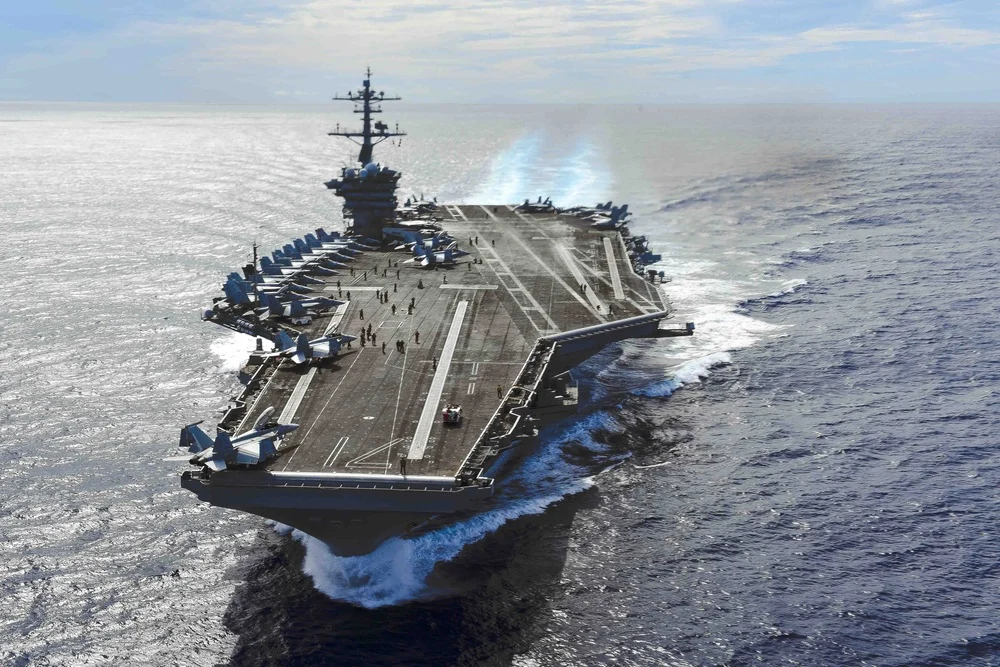
US Navy video: Flight operations aboard USS Theodore Roosevelt
The US Navy released footage of flight operations aboard the Theodore Roosevelt, recorded in the Pacific Ocean on 10 November, before its reported arrival in the Middle East. It is operational footage, not video of the carrier arriving in CENTCOM or launching an attack on Iran. Watch the official US Navy video on DVIDS.
Sources
- US Central Command: USS Theodore Roosevelt operating in CENTCOM area, 16 November 2026
- The National: USS Theodore Roosevelt arrives in CENTCOM area, 16 November 2026
- Reuters: Trump considering restraint on Iran strikes, 14 November 2026
- Reuters: Bahrain intercepts Iranian aerial attacks, 15 November 2026
- INSS: US force posture in the Middle East, 8–15 November 2026
- US Navy / DVIDS: Flight operations aboard USS Theodore Roosevelt, 10 November 2026