The Trump administration paid $495.6 million for a previously shuttered Minnesota prison that its owner offered to sell to the state for $75 million in 2025, according to company filings and documents reported by local television investigators.
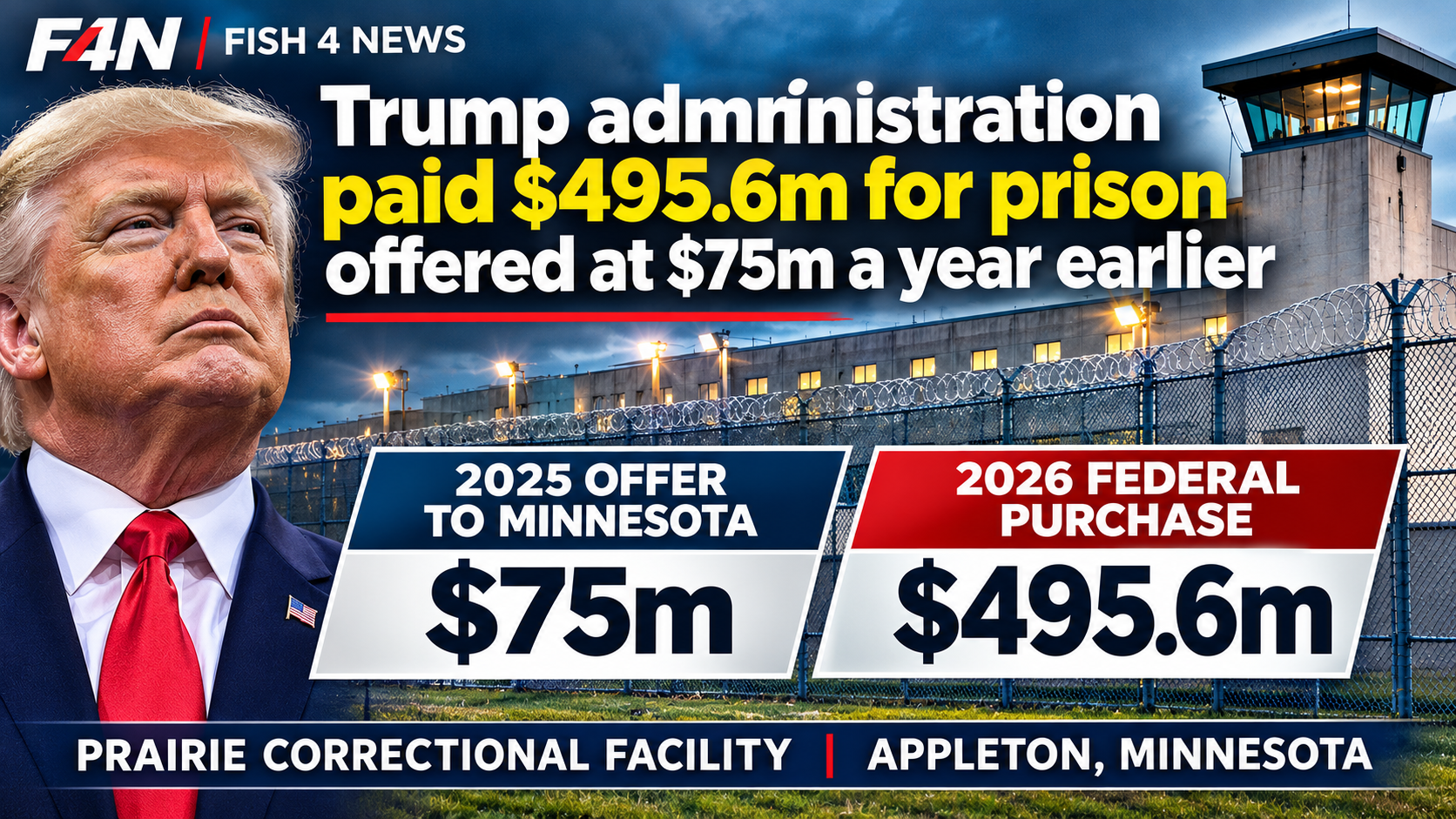
The $420.6 million difference between the two figures has prompted Minnesota’s attorney general to demand a congressional investigation. Private prison operator CoreCivic disputes the suggestion that the figures represent comparable valuations, saying the federal price was based on an independent appraisal.
What the documents show
The 1,600-bed Prairie Correctional Facility in Appleton had been idle since 2010. On 4 August 2026, CoreCivic completed its sale to the US Department of Homeland Security (DHS) for approximately $495.6 million. The transaction is recorded in the company’s filing with the US Securities and Exchange Commission.
KARE 11’s investigation, published on 29 October, reported obtaining an email dated 7 May 2025 in which CoreCivic offered to sell the prison to the Minnesota Department of Corrections for $75 million. According to the station, the proposed figure included upgrades that CoreCivic then considered necessary to reopen the site.
Minnesota did not buy the facility. Its corrections commissioner, Paul Schnell, told KARE 11 that the much higher federal purchase price was difficult to explain. State officials cited concerns about staffing and operating a prison in the rural location when explaining why Minnesota had passed on the earlier offer.
The federal price was approximately 6.6 times the earlier $75 million figure. This comparison establishes a striking difference between a proposed sale price and a later completed transaction. It does not, on its own, establish that the government overpaid by $420.6 million or that corruption took place.
CoreCivic’s explanation and a disputed date
In a statement dated 31 October, CoreCivic said independent appraisers engaged by the federal government had used a cost-based approach incorporating present-day replacement costs, depreciation, land value and renovations needed for ICE operations, including security and fire systems.
The company argued that the $75 million figure was not an appraisal and referred to it as a preliminary figure ‘dating back to 2015’. That description is not reconciled in the statement with the May 2025 written offer reported by KARE 11. The two dates may refer to different stages of discussions, but the company has not explained that distinction in the published statement.
A cost-based appraisal can produce a figure very different from what a seller might accept in a particular negotiation. However, without the full appraisal and supporting assumptions, it is not possible to independently test the basis for the federal purchase price.
The seller also has an operating contract
The change in ownership did not mean CoreCivic would leave the facility. Its 4 August announcement said it had received a five-year Immigration and Customs Enforcement (ICE) contract, starting on 11 August, to operate the site. The arrangement includes fixed monthly payments and additional payments linked to detainee numbers.
CoreCivic projects about $75 million in annual revenue once the centre is fully operational, which it expected in the second quarter of 2027. That is a company forecast rather than a guaranteed annual payment. In August, CoreCivic said it expected to continue managing the prison, although ICE retains contractual termination rights.
Appleton was one of four CoreCivic facilities sold to the federal government in July and August for approximately $2.2 billion in total, according to the company’s investor disclosures.
Political donations and calls for scrutiny
KARE 11 also reported that CoreCivic donated $500,000 to the Trump-Vance 2025 inaugural fund. The contribution is relevant to questions about political access and government purchasing, but a donation is not evidence that the sale price was improperly influenced.
Minnesota Attorney General Keith Ellison has called for the relevant congressional committees to investigate the Appleton purchase. That is a request for an inquiry, not a finding of misconduct. As of 2 November, the evidence reviewed for this article does not establish that a congressional investigation has formally begun.
Earlier watchdog warnings about ICE spending
In a separate report published on 24 September, the non-partisan US Government Accountability Office (GAO) found that ICE’s rapid expansion of detention capacity had proceeded without sufficient planning. The agency reported over $20 million in costs it could not recover after ICE moved to sell seven warehouses originally bought for potential detention use.
The GAO’s findings concern broader detention procurement. They are not a conclusion that the Appleton purchase was fraudulent or overpriced. They do, however, make independent examination of major acquisitions particularly important.
What remains unanswered
- Whether DHS will publish the full appraisal supporting the $495.6 million price, including any renovation assumptions.
- Why CoreCivic’s 31 October statement refers to a 2015 preliminary figure when KARE 11 reported a written $75 million offer dated May 2025.
- Whether federal officials considered alternative facilities, negotiated pricing or compared the costs of purchasing and operating the property over its expected lifespan.
- Whether Congress will open a formal inquiry and what additional purchase records it may obtain.
The central question is not whether the two quoted figures differ. They do. It is whether DHS can demonstrate, with documents open to scrutiny, why it paid nearly half a billion dollars for a prison offered to Minnesota for far less.
Sources
- KARE 11 Investigates: the May 2025 prison offer and state officials’ responses
- CoreCivic SEC Form 8-K confirming the completed August 2026 sale
- CoreCivic statement, 31 October 2026, on the appraisal and earlier $75 million figure
- CoreCivic: new ICE operating contract at Prairie Correctional Facility
- CoreCivic: sale of detention facilities and continuing management
- US Government Accountability Office: ICE detention planning and spending report