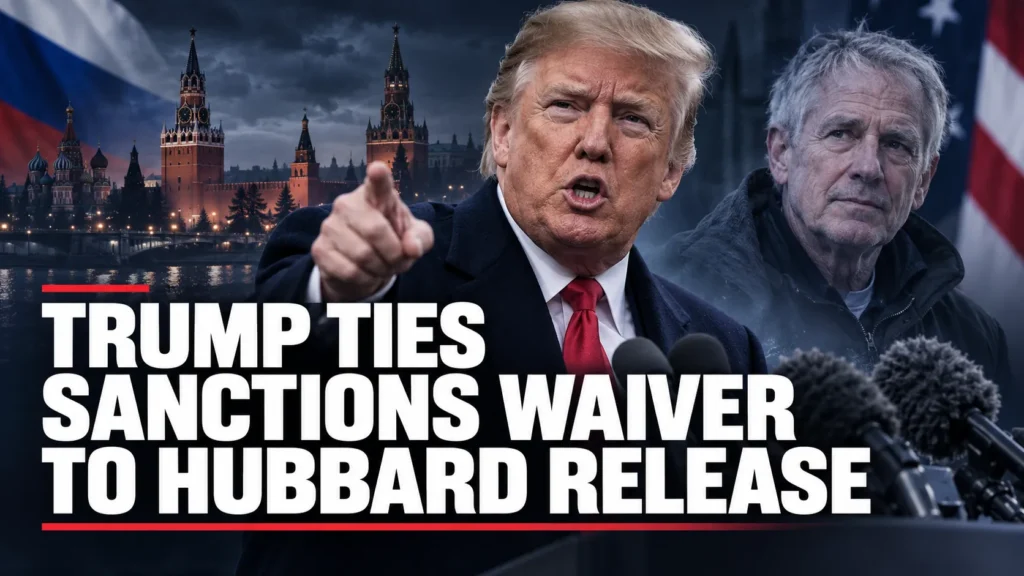
US President Donald Trump has linked his decision to waive new sanctions against Russia to negotiations that secured the release of American prisoner Stephen Hubbard, while insisting that Moscow received nothing in exchange. The 74-year-old retired teacher was freed on 21 October 2026 after more than four years in Russian custody. Trump’s explanation prompted questions about whether the United States had surrendered economic leverage to secure his release, particularly after the president repeatedly blamed his predecessor, Joe Biden, for Hubbard’s imprisonment.
Trump challenged over Russia sanctions
The controversy developed during an exchange with reporters outside the White House on Wednesday, 21 October.
CNN correspondent Kaitlan Collins questioned Trump about his decision to waive sanctions introduced under legislation he had signed just over a month earlier.
Trump defended the decision by explaining that his administration had been negotiating with Russia for Hubbard’s release and that additional sanctions could have jeopardised those discussions.
Collins then challenged his earlier statement that the United States had given Russia nothing in return.
Trump responded that imposing the sanctions would have prevented Hubbard from coming home.
When Collins pressed him on whether the decision therefore amounted to a concession, the president criticised CNN and continued defending his negotiating approach.
He said that Hubbard would never have been released if the sanctions had been imposed.
Trump also cited ongoing negotiations over ending the war in Ukraine, arguing that introducing sanctions during sensitive diplomatic discussions could undermine progress.
When Collins again questioned whether the sanctions had effectively been waived in exchange for Hubbard’s freedom, Trump called her a “dummy” and questioned her intelligence.
ABC News correspondent Karen Travers subsequently raised the same issue and was also insulted by the president.
The exchanges were recorded in the official White House footage and documented in CNN’s broadcast transcript.
The central question remains unanswered: was the sanctions waiver an explicit concession to Russia, or a broader diplomatic decision intended to preserve negotiations?
Who is Stephen Hubbard, and why was he imprisoned?
Stephen Hubbard is a retired American teacher and US Air Force veteran originally from Michigan.
After spending much of his working life teaching English overseas, he settled in Ukraine, where he was living when Russia launched its full-scale invasion in February 2022.
Russian forces detained Hubbard in April 2022, after taking control of the area around Izium in eastern Ukraine.
Russian authorities accused him of joining a Ukrainian military unit and participating in fighting against Russian forces.
However, Hubbard’s family and legal representatives disputed those allegations.
His sister, Patricia Hubbard Fox, questioned the Russian account, while his American lawyer said Hubbard had denied participating in military activities and maintained that Russian soldiers had taken him from his home.
In October 2024, a Moscow court convicted Hubbard of acting as a mercenary and sentenced him to six years and ten months in prison following proceedings held behind closed doors.
Russian authorities reportedly refused American officials consular access, and Hubbard was moved between detention facilities.
His detention lasted approximately four and a half years before his release.
According to Reuters’ account of the case, the US government formally designated Hubbard as wrongfully detained in January 2025.
That designation was made during the final weeks of the Biden administration.
What actually happened under Biden?
Trump repeatedly emphasised that Hubbard was detained while Joe Biden occupied the White House.
That part of the timeline is correct.
However, the suggestion that Hubbard’s case was ignored by the previous administration would not reflect the full record.
In January 2025, before Biden left office, the US government formally recognised Hubbard as wrongfully detained, enabling specialised diplomatic efforts to pursue his release.
Although Hubbard remained imprisoned when Biden’s presidency ended, the former administration had also secured significant prisoner releases from Russia.
On 1 August 2024, the Biden administration completed a major international exchange involving Russia and several other countries.
Among those released were:
- Paul Whelan, an American former Marine detained in Russia since 2018.
- Evan Gershkovich, a Wall Street Journal reporter arrested in 2023.
- Alsu Kurmasheva, a Russian-American journalist imprisoned in Russia.
- Vladimir Kara-Murza, a Russian opposition activist and US permanent resident.
Altogether, the agreement secured the release of 16 people from Russian custody in exchange for eight prisoners held by Western countries.
The negotiations involved Germany, Poland, Norway, Slovenia and Turkey, alongside the United States.
The agreement required concessions. Among those returned to Russia was Vadim Krasikov, a Russian convicted in Germany of murdering a former Chechen militant in Berlin.
Hubbard was not included in that exchange, and Biden’s administration did not secure his freedom before leaving office.
Those facts are important.
Trump succeeded in obtaining Hubbard’s release, but Biden had also negotiated the return of Americans imprisoned by Russia.
The US State Department’s August 2024 statement provides a contemporaneous record of that earlier agreement.
What sanctions did Trump waive?
The sanctions at the centre of the controversy were introduced through the Lindsey O. Graham Sanctioning Russia and Iran Act of 2026.
Trump signed the legislation on 18 September 2026.
It provided for additional economic penalties against Russia and parties helping finance or support Moscow’s activities.
On 16 October, Trump signed Executive Order 14436, waiving substantial provisions of the new legislation before they took effect.
The measures covered by the waiver included major restrictions targeting Russian activities and additional tariffs.
The executive order specified a 500% tariff increase on goods imported from Russia, alongside 100% tariffs targeting certain major purchasers of Russian oil and gas and facilitators of sanctions evasion. The relevant tariffs were then waived.
Crucially, Trump did not remove every existing American sanction against Russia. His order specifically preserved sanctions imposed under certain previous executive orders.
Nevertheless, the waiver meant that significant additional economic measures approved by Congress would not be applied at that time.
In his official certification to Congress, Trump justified the decision by arguing that the new measures would interfere with efforts to negotiate a lasting peace between Russia and Ukraine.
That written explanation focused on the wider war rather than Hubbard’s detention.
Five days later, however, the president explicitly connected the decision not to impose sanctions with securing Hubbard’s release.
Both explanations could form part of the administration’s negotiating strategy. Neither establishes that Putin specifically demanded the waiver in return for releasing Hubbard.
America does negotiate to bring prisoners home
Trump’s statements also raise a broader question about the longstanding American principle of refusing to make concessions to hostage-takers.
The familiar phrase that America does not negotiate with terrorists is frequently invoked in discussions about hostage diplomacy.
However, negotiations with foreign governments over detained citizens are not identical to negotiations with terrorist organisations.
Successive American administrations, Republican and Democratic, have negotiated prisoner exchanges and other arrangements to secure the freedom of citizens held overseas.
And Trump himself has previously authorised prisoner exchanges with Russia.
In February 2025, during Trump’s second presidency, Russia released American teacher Marc Fogel. In return, the United States agreed to release Alexander Vinnik, a Russian national who had pleaded guilty to a money-laundering conspiracy.
In April 2025, the Trump administration negotiated another exchange. Russia freed dual US-Russian citizen Ksenia Karelina, while the United States released Arthur Petrov, a German-Russian national accused of illegally exporting sensitive electronics.
Both arrangements involved identifiable concessions.
These exchanges do not establish that Trump made an equivalent concession in Hubbard’s case.
They do, however, contradict any literal suggestion that his administration never gives anything in prisoner negotiations.
The underlying policy question is not whether governments negotiate, but what they agree to give up, and whether those concessions encourage further wrongful detentions.
What did Russia receive?
Russia’s explanation for Hubbard’s release differed from Trump’s emphasis on the negotiations.
Kremlin spokesman Dmitry Peskov said that Putin had agreed to release the American on humanitarian grounds, taking his health into consideration.
Putin granted Hubbard a pardon, and US special envoy Steve Witkoff travelled to St Petersburg, where he met the Russian president.
During their meeting, Witkoff praised Putin for allowing Hubbard to return home, describing him as a humanitarian.
The remarks attracted criticism because Russia continues its invasion of Ukraine and has faced international condemnation over its treatment of detainees and civilians.
The American president has maintained that Russia received no prisoner in exchange for Hubbard.
That claim appears consistent with the absence of an announced prisoner swap.
But a prisoner exchange is not the only possible form of diplomatic concession.
Economic sanctions, trade restrictions and other policy decisions can also carry considerable value in international negotiations.
The precise terms of the discussions between Washington and Moscow have not been publicly established.
It would therefore be inaccurate to state as a proven fact that Trump traded the sanctions waiver for Hubbard’s freedom.
It would be equally difficult to ignore his own explanation that imposing the sanctions would have prevented the release.
A welcome release, but questions remain
For Stephen Hubbard and his family, the outcome is significant.
After more than four years in Russian custody, a disputed criminal conviction and considerable uncertainty surrounding his welfare, he has finally been freed.
Trump’s intervention helped secure that result, and the Kremlin has confirmed that the American president requested his release.
That achievement deserves recognition independently of the political controversy.
However, the broader implications of the sanctions decision remain unresolved.
The new measures were designed to increase economic pressure on Russia as its war against Ukraine continued. Waiving them avoided introducing that additional pressure.
The White House’s formal explanation centred on peace negotiations, while Trump’s subsequent remarks directly connected the absence of sanctions to Hubbard’s freedom.
His criticism of Biden also leaves out the prisoner exchanges secured under the previous administration and the decision to designate Hubbard as wrongfully detained before Trump returned to office.
Hubbard’s freedom is no longer in question. What remains unclear is whether Russia obtained a wider diplomatic or economic benefit in securing it, and whether the sanctions waiver was an explicit part of the agreement.
Until the administration explains the terms of those discussions, that question remains open.
Watch: Trump questioned over the Russia sanctions waiver
Official White House footage from 21 October 2026 shows Donald Trump responding to questions from CNN’s Kaitlan Collins and other reporters about the sanctions decision and Stephen Hubbard’s release.