Democrats’ victory in both chambers of the US Congress has changed the political landscape for three of America’s most influential technology and media executives: Elon Musk, Mark Zuckerberg and David Ellison.
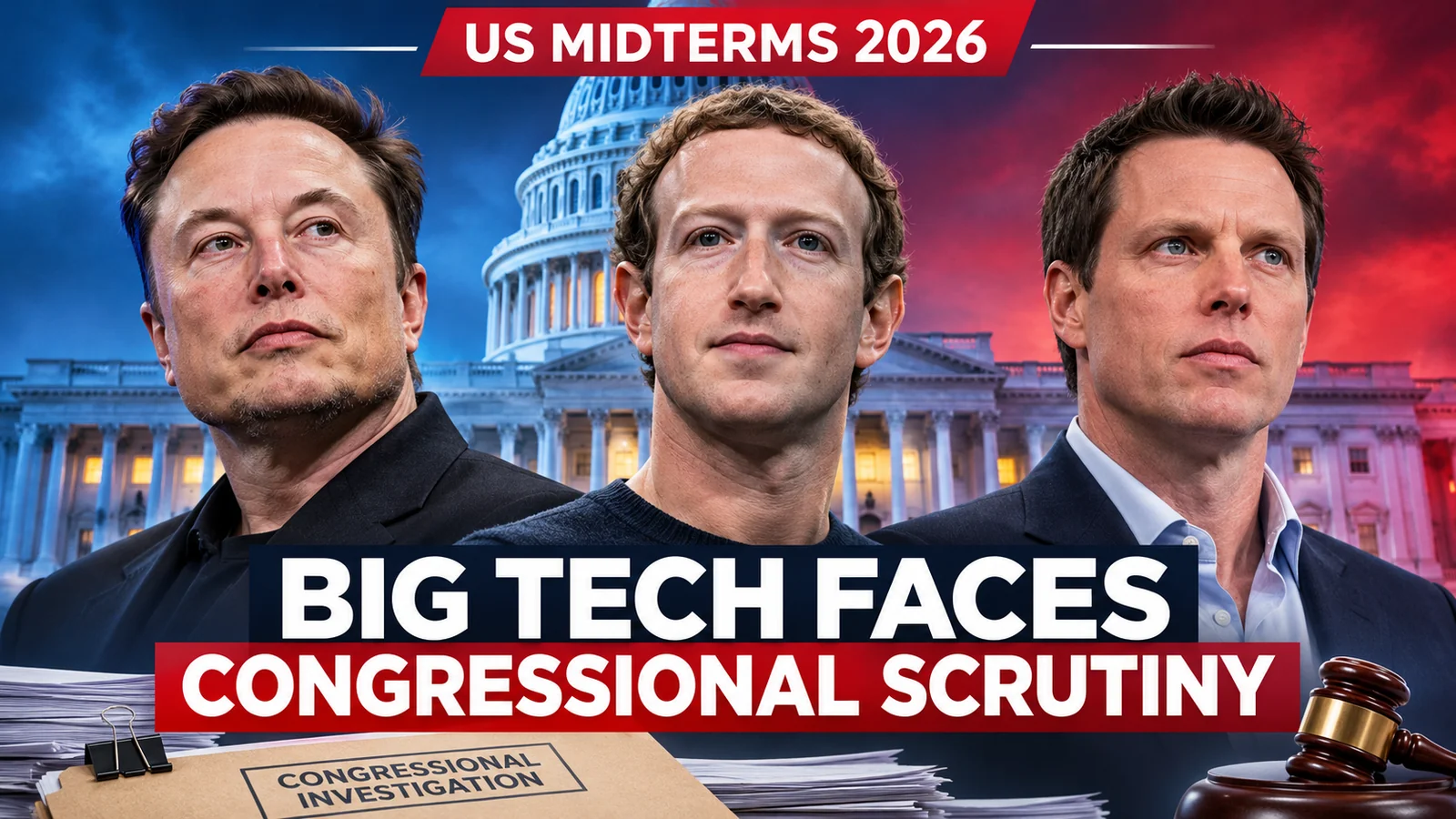
For Musk, the threat of congressional questioning is already explicit. For Meta, lawmakers have begun challenging the secrecy surrounding data-centre developments. And for Ellison, questions about editorial independence at CBS News predate the election and may receive renewed attention when Democrats take committee control in January.
These are three distinct cases. Congressional hearings and subpoenas can put pressure on powerful companies, but an investigation is not proof of wrongdoing, and no evidence reviewed for this report establishes criminal liability for any of the three executives.
What the midterm results changed
The Associated Press confirmed that Democrats won control of the Senate on the evening of 3 November 2026 and the House early on 4 November. The newly elected Congress is due to begin its term on 3 January 2027, giving Democrats the chance to chair committees, control hearing agendas and authorise formal investigative steps.
In an 8 November Reuters report, California Democrat Robert Garcia, expected to lead the House Oversight Committee, identified Musk’s work on federal workforce reductions as an area for investigation. Senator Elizabeth Warren, set to lead the Senate Banking Committee, separately warned of serious scrutiny for businesses accused of exploiting consumers or investors. Warren did not identify Zuckerberg, Ellison or their companies by name.
The practical change is not that prosecutors automatically have new cases. It is that congressional committees can demand records and testimony, question witnesses publicly and seek to enforce subpoenas within the law. The Trump administration will still control the executive branch, and the courts can become involved in disputes over compliance.
Elon Musk: DOGE, contracts and political influence
Musk’s exposure is the most specific of the three. In a 5 November PBS NewsHour interview, Garcia said lawmakers wanted answers about the Department of Government Efficiency (DOGE), job losses across federal agencies, access to personal information and how contracts involving Musk’s businesses were awarded. On CNN on 8 November, he again said multiple committees had an interest in speaking to Musk.
Those questions are not findings that data was stolen or that contracts were improperly awarded. They describe subjects lawmakers say they intend to examine, including who accessed government information and what safeguards were in place.
Musk’s political involvement also forms part of the background. Associated Press reporting put his spending to support Republicans in the 2026 midterms at no less than $445 million. Political donations and support for a party are lawful activities in themselves. The potential oversight issue is whether decisions about government policy, contracts or agency access were influenced by conflicts of interest.
Before the election, Musk publicly warned Democrats seeking to investigate him that he would fight back. Any eventual committee investigation will need to distinguish political associations from verifiable misconduct.
Mark Zuckerberg: Meta’s data-centre secrecy questions
Meta has already received a congressional demand for answers. On 30 September, House Judiciary Committee Democrat Jamie Raskin announced letters to Meta, Amazon, Google and Oracle about nondisclosure agreements involving proposed data centres and local government officials.
The concern raised by lawmakers is that restrictive agreements could make it harder for residents to learn how large computing facilities might affect electricity bills, water supplies or development decisions. The investigation focuses on agreements and their effects, not on an established offence by Zuckerberg personally.
The issue is not confined to Democrats. A bipartisan proposal, the No Secrets for Data Centers Act of 2026, was introduced in September to limit enforceability of certain nondisclosure clauses. The legislation was introduced, not enacted. It reflects wider concern about community transparency as AI infrastructure expands.
The Washington Post reported on 6 November that Meta was among companies being considered for further investigations following the midterms. That report cited people familiar with the plans. The precise scope, schedule and powers of any new enquiry have not yet been formally settled.
David Ellison: CBS, CNN and editorial independence
David Ellison’s position is different again. On 14 July, Raskin wrote to Ellison raising concerns that editorial decisions at CBS News may have been shaped by the company’s relationship with the Trump administration. His letter followed claims by journalist Scott Pelley about interference in coverage of immigration enforcement and related events. These were allegations requiring answers, not proven findings.
The stakes changed further when Skydance completed its acquisition of Warner Bros. Discovery on 6 October. The roughly $110 billion transaction brought CBS News and CNN under one corporate group led by Ellison. In its own announcement, Skydance described the combination as a way of creating a stronger competitor in entertainment and streaming.
The US Justice Department had closed its antitrust investigation on 12 June, saying the evidence did not indicate the merger was likely to harm competition. That is an important counterpoint to claims that the acquisition itself was found unlawful. A congressional review of merger approvals or news independence would not by itself reverse the deal.
The key questions for any fresh oversight would be whether executives or officials exchanged commitments about news coverage for regulatory advantages, whether newsroom decision-making remained independent and what documented evidence exists. A lawmaker’s accusation is not a legal finding, and the company’s editorial decisions cannot be assumed to have been dictated by the White House.
Could Congress subpoena these executives or bring criminal charges?
Congressional committees can seek documents, conduct hearings, call witnesses and, subject to applicable rules, issue subpoenas. A refusal can generate a legal dispute. But congressional oversight and criminal prosecution are separate processes: committees do not themselves convict executives or order prosecutors to bring charges.
There is also an immediate political confrontation. According to Associated Press reporting on 9 November, President Trump and Attorney General Todd Blanche have criticised the Democrats’ planned investigations. Blanche said the administration would resist what it regarded as improper pressure. Democrats, meanwhile, say oversight is a constitutional responsibility. The legal merits of each future request will depend on its purpose and how it is pursued.
What is confirmed and what remains unknown
- Confirmed: Democrats secured both chambers in the midterms; Garcia has publicly identified Musk and DOGE as subjects of interest.
- Confirmed: Raskin has raised formal questions about Meta’s data-centre nondisclosure agreements and about editorial independence at CBS under Ellison.
- Confirmed: Skydance completed its Warner Bros. Discovery transaction, and the Justice Department closed its federal antitrust review.
- Not established: Any criminal wrongdoing by Musk, Zuckerberg or Ellison in connection with these issues.
- Not yet clear: The final list of subpoenas, hearing dates, witnesses and document requests that the incoming Congress may authorise.
Why this matters beyond three executives
The wider story concerns how political access intersects with federal contracts, artificial intelligence infrastructure and the ownership of national news organisations. Researchers at Brookings have also noted that data-centre transparency and local development policy could change after the elections, even as businesses argue that growth and commercial confidentiality need protecting.
For the new congressional majority, the challenge will be establishing facts while also addressing voters’ concerns about living costs. For the companies, the challenge will be explaining consequential decisions without treating scrutiny itself as evidence of guilt. The next substantive development to watch is a committee announcement setting out exactly what records or testimony it wants.
Sources
- Associated Press: how control of Congress was called, 5 November 2026
- Reuters: Democrats outline investigations, 8 November 2026
- PBS NewsHour: Robert Garcia interview, 5 November 2026
- US House Judiciary Committee Democrats: Meta and data-centre NDAs, 30 September 2026
- US House Judiciary Committee Democrats: letter to Ellison, 14 July 2026
- Skydance: merger completion statement, 6 October 2026
- US Department of Justice: merger antitrust decision, 12 June 2026
- Associated Press: reaction to incoming congressional investigations, 9 November 2026