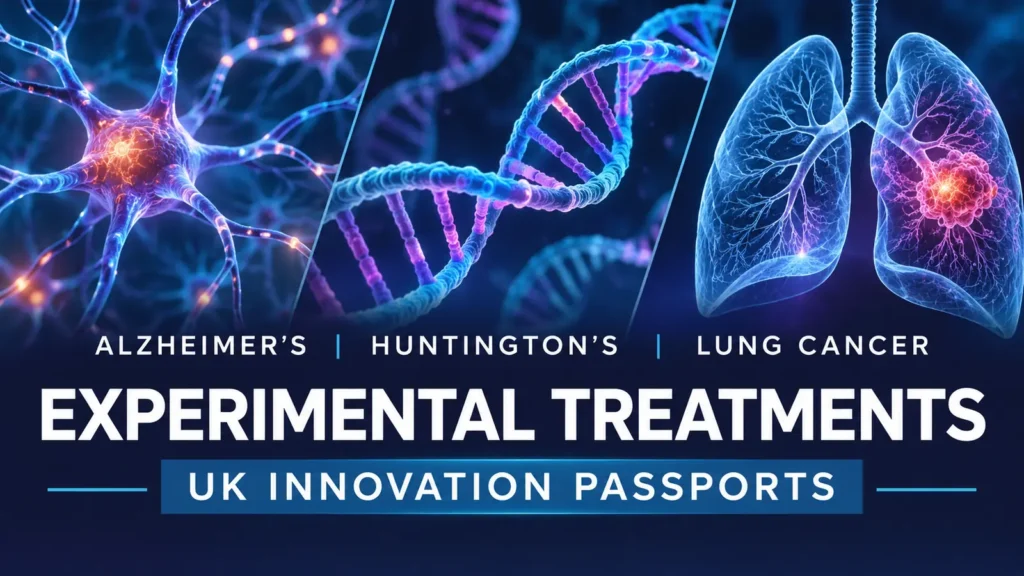
Three experimental medicines being developed for Alzheimer’s disease, Huntington’s disease and lung cancer have received UK Innovation Passports, giving their developers access to coordinated regulatory support. None has been approved for routine patient use as a result of the decision.
The Medicines and Healthcare products Regulatory Agency (MHRA) announced the awards on 9 November 2026 through the Innovative Licensing and Access Pathway (ILAP), a programme intended to help promising treatments navigate clinical development, regulatory assessment and possible future access through the NHS. The designation is an early development milestone, not a finding that any treatment is safe and effective for widespread use. Read the MHRA announcement.
Which three experimental medicines received Innovation Passports?
Huntington’s disease: brezosiran. Developed by Alnylam, brezosiran is an RNA interference (RNAi) treatment designed to reduce production of huntingtin protein, including the abnormal form associated with the inherited neurological condition. It is being tested in clinical trials, and no treatment has yet been established to halt the progression of Huntington’s disease.
In October, Alnylam reported results from an ongoing Phase 1b trial involving 48 participants across five dose groups. The company said levels of mutant huntingtin in cerebrospinal fluid fell by an average of about 60–64% at three months in the highest dose group evaluated at the time. This measures the drug’s biological effect, not whether patients live longer or experience slower deterioration. Alnylam plans a larger placebo-controlled trial in 2027, subject to regulatory discussions. Alnylam’s Phase 1b results.
Non-small cell lung cancer: BGB-58067. BeOne Medicines is developing this targeted PRMT5 inhibitor for tumours with a particular molecular feature, known as MTAP deficiency. Non-small cell lung cancer is expected to be its lead indication. It is not a potential treatment for every type of lung cancer.
BGB-58067 is being investigated in an early Phase 1a/1b study, including people with advanced solid tumours. Preliminary results reported by BeOne showed signs of antitumour activity, but also treatment-related adverse events, some serious. Those early observations do not demonstrate that the drug improves survival or will be approved. UK Health Research Authority trial summary and BeOne’s early study results.
Early Alzheimer’s disease: diranersen. Biogen’s experimental antisense oligonucleotide treatment is designed to reduce production of tau, a protein linked to the abnormal changes seen in Alzheimer’s disease.
In May 2026, Biogen reported that its Phase 2 CELIA trial showed reductions in tau-related measures and encouraging signals on certain tests of cognitive decline. Importantly, the trial did not meet its primary endpoint for dose response. That limitation matters: further research must establish whether the treatment delivers a reliable clinical benefit and what risks it presents. Biogen’s CELIA trial statement.
What is an MHRA Innovation Passport?
An Innovation Passport is the entry point to ILAP, a UK-wide initiative involving the MHRA, NHS England and bodies that assess the clinical and economic value of treatments, including NICE, the Scottish Medicines Consortium and Welsh and Northern Irish partners.
The programme gives developers access to joined-up advice rather than having to navigate each part of the UK medicines system separately. Support can include a tailored Target Development Profile, early scientific and regulatory discussions, guidance on evidence needed for assessment and planning for clinical trials and possible adoption by health services.
Its purpose is to reduce avoidable delays if an investigational product ultimately proves worthwhile. It does not remove the requirement for robust clinical evidence or grant access to an NHS prescription.
Does this mean the medicines are approved or coming to the NHS?
No. An Innovation Passport is not a marketing authorisation from the MHRA, proof that a drug works, a promise of NHS funding or a guarantee that a medicine will ever become available to patients.
Before a new treatment can be used routinely, developers must establish an acceptable balance of benefit and risk through further studies and secure the necessary regulatory authorisation. Decisions about NHS availability and value also depend on health technology assessments and other access arrangements.
The three medicines remain at different stages of research, so it would be misleading to predict when any could become available. Patients should not change or stop existing treatment because of this announcement.
Why has the MHRA selected these treatments?
Each treatment is intended to address an area of substantial unmet need: a progressive inherited neurological disease, a genetically defined subset of lung cancer and early Alzheimer’s disease. The MHRA says the applications were assessed against published selection criteria concerning their potential value and readiness for coordinated support.
According to the MHRA’s November 2026 performance update, four eligible applications reached full assessment in the latest round and three were awarded passports. The programme had received 25 eligible applications in total and awarded eight Innovation Passports cumulatively by November 2026.
What happens next?
Developers can now work with ILAP partners on the scientific evidence, trial plans, regulatory questions and future assessment requirements for their respective medicines. Success will depend on what subsequent research shows, not on the passport designation itself.
The MHRA has opened another application round, with submissions due by 11 February 2027. Further details are available in the official ILAP guidance.
Sources
- MHRA: Three investigational treatments receive Innovation Passports (9 November 2026)
- MHRA: Innovative Licensing and Access Pathway guidance
- MHRA: Innovation Passport programme figures
- Alnylam: Brezosiran Phase 1b findings (23 October 2026)
- Biogen: CELIA Phase 2 diranersen results (14 May 2026)
- Health Research Authority: BGB-58067 clinical trial
- BeOne Medicines: BGB-58067 early trial data