Why did an American air traffic control network with backup safeguards suffer disruption severe enough to stop departures nationwide? The Federal Aviation Administration has restored flights after Friday’s outage, but the failure of protections designed to limit such disruption remains a central unanswered question.
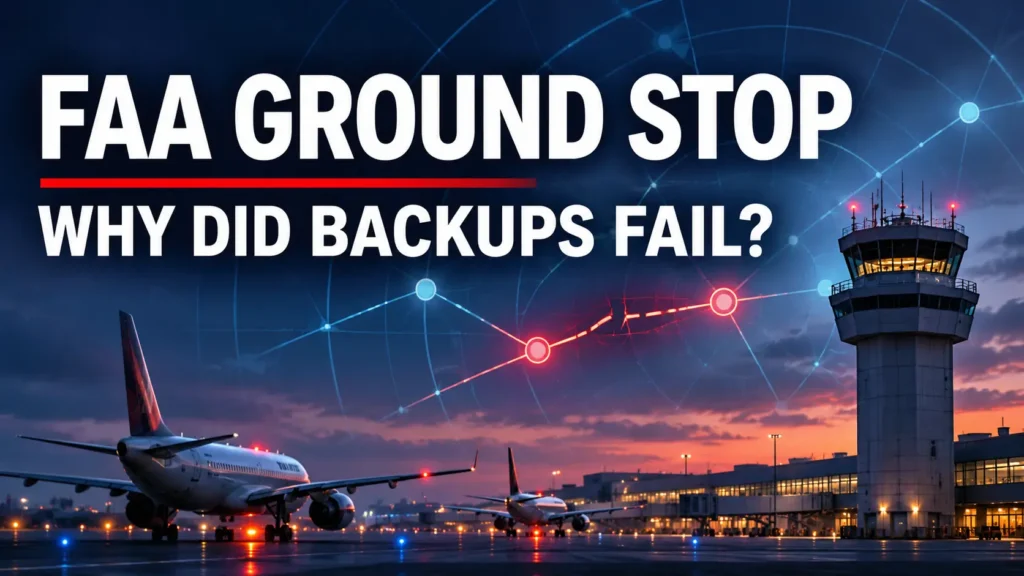
On 13 November 2026, the FAA suspended departing flights across the United States after intermittent communications and inconsistent radar information emerged in air traffic control systems. The ground stop was lifted at approximately 8.15pm Eastern Time after checks and temporary measures stabilised operations. The full technical cause has not yet been established. This investigation examines what officials have said, what the backups were supposed to do and whether the breakdown could have been prevented.
Our original FAA ground stop report covers the initial shutdown and the FAA’s subsequent public statements.
Why did the FAA ground flights nationwide?
Transportation Secretary Sean Duffy told reporters that ageing telecommunications equipment, including switches and routers using time-division multiplexing technology, became overloaded with data. He clarified that the equipment did not necessarily go completely dark: it returned inconsistent information, contributing to intermittent voice communications and radar data. That made continuing normal departures unsafe. More than 3,500 aircraft were already in the air when the decision was taken, according to Duffy.
Officials said aircraft already airborne were handled through established procedures. The ground stop was a precautionary measure to prevent the problem growing while controllers managed existing traffic. Associated Press reported at least 827 diversions. These figures demonstrate the scale of disruption, but do not establish its underlying technical cause. Associated Press’ account of the briefing provides further context.
What happened to the backup systems?
Air traffic control infrastructure is designed with multiple safeguards, including alternative communications routes and operational procedures when specific components fail. But the existence of backup equipment is not proof that every conceivable failure can be isolated. A shared network dependency, corrupted or inconsistent information, a configuration change or an overwhelmed interface between old and new equipment could defeat several apparent layers at once.
It is not yet known which specific safeguards failed, were unavailable, were bypassed or worked but could not maintain the necessary safety margin on 13 November. The FAA has not published a complete component-by-component failure sequence establishing what happened to every redundant path. Claims that ‘four backup systems failed’ should not be repeated as a confirmed description of this incident without technical documentation.
The comparison with the January 2023 nationwide ground stop needs care. That earlier shutdown involved the Notice to Air Missions (NOTAM) database system. Statements concerning its primary and backup databases do not automatically describe the architecture of the telecommunications and radar-data networks affected in November 2026.
Did new technology overwhelm an ageing network?
Homeland Security Secretary Markwayne Mullin said during the White House briefing that new equipment and technology being installed as part of FAA upgrades appeared to be overwhelming older parts of the system. Duffy described the legacy communications system as overloaded, and officials said they had stabilised it before departures resumed.
This raises a more precise question than whether the FAA’s equipment was old: did an identifiable change, patch, upgrade or new data load trigger the overload, and was that interaction tested? Mullin’s account is a preliminary official explanation, not an independently verified engineering finding. The equipment involved, any contractor responsibility and the precise triggering change remain unconfirmed.
CBS News, citing sources familiar with the situation, reported that an update to a private communications network had caused a reboot and communications failure. The network was described as operated by L3Harris. That report is a significant lead for investigators, but the reported mechanism has not been established by a published FAA root-cause report. Read CBS News’ account.
Could this failure have been prevented?
At present, there is insufficient public evidence to answer definitively. Preventability depends on the actual trigger and on what tests, risk assessments, rollout controls and contingency arrangements were available to the FAA and its contractors before the incident.
An effective independent review would need to establish:
- Which switches, routers, circuits or other devices first began giving inconsistent data, and at what time.
- Whether a software patch, security change, network configuration or equipment installation preceded the fault.
- Whether older and newer technologies shared a common point of failure that undermined the intended redundancy.
- What tests and fallback procedures were carried out before changes were introduced nationally.
- Whether the FAA or its contractors had previously recorded similar faults, warnings or near misses.
- Why the disruption expanded nationwide instead of remaining isolated to affected facilities.
A system can be old and still be operated safely; a new replacement can also introduce risks if it interacts badly with existing components. The distinction matters because it determines which corrective measures would prevent a recurrence rather than merely restore service.
What did an independent audit warn before the shutdown?
On 14 September 2026, the US Government Accountability Office (GAO) published a report on the FAA’s Brand New Air Traffic Control System (BNATCS) programme. It found that, as of May 2026, the FAA had 11,389 individual project schedules that had not been integrated into a single master schedule. The watchdog said this made it harder to coordinate installations at the same facilities, identify scheduling conflicts and minimise disruptions to controllers.
The GAO also found that the programme lacked a reliable lifecycle cost estimate. It warned that accelerated implementation without coordinated planning could increase disruption to air traffic control operations, prolong reliance on ageing systems and contribute to future outages. The Department of Transportation partially agreed with the GAO’s recommendations, while disputing some of its assessment of scheduling work. Read GAO report 26-107992 in full.
The audit also noted that an AI-assisted tool was being tested to help identify installation scheduling conflicts. This is a project-management application, distinct from the FAA’s SMART airspace-planning system. Neither the audit nor the reported scheduling weaknesses establish that the modernisation programme caused the 13 November ground stop. What they do show is that independent officials had already identified risks to the coordination of upgrades, making the adequacy of testing, sequencing and backup arrangements legitimate questions for the technical investigation.
What has the Trump administration done to modernise the FAA?
The Trump administration secured an initial $12.5 billion for air traffic control modernisation and has promoted an extensive replacement programme covering telecommunications, radios, radar and other facilities. Officials have said further money is needed to complete the overhaul. This work is real, but the overall system is far from fully replaced.
The Biden administration also invested in FAA infrastructure. The 2021 bipartisan infrastructure law provided $5 billion for improvements to air traffic control facilities and equipment, and work on modern communications contracts was under way before Donald Trump returned to office. The system’s weaknesses and the effort to fix them span multiple administrations.
The pertinent question is not which administration can claim ownership of modernisation. It is whether the design, sequence and oversight of changes were adequate, and whether anyone knew that a partially upgraded network was vulnerable to disruption of this scale.
Was artificial intelligence or Microsoft involved?
The FAA recently expanded SMART, an AI-supported airspace planning tool, to its 22 en-route control centres. The timing attracted attention, but Duffy said SMART was not responsible for the communications failure. The system’s developer also denied a connection. No verified technical evidence currently ties SMART to the nationwide grounding.
A separate Microsoft services disruption occurred close to the FAA incident, but temporal proximity alone is not evidence of shared infrastructure or cause. There is no verified public finding linking Microsoft or a rogue AI system to the ground stop. Investigators should follow network logs, change records and technical evidence rather than coincidences.
Why Pete Buttigieg’s question matters
Former Transportation Secretary Pete Buttigieg has questioned why protections designed to keep the system operating during a failure did not prevent an outage of this magnitude. His remarks have prompted a wider political debate about whether the Trump or Biden administration bears responsibility.
The more consequential issue is technical: a nationwide aviation safety system should not depend on political arguments to explain why it stopped working. Buttigieg’s question about redundancy is legitimate, even though the specific failure mechanisms remain unresolved. Neither his criticism nor the administration’s preliminary explanation amounts to a completed investigation.
What remains unknown
- The precise initiating event and full sequence of technical failures.
- Whether one or more backup paths failed, or whether shared dependencies made the backups inadequate.
- Whether recent upgrades or patches directly caused the overload.
- Whether a documented warning or failed test could have predicted this outage.
- Which permanent fixes the FAA will implement, and how they will be independently validated.
The White House has said there is no evidence so far of a cyberattack. That is a description of the evidence reported at the briefing, not proof that every alternative has been exhaustively ruled out.
What happens next?
Restoring flights is not the same as explaining a failure. Fish 4 News will follow any FAA technical findings, congressional oversight, contractor evidence and independent reviews. A confirmed root cause, a new safety warning or an identified change that triggered the incident would warrant a separately linked follow-up report.
Updated 14 November 2026: Added the GAO’s September audit findings and clarified that the behaviour of the backup safeguards has not yet been established.
Follow this story: FAA nationwide ground stop coverage.
Video: Pete Buttigieg discusses the outage
The C-SPAN interview below features Buttigieg discussing the air traffic control failure and why multiple levels of redundancy did not prevent a nationwide shutdown. His comments are presented as one perspective on the unresolved technical questions, not proof of the cause.
Sources and further reading
- US Government Accountability Office: September 2026 audit of FAA modernisation planning
- Associated Press: ground stop lifted and officials’ explanations
- CBS News: technical investigation and contractor reporting
- Los Angeles Times: the FAA’s account of overloaded equipment
- Federal Aviation Administration: official statements
- C-SPAN interview hosted on YouTube