US Transportation Secretary Sean Duffy used Friday’s nationwide air traffic shutdown to make an urgent appeal for $50 billion in funding, repeatedly crediting President Donald Trump. By Saturday, officials were describing a much more specific technical lead: a router problem during work to replace copper telecommunications lines with fibre. Whether faulty equipment or a contractor mistake triggered the disruption remains unconfirmed.
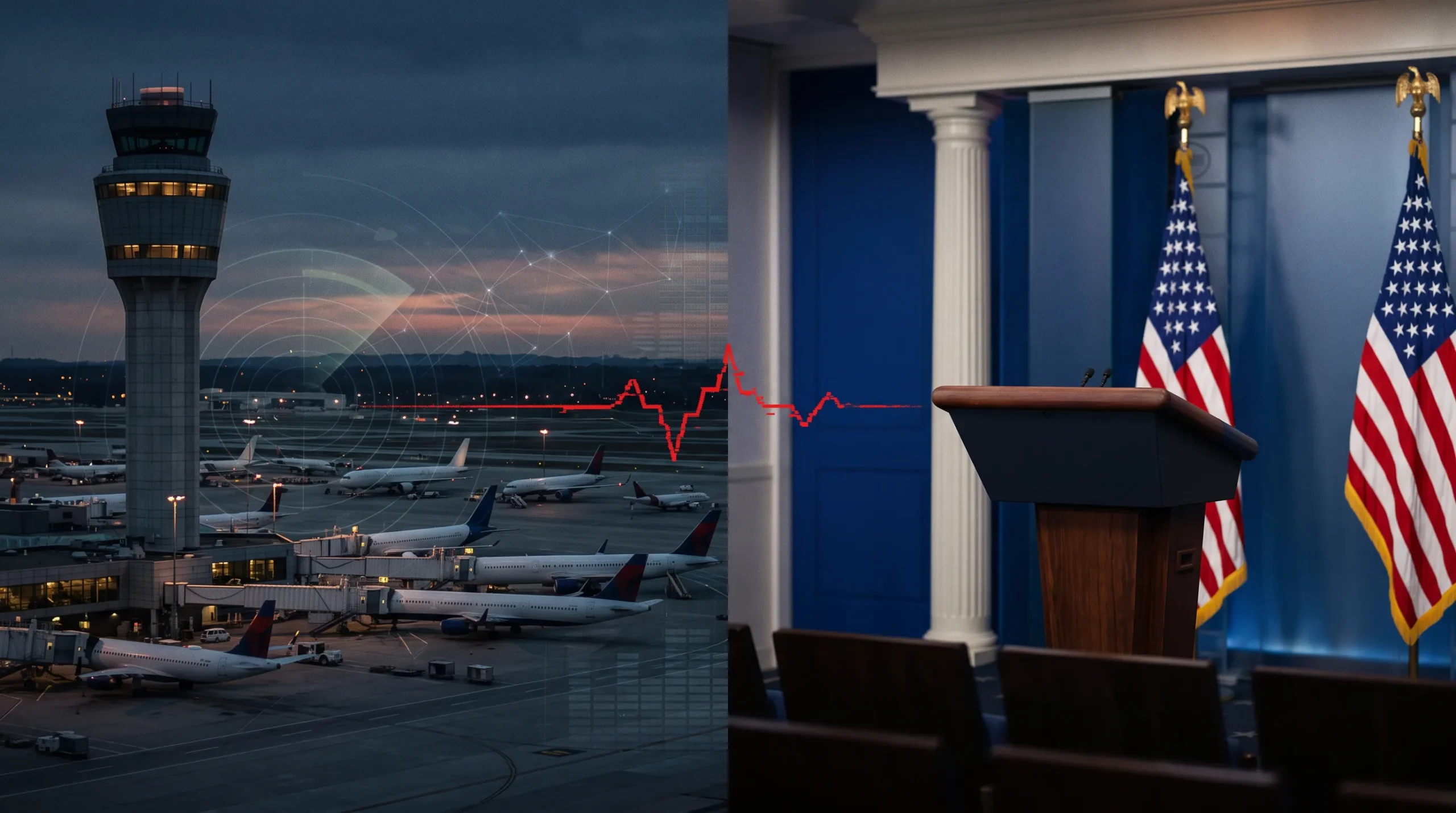
The FAA stopped departures across the United States on Friday 13 November 2026 after intermittent communications and inconsistent radar data affected air traffic control. The ground stop ended at approximately 8.15pm Eastern Time, but flight disruption continued into Saturday. The episode raises two separate questions: what made the network vulnerable and whether Duffy’s high-profile funding appeal was matched by sufficient explanation and accountability. The US Department of Transportation published highlights of Friday’s briefing.
What Duffy explained at the White House
Duffy told reporters that instability began at around 3.36pm Eastern Time, affecting communications and radar information used by FAA en-route centres and terminal approach control facilities. He said more than 3,500 aircraft were in the air as crews and controllers followed established procedures to bring aircraft down safely. Communications and radar had not disappeared altogether, but intermittent or inconsistent information was considered too dangerous for normal departures.
Those were substantive safety and operational explanations. The decision to stop departures when controllers cannot rely on their information is not, by itself, evidence of poor management. But the immediate safety response does not answer why a telecommunications problem became severe enough to affect the national network. A full transcript of Friday’s White House briefing records the questions and answers.
A technical briefing or a political sales pitch?
The White House appearance was also unmistakably a funding pitch. Duffy repeatedly invoked Trump, described him as a president who could build a replacement network and urged Congress to release the money. At one point he said: “I want $50 billion.” Homeland Security Secretary Markwayne Mullin also praised Trump’s leadership and argued against continuing to replace the network in separate pieces.
Duffy contrasted the administration’s programme with what he described as inadequate progress under previous governments. He credited Trump with securing a $12.5 billion initial allocation and suggested that the system could not be properly rebuilt without further Congressional funding. These statements promoted a political case for new spending while officials were still investigating the immediate trigger of the outage.
The distinction matters. Duffy did give details of the incident, including the timeline, safety procedures and condition of the legacy network. The briefing was therefore not simply an advertisement. Equally, repeated praise for the president did not establish whether the outage was foreseeable, whether maintenance had been properly tested or who approved changes to a system supporting national air traffic.
Saturday’s update points to an L3Harris network change
On Saturday 14 November, Duffy and FAA Administrator Bryan Bedford gave a more specific account. According to the Department of Transportation’s Saturday briefing, L3Harris, a longstanding FAA telecommunications contractor, was performing routine work at at least one remote FAA location to move a line from ageing copper to fibre.
Duffy said a router involved in the change began flooding other routers across the air traffic control network with more than 1,000 connection attempts every four to five seconds. That appeared to destabilise voice communications and radar feeds. Officials said isolating the affected work allowed systems to return to operation, but they had not determined whether an installation mistake, operator error or defective equipment was responsible.
These are preliminary findings, not a determination that L3Harris was negligent. The company carried out the work identified by Duffy, but no published independent technical report yet establishes the initiating fault, the precise mechanism by which the disruption spread or the allocation of responsibility. Reuters reported that 17 of the FAA’s 22 en-route control centres were affected. Read Reuters’ 14 November report.
Why could one maintenance job disrupt the wider system?
That is a more immediate accountability question than whether Washington approves another funding package. The FAA and its contractors need to establish why an apparently routine transition at a remote location could produce disruption on such a scale, including whether network segmentation, validation checks, change-control procedures and independent backups worked as intended.
Reporters also asked why the maintenance was undertaken during a busy travel period rather than overnight. Officials described the work as routine, but the evidence made public so far does not establish what risk assessment was performed or what safeguards would have isolated an unexpected surge in network traffic. NPR reported those questions from Saturday’s briefing.
What does the $50 billion request leave unanswered?
There is evidence that America’s air traffic control infrastructure needs significant investment. The 2021 bipartisan infrastructure law allocated $5 billion over five years to FAA air traffic facilities and equipment. Separately, the 2025 funding legislation allocated $12.5 billion to the current modernisation initiative: approximately $9 billion for systems and $3.5 billion for facilities. These sums are not interchangeable and do not demonstrate that every necessary improvement has been delivered.
A US Government Accountability Office report published on 14 September 2026 found that the FAA did not have a reliable full lifecycle cost estimate or an integrated master schedule connecting 11,389 separate project schedules for the modernisation programme. The watchdog warned that poor coordination could cause operational disruption and increase the risk of delays and failures. The Department of Transportation partially disagreed with the recommendations.
That audit does not prove that the management weaknesses caused Friday’s outage. It does, however, make the request for more money inseparable from questions about programme oversight, contractors, installation planning and how Congress would verify progress.
Does the outage establish that Duffy should lose his job?
The public evidence does not yet establish personal fault by Duffy. The safety decision to halt departures and the underlying vulnerability of an ageing network must be assessed separately. A finding that officials ignored specific warnings, approved inadequate safeguards, misrepresented the risks or failed to act on known defects would materially change the accountability picture. None of those findings has been publicly demonstrated in relation to this incident.
Responsibility for the FAA sits within Duffy’s department, so scrutiny of his oversight is legitimate regardless of which company supplied the affected equipment. But political praise, a funding request and the fact that a serious outage occurred are not substitutes for evidence about who knew what, when decisions were made and which actions could reasonably have prevented it.
The questions the investigation must answer
- Which change or device first generated the abnormal connection attempts, and what did the network logs show?
- Who authorised and tested the copper-to-fibre transition, and was there a rollback plan?
- Why did the disturbance reach so many air traffic control centres instead of remaining local?
- Which redundant communications paths were available, and how did they perform?
- Did the FAA or its contractors receive prior warnings about this failure mode?
- What independent evidence and costed milestones will support any new funding request?
Friday’s briefing established why officials took emergency precautions. Saturday’s account advanced the technical investigation. Neither yet provides a completed, independently tested explanation of the failure or answers every question about oversight.
Follow this story: Read our investigation into the FAA’s backup safeguards and our initial report on the nationwide ground stop. We will link confirmed technical findings, contractor responses and Congressional scrutiny as they emerge.
Video: Duffy and Mullin address the ground stop
The official White House briefing from Friday 13 November includes Duffy’s explanation of the shutdown and his appeal for further funding.
Sources
- US Department of Transportation: White House briefing, 13 November 2026
- US Department of Transportation: Duffy and Bedford briefing, 14 November 2026
- Roll Call Factba.se: full Friday briefing transcript
- US Government Accountability Office: GAO-26-107992, 14 September 2026
- Federal Aviation Administration: bipartisan infrastructure law funding
- Reuters: 14 November report on the L3Harris-related investigation
- NPR: impact and outstanding technical questions