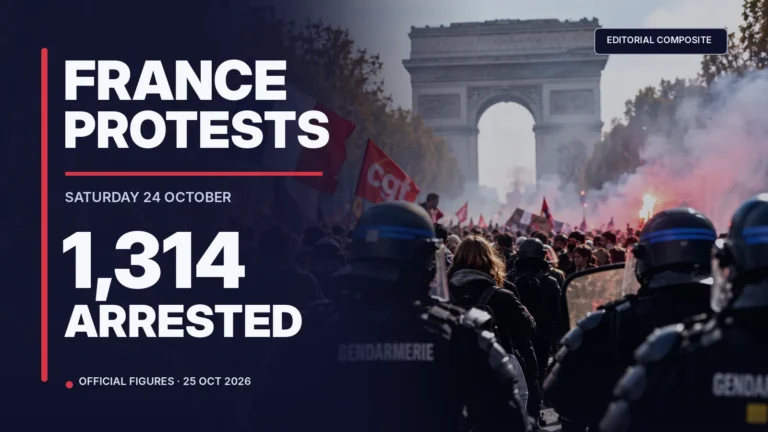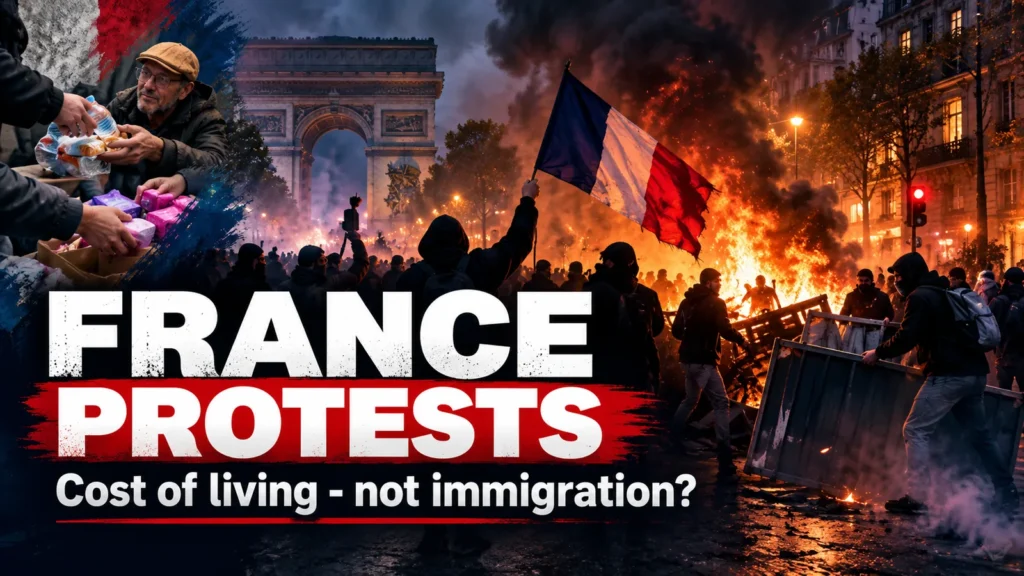
Hundreds of thousands of people took to the streets across France on Saturday 17 October 2026, protesting against rising living costs, poor school conditions and declining public services. Although violence, looting and arson erupted in several cities, much of the nationwide mobilisation was peaceful. US President Donald Trump and Vice-President JD Vance have blamed immigration for the unrest, but French authorities have not established a connection between immigrants and the rioting.
Why are the French protesting?
Before the burning cars, smashed shop windows and scenes of violent confrontation, there were schoolchildren demanding better classrooms.
France’s latest wave of demonstrations began in mid-September, when secondary school pupils protested against teacher shortages, overcrowded classrooms and deteriorating school buildings.
The movement spread from schools in the Paris suburbs to other parts of the country.
Teachers, parents, university students and trade unions subsequently joined the demonstrations, broadening the movement into a wider protest against inequality and economic pressures.
By Saturday 17 October, the grievances extended far beyond education.
The CGT, one of France’s major trade unions, backed the demonstrations, calling for higher wages and pensions, lower prices and stronger public services.
Activists associated with the Yellow Vest movement, which began in 2018 over fuel costs and wider economic inequality, also called for participation.
The demands were not primarily about immigration. They concerned the cost of everyday life, the education system and people’s relationship with their government.
Hundreds of thousands marched, but violence dominated the headlines
France’s Interior Ministry estimated that approximately 550,000 people joined Saturday’s demonstrations. Trade union organisers estimated 800,000.
Reuters reported that hundreds of thousands marched peacefully, although violent groups attacked public buildings, looted shops and clashed with police.
In Limoges, flames engulfed the historic 19th-century town hall, causing its roof to collapse.
In Marseille, masked individuals forced their way into the town hall, while serious destruction was reported in Paris, Lyon and other cities.
By Sunday, authorities reported at least 2,400 arrests.
Businesses suffered extensive damage, police officers were injured and investigations were opened into severe injuries, including those suffered by young people. In Mulhouse, a 17-year-old girl lost her left eye. According to French reporting, she was not participating in the demonstration. Prosecutors have opened an investigation into the circumstances of her injury.
These were not minor disturbances, and those responsible for attacks on businesses, public buildings or individuals must be distinguished from people exercising their right to protest peacefully.
French President Emmanuel Macron blamed much of the destruction on radical far-left groups and criminal elements, while condemning the damage caused to communities.
However, photographs of burning buildings cannot, on their own, explain why hundreds of thousands of people had gathered in the first place.
Why are Trump and Vance blaming immigration?
As France confronted the destruction, the US president offered a very different explanation for the unrest.
On Sunday 18 October, Trump declared on Truth Social that France was burning and claimed immigration had shattered the country.
He urged French authorities to close their borders.
Vice-President JD Vance similarly blamed Western immigration and integration policies.
In a post on X, Vance claimed that Western liberals had imported people from developing countries into France without sufficiently considering cultural integration.
He also connected the French unrest to American politics, arguing that voters should regard the events as a warning about the policies of congressional Democrats.
Their statements framed the violence principally as a consequence of immigration rather than examining the documented origins of the demonstrations.
Both leaders are entitled to argue for stricter immigration policies. But their explanation for the riots raises a factual question: what evidence connects immigration to the violence?
What does the evidence actually show?
The distinction between a political claim and an established fact is important.
The Associated Press reported on 18 October that French authorities and police had not linked immigrants to the rioting.
That does not mean investigators have established the citizenship or background of every participant. Nor does it rule out the involvement of individuals from immigrant backgrounds.
It means the sweeping explanation offered by Trump and Vance has not been substantiated by the available official findings.
The known origins of the demonstrations are considerably clearer.
Students were protesting school conditions. Trade unions were demanding better wages and public services. Yellow Vest supporters were mobilising over living costs and economic inequality.
French authorities have attributed much of the violence to radical political groups and opportunistic criminals.
These facts do not support treating hundreds of thousands of protesters as participants in an immigration-related uprising.
How the immigration narrative spread
The political interpretation was also reflected in parts of the media.
On 18 October, Breitbart published an article amplifying Trump’s immigration claims and describing the participants in sweeping terms as violent left-wing protesters.
That portrayal contrasts with reporting from Reuters and Associated Press, which documented extensive peaceful participation alongside serious criminal violence.
There is a legitimate public debate about immigration, integration, public safety and political extremism in France.
But those wider arguments should not be confused with evidence about the causes of these particular demonstrations.
If immigration is claimed to be responsible for the riots, that claim requires supporting evidence.
The concerns about schools, prices, wages and services do not disappear simply because a political figure offers a different explanation.
Another side to the demonstrations
Not every video emerging from the unrest shows violence.
Footage shared by AJ+, part of the Al Jazeera Media Network, has circulated on social media showing what are described as protesters giving food to homeless people, distributing sanitary products and donating trainers.
Other scenes appear to show people moving barricades, with captions claiming they were clearing access for emergency vehicles.
The circumstances, timing and locations of these clips have not all been independently verified. Nor is it established whether the distributed supplies had been taken from looted businesses.
They should therefore be treated as circulating claims rather than proven accounts of what happened on 17 October.
Nevertheless, the footage provides a reason to investigate behaviour beyond the violence dominating international coverage.
Helping someone in need would not excuse theft or vandalism. Equally, criminal behaviour by some individuals does not establish the intentions of an entire movement.
A crisis that extends beyond France
France is not alone in experiencing public frustration over living costs and government policy.
Demonstrations also took place in Belgium, Portugal and Italy on 17 October, with protesters raising concerns over education, housing, affordability and economic conditions.
The circumstances differed between countries, and these were not a single coordinated European movement.
Nevertheless, the events illustrate how economic pressures and dissatisfaction with public services can bring large numbers of people into the streets.
France’s unrest has particular political significance because the country is approaching its 2027 presidential election, at a time when Macron’s government is already under substantial pressure.
Update: curfews imposed after weekend of unrest
On Monday 19 October, police announced overnight curfews in two areas of Paris, Place de la République and Les Halles, from 11pm until 6am on Tuesday. Gatherings in the affected areas were banned from 8pm. Several other cities introduced targeted restrictions, including curfews for under-18s.
French authorities estimated that at least 3,000 businesses had been damaged or looted. The government announced emergency support measures for affected employers and businesses, although full details of the funding had not yet been provided.
Interior Minister Laurent Nuñez offered his resignation, but Macron refused it and ordered a review of the failures in intelligence and planning before the riots. Student organisations and Yellow Vest activists have called for further demonstrations.
The government has pledged to deploy about 3,000 qualified teachers who had not yet taken up posts to help address staffing shortages. Reuters reported that a substantial increase in school funding had not been promised.
The questions behind the burning barricades
The French authorities face serious questions about the violence, their preparedness, the conduct of police and the protection of ordinary citizens and businesses.
Those responsible for criminal attacks must be investigated, while allegations of excessive police force also require scrutiny.
But the original demands of the protesters deserve answers as well.
Why are pupils taking to the streets over conditions in their schools? Why are workers demanding higher pay and protection against rising prices? And why are so many people dissatisfied with their government’s response?
These questions are not answered by blaming immigration without evidence.
France’s protests are a story about education, living standards, political frustration and serious outbreaks of violence. Reducing that complex picture to an immigration narrative risks obscuring the very grievances that brought hundreds of thousands onto the streets.
Update, 19 October 2026: This article has been updated to include the overnight curfews, new estimates of business damage and further details of the investigation into the Mulhouse teenager’s injury, including clarification that she was not participating in the protest.
Sources
Reuters: France in turmoil after riots and looting, what we know (19 October 2026)
Associated Press: Paris police impose overnight curfews (19 October 2026)
TF1 Info: Prosecutors investigate serious eye injury in Mulhouse (18 October 2026, in French)
Reuters: Students, trade unions and Yellow Vests set to protest across France (17 October 2026)
Associated Press: How the riots unfolded and how the government responded (19 October 2026)
AFP / Channels TV: Trump and Vance blame immigration (18 October 2026)
Breitbart: Trump warns “France is Burning!” (18 October 2026)
Al Jazeera: Why have France’s school protests become a wider political crisis? (18 October 2026)
AJ+ social video, reposted to Reddit: unverified footage of assistance during demonstrations