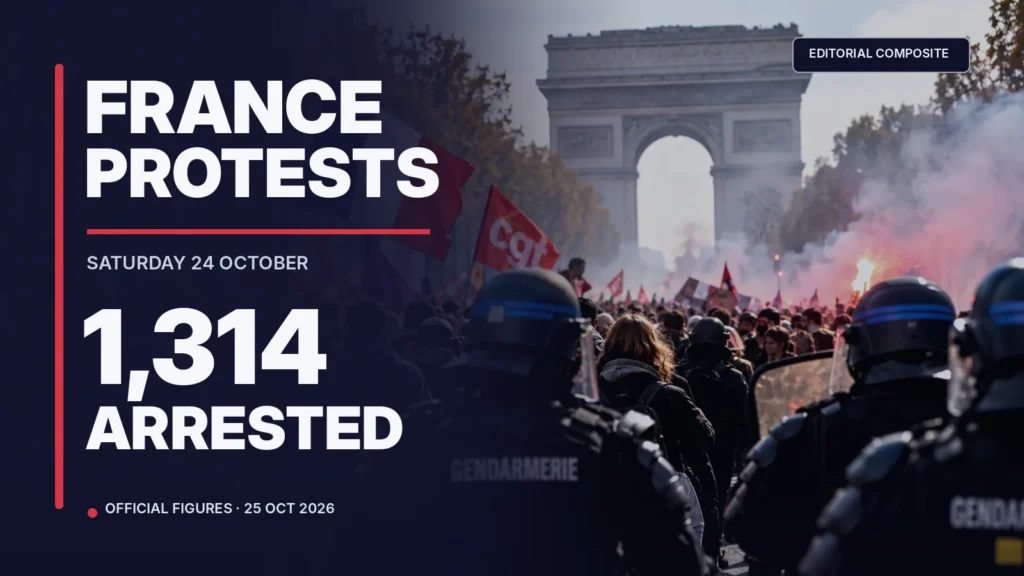
France’s second weekend of nationwide protests saw fewer incidents of serious disorder than the previous week, but more than 1,300 arrests, injuries under investigation and fresh calls for demonstrations show that the crisis remains unresolved.
France’s latest nationwide demonstrations on Saturday 24 October 2026 attracted an estimated 410,000 people, according to the Interior Ministry, with 1,314 arrests reported by Sunday morning. Although most organised marches proceeded peacefully and widespread destruction was substantially reduced compared with the previous weekend, serious injuries, confrontations with police and allegations of violence involving far-right groups have prompted further investigations. Protest organisers are already calling for renewed action on 31 October and a national strike on 5 November.
France Reports 1,314 Arrests After Nationwide Demonstrations
France’s Interior Minister, Laurent Nuñez, confirmed on Sunday 25 October that 1,314 people had been arrested during the latest round of demonstrations.
The figure replaces earlier provisional reports of nearly 1,000 arrests.
According to the French Interior Ministry’s official assessment, the latest demonstrations involved:
- 410,000 participants, including 110,000 in Paris, across 289 recorded public demonstrations and actions.
- 1,314 arrests, compared with 2,628 the previous Saturday.
- 53 injured police officers and gendarmes, compared with 1,144 on 17 October.
- 75 fire-related emergency interventions, compared with 2,025 the previous weekend.
- 24 shops looted, compared with 1,522 businesses reported damaged or looted the previous Saturday.
The government described its assessment, compiled at 7.30am on Sunday, as provisional.
Trade union organisers disputed the government’s attendance estimate, claiming approximately 800,000 people participated nationwide.
The two attendance figures are competing estimates rather than independently established totals.
The dramatic reduction in damage and police injuries suggests that Saturday’s extensive security operation prevented a repeat of much of the destruction seen on 17 October.
However, the figures do not establish that the political and economic grievances behind the demonstrations have been resolved.
What Happened During Saturday’s Demonstrations?
Approximately 70,000 police officers and gendarmes were mobilised across France, supported by specialist units, armoured vehicles, helicopters and water cannon.
The deployment had been announced ahead of Saturday’s demonstrations following criticism of the authorities’ response to the previous weekend’s violence.
Many organised marches took place without major incidents.
However, disturbances developed towards the end of demonstrations in several cities, including Paris, Marseille, Lyon and Toulouse.
Authorities reported individuals throwing projectiles and fireworks towards police, while officers used tear gas and other crowd-control measures.
Nuñez attributed much of the disorder to groups he described as belonging to the radical far left.
That assessment reflects the Interior Minister’s account of the disturbances and should not be taken as describing the hundreds of thousands of people who participated in largely peaceful demonstrations.
In Paris, clashes followed an organised procession that had otherwise taken place with relatively limited disruption.
In Marseille, police used tear gas after confrontations developed near the end of the demonstration.
Despite these incidents, the extensive looting and destruction witnessed on 17 October was not repeated on the same scale.
The distinction between peaceful participants and individuals suspected of criminal violence remains essential.
Arrest does not establish criminal guilt, and the circumstances of individual arrests remain subject to investigation and, where appropriate, judicial proceedings.
Serious Injuries Reported in Toulouse, Clermont-Ferrand and Poitiers
Reports of serious injuries have raised further questions about the confrontations between demonstrators and police.
In Toulouse, a 20-year-old man suffered a severe hand injury during disturbances near the conclusion of Saturday’s demonstration.
TF1 Info reported that a volunteer street medic described extensive injuries involving several fingers.
The precise circumstances of the injury remain under investigation.
In Clermont-Ferrand, prosecutors opened an investigation after a demonstrator suffered a serious hand injury during a police dispersal operation.
Prosecutor Éric Serfass said the injury could have been caused by a grenade thrown by police, but that possibility had not been established as the cause.
Le Parisien reported the prosecutor’s statement on Sunday.
Local rescuers also disputed social media claims that the injured man had lost his hand or fingers. They described substantial injuries but said his fingers remained attached when they treated him.
Separately, a 19-year-old demonstrator was reported to have suffered an eye injury in Poitiers. French media reported that an investigation had been opened into the circumstances.
These are separate incidents, and their causes must not be assumed to be identical.
The Interior Minister identified two serious injuries in his initial comments, while subsequent local reporting described additional incidents. The reports should not automatically be combined into a single confirmed national casualty total.
Determining what happened will require medical evidence, witness testimony and the results of the relevant investigations.
Nice: 59 Detained, Including 11 Suspected Far-Right Activists
Further details emerged on Sunday concerning disturbances in Nice, where demonstrations had been restricted by local authorities.
Prosecutor Damien Martinelli confirmed that 59 people had been placed in police custody following Saturday’s events.
Among them were 11 individuals suspected of belonging to far-right extremist groups.
According to the prosecutor, the 11 were intercepted in two vehicles. Some were allegedly carrying masks, gloves, defensive sprays and batons.
The prosecutor said the arrests related to suspected participation in groups preparing to commit violence or damage property.
A separate investigation was opened into aggravated violence involving suspected far-right activists in the city centre.
Le Parisien reported the prosecutor’s findings.
The investigation will need to establish the individual involvement, if any, of those detained in particular acts of violence.
The Nice custody figures are local figures and must not be added to the nationwide total of 1,314 arrests.
The reported involvement of suspected far-right groups also complicates any attempt to attribute all the weekend’s confrontations to a single political movement.
Paris March Diverted After Court Rejects Route Challenge
The restrictions imposed on demonstrations remained controversial throughout the weekend.
In Paris, trade union organisers had initially secured agreement for a demonstration between Bastille and Nation.
However, the Police Prefecture subsequently withdrew approval for that route, citing public-order concerns and the potential for further attacks on businesses.
Instead, authorities authorised a route between Porte d’Italie and Porte de Vincennes, along the city’s outer boulevards.
Organisers challenged the change before the Paris Administrative Court.
On Saturday morning, the court rejected their application, leaving the alternative route in place.
Le Monde reported the decision and the dispute over the route.
The ruling was separate from an earlier court intervention involving student protesters.
As Fish 4 News reported on 22 October, a Paris administrative court suspended a police prohibition on a demonstration organised by the Interfac Île-de-France student collective.
The students subsequently gathered peacefully following that decision, although their original march did not proceed as planned.
A separate court ruling established a requirement for Paris police protest bans to be published at least 12 hours before taking effect, allowing time for legal challenges.
Together, these decisions demonstrate how individual restrictions can be examined by the courts without necessarily overturning wider public-order measures.
France’s Highest Administrative Court Rejects National Protest Challenges
A further significant legal development occurred on Friday 23 October.
France’s highest administrative court, the Conseil d’État, rejected emergency applications challenging President Emmanuel Macron’s statements about restricting demonstrations.
The challenges were brought by civil liberties organisations, trade unions and political groups concerned that the president’s approach could disproportionately restrict peaceful assembly.
However, the court did not endorse a blanket prohibition on demonstrations organised by groups other than recognised trade unions.
In its published decision, number 520729, the court concluded that Macron’s statements did not themselves constitute a binding decision or instruction requiring prefects to prohibit demonstrations.
It reaffirmed that authorities must examine public-order risks individually and that restrictions must be appropriate, necessary and proportionate.
A demonstration cannot lawfully be prohibited solely because of the president’s statements.
The decision therefore rejected the applications while maintaining the legal safeguards governing restrictions on peaceful assembly.
For protesters and civil liberties organisations, the continuing concern is whether those safeguards are being applied consistently in practice.
For the government, the challenge remains preventing violence while permitting lawful demonstrations to proceed.
French Broadcasters Apologise After Showing Albanian Protest Footage
The weekend also produced a separate controversy concerning misleading television coverage.
Two French broadcasters apologised after mistakenly presenting footage from protests in Albania as scenes from demonstrations in France.
According to an Associated Press investigation, CNEWS incorrectly identified footage from Tirana as showing protesters near Porte d’Italie in Paris.
The images prompted commentary about the possibility of violent disturbances in the French capital, even though the footage had been recorded in a different country.
Public broadcaster Franceinfo separately aired Albanian police footage and incorrectly identified it as live scenes from Lyon.
Franceinfo corrected the error shortly afterwards.
Both broadcasters acknowledged mistakes.
The incidents demonstrate why images of unrest must be verified before being attributed to particular locations or demonstrations.
Although genuine clashes occurred in several French cities, footage from Albania cannot be treated as evidence of those incidents.
Why Are People Still Protesting?
France’s protest movement began with concerns about the education system, including teacher shortages, deteriorating school buildings and pressure on students.
It subsequently expanded to encompass wider economic grievances.
Demonstrators and trade unions have demanded action over wages, pensions, rising living costs and the quality of public services.
The protests have also attracted supporters of the Yellow Vest movement, which first emerged in 2018.
The origins of the unrest were examined in our earlier report, France’s Cost-of-Living Protests: What Trump and Vance’s Immigration Claims Leave Out.
That investigation examined claims made by US President Donald Trump and Vice-President JD Vance linking the unrest to immigration, despite the absence of established evidence that immigration was the cause of the demonstrations.
Macron subsequently criticised foreign political figures for spreading misleading interpretations of France’s unrest.
Meanwhile, the French government has begun discussions with trade unions and student representatives.
However, protest leaders say the measures proposed so far do not adequately address their demands.
The fall in violent incidents over the latest weekend does not necessarily signal a reduction in dissatisfaction with government policy.
Further Protests Planned for 31 October and 5 November
Protest organisers are now seeking to maintain pressure on the French government.
Reuters reported on Sunday that the Solidaires federation and Yellow Vest activists were calling for further demonstrations on Saturday 31 October.
The SUD Education union has indicated that it will participate, while the CGT said it would decide during the coming week.
A nationwide strike is also being called for Thursday 5 November.
The extent of participation in these future actions remains uncertain.
Police unions have meanwhile warned that maintaining the security deployment seen on 24 October for an extended period would be difficult.
The government therefore faces several simultaneous challenges: maintaining public order, responding to allegations of excessive restrictions, investigating serious injuries and addressing the economic and educational complaints driving the protests.
What Happens Next for France?
Saturday’s figures show a substantial reduction in disorder compared with the previous weekend.
Fewer arrests were made, fewer police officers were injured, and reports of looting and fires were markedly lower.
That is an important development for residents, businesses, demonstrators and emergency services.
But the continuation of largely peaceful mass demonstrations, serious incidents requiring investigation and plans for further action demonstrate that the wider dispute remains unresolved.
The immediate questions are whether the government can reach an agreement with student organisations and trade unions, whether the investigations into injuries and violence establish accountability, and whether future restrictions can balance security with the right to peaceful protest.
For now, France has avoided a repeat of the previous weekend’s widespread destruction. It has not yet resolved the issues that brought hundreds of thousands of people onto the streets.
Sources and Further Reading
- French Interior Ministry: Official assessment of 24 October demonstrations, published 25 October
- Reuters: French protest groups demand further rallies, 25 October
- CBS News / Associated Press: More than 1,000 arrested in France, updated 25 October
- Conseil d’État: Decision 520729, 23 October 2026
- Le Monde: Paris protest route challenge and administrative court ruling, 24 October
- Le Parisien / AFP: Clermont-Ferrand injury investigation, 25 October
- Le Parisien: Nice detentions and suspected far-right involvement, 25 October
- Associated Press: French broadcasters apologise over incorrectly identified Albanian protest footage