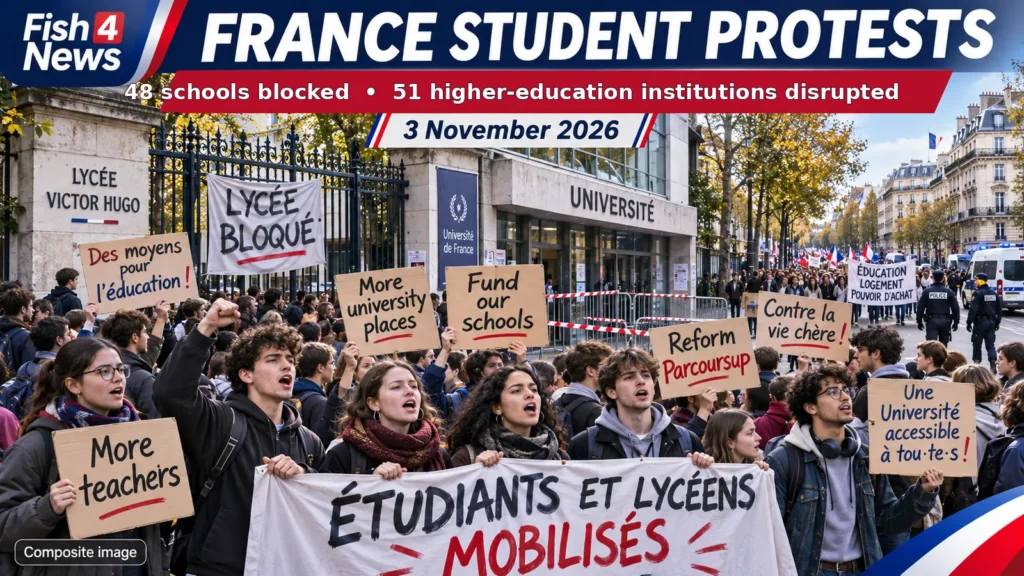
French students returned to school and university protests on Tuesday 3 November, with the government reporting 48 secondary schools blocked and 51 of 184 higher-education institutions disrupted. Student unions disputed the scale of the school figures as demonstrators challenged restrictions on a Paris march ahead of a national strike planned for Thursday.
The official figures describe different measures: the Education Ministry counted 48 blocked lycées at 9.30am, out of about 3,700 nationwide, while the Higher Education Ministry reported 51 institutions experiencing disruption, not 51 universities completely closed. The ministries’ figures were reported by TF1 Info and France Télévisions.
Government and union figures differ sharply
The secondary-school union Union syndicale lycéenne (USL) said more than 500 lycées experienced full or partial, or so-called filtering, blockades. The higher-education organisation Union étudiante claimed more than 50 campuses blocked and around half of universities affected, in its 3 November statement. These are union assessments, not independently verified national totals.
A campus can be part of a larger institution, and disruption can include limited access or precautionary closure rather than a complete blockade. Different reporting times and definitions help explain why the figures cannot be compared directly. They do not establish which national estimate is correct.
The official school total was slightly higher than the 41 reported at the same time on Monday 2 November, when pupils returned from the autumn break. Reuters reported that the resumption was much smaller than the peak of the protests before the holiday.
Paris march challenged police restrictions
In Paris, organisers from Interfac Île-de-France wanted to march from the Panthéon to the Medef employers’ organisation headquarters. Police instead authorised a route around the eastern edge of the city. An administrative court upheld the prohibition on the central route on Tuesday, according to French reporting. The ruling related to the 3 November route and must not be confused with the separate court decision involving an October student demonstration.
Students nevertheless gathered in the Latin Quarter. Le Monde’s video report showed demonstrators under police escort, with the group later moving towards the Sorbonne and dispersing peacefully at around 4pm. Reports varied on turnout and no verified national attendance figure for Tuesday was available.
Where schools and universities were affected
Protests or disruption were reported in Paris, Rennes, Lyon, Marseille, Montpellier, Grenoble and Strasbourg. Union representatives named campuses including Paris Nanterre, Strasbourg, Montpellier Paul-Valéry, Lyon 2 and sites in Rennes. Not every named campus had independently verified evidence of complete closure.
TF1 reported preventive administrative closures affecting a number of institutions, including Paris 1 Panthéon-Sorbonne, Rouen Normandie, Lille and Rennes 2. Such management decisions should not automatically be counted as student-enforced blockades.
Police interventions and arrests
In Rennes, local outlet Rennes Infos Autrement reported fires near the gates of Jean-Jaurès and Bréquigny secondary schools, damage to bus shelters, intervention by riot police and firefighters, and at least one arrest. That arrest figure came from local reporting; a consolidated official national arrest figure for the 3 November education protests had not been verified.
French reporting also described tensions during school blockades in other cities, including Lyon. No reliable nationwide tally of injuries from Tuesday’s student actions was available. The arrests and serious disorder reported during the larger demonstrations on Saturday 31 October relate to a separate day and must not be attributed to Tuesday’s school protests.
Why students are protesting
Pupils and students have called for better-maintained buildings, more teaching staff, additional higher-education places, improved financial support and changes to Parcoursup, the university admissions platform criticised by some students as unfair. Protesters argue that the government’s announcements have not yet addressed the underlying problems.
In its 26 October policy statement, the government promised to replace Parcoursup in 2028, open 15,000 further places in higher education over 2027–28, cap certain lycée classes at 28 and make funds available to refurbish school and campus buildings. The school-renovation element includes €4 billion in loans, rather than a claim of €4 billion in direct grant spending. It also outlined staffing and student-support measures.
Education Minister Édouard Geffray has said pupils have a right to demonstrate but not to block access to schools. Ministers present the measures as a substantive response; student organisations describe them as insufficient and demand faster changes and additional funding. The Union étudiante campaign calls for a €10 billion youth package, according to its statement.
What happens on 5 November?
Student unions intend to join a wider French interprofessional mobilisation on Thursday 5 November, alongside trade unions representing public- and private-sector workers. Their stated demands include education funding, pay, working conditions and the cost of living. The size of the planned action cannot yet be verified.
For background on the wider demonstrations, see Fish 4 News’ report on the 31 October protests and subsequent clashes and its earlier report on student-march restrictions in Paris. Those incidents and the current school and university protests are distinct events.
Sources
- TF1 Info, 3 November: ministry figures and union claims
- Union étudiante: statement of 3 November
- French Education Ministry: proposals announced 26 October
- Le Monde: video and reporting from Paris on 3 November
- Rennes Infos Autrement: school blockades and police response
- Reuters, 2 November: reopening and background