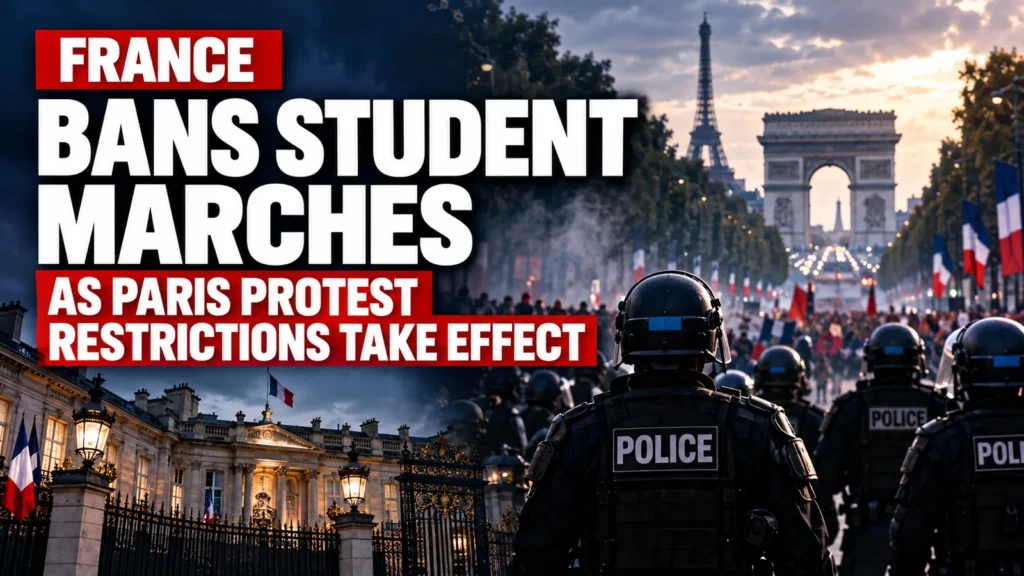
A Paris court has suspended a ban on a student demonstration, allowing a peaceful gathering on 22 October. Other French cities have imposed protest restrictions ahead of further nationwide action on Saturday.
A Paris administrative court suspended a police ban on a student demonstration on Thursday 22 October 2026, allowing protesters to gather peacefully as France imposed new restrictions following last weekend’s violence. The ruling concerns the planned Interfac Île-de-France march and does not overturn separate restrictions on undeclared protests in designated parts of Paris or bans imposed in other French cities.
Paris Student March Ban Overturned by Court
Police had prohibited the demonstration organised by Interfac Île-de-France, a collective representing university students in the Paris region. Organisers had declared a route from the Boulevard de l’Hôpital area near Pitié-Salpêtrière hospital towards Place de la Bastille.
The Paris Police Prefecture cited the risk of renewed violence and damage following clashes and looting during the protests of Saturday 17 October.
But the organisers challenged the order, and the administrative court suspended the ban on Thursday, according to Anadolu Agency. The ruling applied to this specific demonstration.
The Associated Press reported that thousands of protesters, including young people, gathered peacefully under a heavy police presence in south-eastern Paris. Organisers agreed with police that the demonstration would remain stationary because of the risk of disorder.
The developments mean an earlier announcement that the student march had been banned was overtaken by the court’s decision. The demonstrators were able to assemble, although the gathering did not proceed as an unrestricted march along the originally declared route.
Which Restrictions Applied in Paris on 22 October?
Separate from the court case, the Paris Police Prefecture introduced an order prohibiting participation in undeclared gatherings and marches between 8am and 8pm French time on Thursday in defined areas of the capital.
The affected areas included the surroundings of the Élysée Palace, Hôtel de Matignon, the National Assembly, the Senate, the Louvre and the Champs-Élysées, as well as areas around major railway stations.
The order also covered specified zones including Place de la République, Place de la Bastille, Place d’Italie, Châtelet, Les Halles and Île de la Cité.
The measures did not amount to a general prohibition on every demonstration across Paris. The geographical restrictions on undeclared gatherings and the specific student march ban were legally distinct decisions. Thursday’s court ruling concerned the latter.
Authorities had separately imposed overnight curfews in parts of the capital following the violence. These were different from Thursday’s daytime demonstration restrictions.
Student Protests Banned in Lyon and Other Cities
In Lyon, the Rhône prefecture banned a separately organised student demonstration planned for Thursday afternoon by the UNEF student union and the New Anticapitalist Party’s revolutionary wing.
That proposed march was scheduled to travel from Manufacture des Tabacs to Place Bellecour. Authorities said the risk of renewed public disorder justified the decision.
Further restrictions were introduced in other French cities, including Lille and Grenoble, although the precise rules and geographical areas varied from place to place.
As authorities prepared for Saturday 24 October, Reuters reported that all protests planned for Saturday in Lyon had been prohibited. Restrictions in other cities should not be confused with a nationwide blanket ban.
Macron Defends Tougher Approach After Weekend Violence
The restrictions followed demonstrations on 17 October that were accompanied by clashes, looting and damage to businesses in several cities. The original protests centred on concerns over education funding, school conditions and staff shortages, but the movement expanded into wider protests over the cost of living and government economic policies.
President Emmanuel Macron met intelligence and security officials on Thursday to review the response to the unrest. He blamed radical far-left groups and opportunistic looters for much of the violence, an assessment attributed to the president rather than an established finding about all those involved in the demonstrations.
Macron said the authorities would seek to prohibit demonstrations organised by individuals or groups he described as lacking legitimate authority. He indicated that recognised trade unions could be offered alternative routes to protect public buildings and businesses.
Those statements reflect the government’s approach to public order, but French law also protects peaceful assembly and permits court challenges to police restrictions. Thursday’s judicial decision demonstrates that an announced police prohibition can still be tested in court.
Paris Prepares for More Demonstrations on Saturday
France is bracing for further nationwide protests on Saturday 24 October involving students, trade unionists and Yellow Vest activists. Prime Minister Sébastien Lecornu has promised a substantial security operation following criticism of the handling of last weekend’s disorder.
In an announcement dated 22 October, the City of Paris said municipal teams were removing loose street equipment and other items that could be used to cause damage. It also urged residents and businesses to secure bicycles, bins and outdoor furniture ahead of Saturday.
The city said more than 1,000 street-cleaning personnel would be mobilised during the weekend and that a crisis coordination unit would be activated on Saturday at noon.
Union representatives have also called for another national day of action on 5 November after talks with the prime minister failed to produce concrete proposals, according to the Associated Press.
What Happens Next?
The Paris court ruling is a significant development in the confrontation between France’s authorities and protest organisers, but it should not be interpreted as ending other legally separate restrictions.
The key distinction is that one student protest ban in Paris was suspended and a peaceful gathering went ahead, while targeted restrictions elsewhere remained in effect and further demonstrations are planned for 24 October. Whether security measures prevent further unrest without unduly limiting peaceful protest will be closely watched.
Update: What Happened After the Court Ruling?
Following the court’s decision on 22 October, students gathered peacefully in Paris but did not proceed along their original march route. Le Monde subsequently reported a second police prohibition. Read our separate report on the Paris gathering and the court’s decision.
Sources and Further Reading
- Associated Press: Court ruling and Paris demonstration, 22 October 2026
- Anadolu Agency: Paris court suspends student protest ban
- Le Monde: Paris restrictions and French government response
- Reuters: Macron outlines protest restrictions, 22 October
- City of Paris: Preparations for 24 October
- Le Progrès: Lyon student demonstration ban
- RATP: Transport disruption notice, 22 October