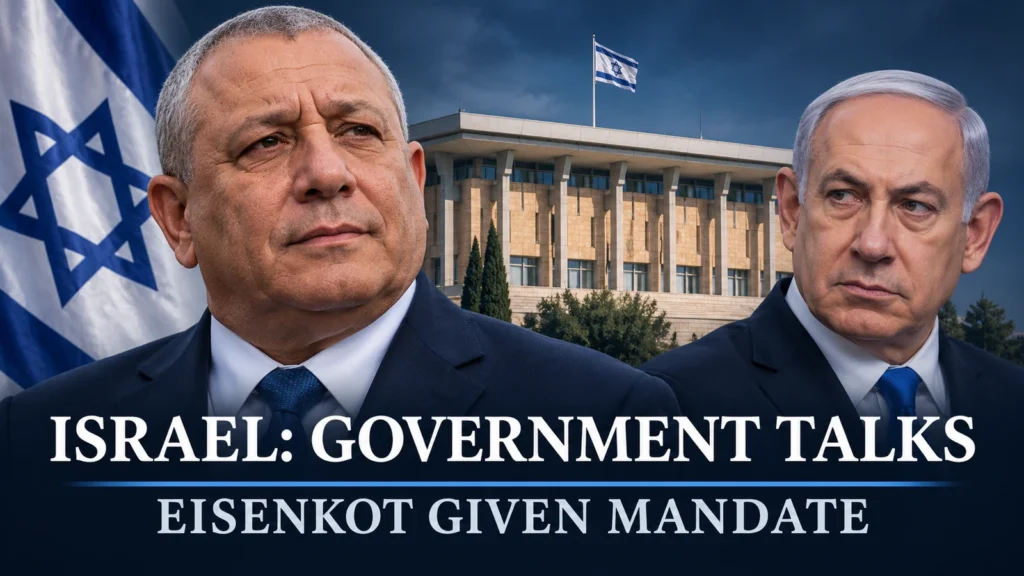
Israel’s President Isaac Herzog has formally given opposition leader Gadi Eisenkot the first opportunity to form a government after the 27 October election left both his alliance and Benjamin Netanyahu’s bloc without a parliamentary majority.
At a ceremony in Jerusalem on Sunday 8 November 2026, Herzog handed the Yashar party leader the mandate to begin negotiations. Eisenkot said he would seek a broad national emergency government, acknowledging that the process would require political compromises. The decision does not make him prime minister. Netanyahu remains in office while the attempt to form a new government proceeds.
Why Eisenkot was given the first chance
The answer lies in the difference between winning the most seats as an individual party and gaining enough support to form a coalition. Netanyahu’s Likud won 27 of the 120 Knesset seats, more than any other single party. Eisenkot’s centrist Yashar came second with 21.
But consultations with the president produced a different picture. The President’s Residence confirmed that parties representing 67 lawmakers recommended Eisenkot, compared with 46 recommending Netanyahu. The seven-seat United Torah Judaism faction nominated neither man.
Those recommendations gave Herzog grounds to choose Eisenkot. They are not binding agreements to join a coalition or vote for it in a confidence motion. Herzog himself warned of vetoes and disagreements both between and within the political blocs.
What the official Israeli election results show
The Knesset’s official results confirm the following distribution, using commonly reported political groupings rather than formal coalition memberships:
- Netanyahu-aligned parties: 53 seats. Likud 27, Otzma Yehudit 7, United Torah Judaism 7, Shas 6 and Religious Zionism–Zehut 6.
- Eisenkot’s four-party opposition grouping: 48 seats. Yashar 21, Naftali Bennett’s Be’Yahad 12, the Democrats 8 and Yisrael Beytenu 7.
- Two Arab-led parties: 19 seats. The Joint List 11 and Ra’am 8.
A majority in the Knesset requires 61 seats. Neither of the two main groupings reached that number. All four parties in Eisenkot’s bloc, along with the two Arab-led parties, recommended him to the president, making 67 in total. That is why a candidate whose own party finished second received the mandate.
Eisenkot’s difficult choices
The arithmetic offers several possible routes to government, but each runs into political disagreements.
Support from Arab-led parties: Ra’am and the Joint List together hold 19 seats. Both recommended Eisenkot, but members of his prospective governing alliance have rejected forming a coalition with Arab-led parties. A minority administration supported from outside, or a confidence vote helped by their votes or abstentions, could be discussed. Such an arrangement has not been secured.
The Associated Press reported that Ra’am has expressed a willingness to support him, while the Joint List has offered support from outside a coalition. It is important not to confuse those positions with a signed governing agreement.
A deal with ultra-Orthodox parties: Adding United Torah Judaism’s seven seats and Shas’s six to Eisenkot’s 48 would produce exactly 61. Yet the parties have historically supported Netanyahu, and disputes over exemptions from compulsory military service remain a significant obstacle. Opposition politician Avigdor Liberman has indicated some openness to working with ultra-Orthodox parties if military service requirements are addressed.
A broader unity arrangement: At Sunday’s ceremony Eisenkot invited members of Likud and the Religious Zionism party to support a government led by him if they accepted his principles. Netanyahu has also advocated a unity government of Zionist parties, but this is not an agreed power-sharing plan. It remains unclear which politicians would accept whose leadership.
What Eisenkot said when he received the mandate
Eisenkot, a former chief of the Israeli military, described the negotiations as exceptionally complex and called for a national emergency government. He set out principles including recognition of Israel as a Jewish and democratic state, the country’s founding declaration, wider national service and opposition to Hamas’s military and governing role in Gaza.
The approach could attract politicians from different parts of the Knesset, but it could also exclude parties whose positions differ on Israel’s national identity, military service and the Palestinians. Reuters reported that he wants to form a wide government quickly, while acknowledging that difficult compromises will be needed.
Where does this leave Netanyahu?
Netanyahu is still prime minister. The president’s choice changes which politician gets the first formal opportunity to build a government; it does not remove the existing administration. Likud remains the largest party and Netanyahu could still be invited to attempt forming a government if Eisenkot fails.
The newly elected Knesset is scheduled to be sworn in on Tuesday 10 November. The next political test will be whether the parties that recommended Eisenkot can cooperate when negotiations turn to ministerial appointments, military service, parliamentary confidence and the future of the outgoing government.
Election-fraud allegations have not overturned the result
Netanyahu has made unsubstantiated claims that Arab-led parties stole the election. Israeli authorities have been examining suspected electoral misconduct and possible interference, but the Central Elections Committee approved the official results and has not found irregularities that changed the outcome.
On 8 November, Attorney General Gali Baharav-Miara said she was not aware of evidence from the investigations capable of affecting the overall election result, according to The Times of Israel. That does not mean every possible inquiry is complete. It does mean that allegations should not be reported as proof that the election was stolen.
What this could mean for Gaza and the wider region
A change in leadership could affect Israel’s approach to Gaza, the occupied West Bank, relations with Lebanon and Iran, and its dealings with the United States and European governments. However, those consequences depend on who joins the coalition and which policies they agree to implement.
Eisenkot’s military background and stated security principles do not justify an assumption that a government under him would immediately end military operations, ease humanitarian restrictions or revive negotiations over Palestinian statehood. Palestinians and Israeli citizens alike have reasons to follow the coalition negotiations closely, but the mandate itself changes no policy on the ground.
How long does Eisenkot have to form a government?
Under Israel’s constitutional government-formation process, Eisenkot has 28 days from 8 November to assemble a government, making 6 December 2026 the initial deadline. Herzog may grant up to 14 extra days, potentially extending the effort to 20 December.
If he cannot obtain the required parliamentary confidence, the president can give another politician an opportunity to form a government. A further parliamentary nomination process can follow. Repeated failure could trigger another election in 2027, with Netanyahu continuing as caretaker until a replacement takes office.
For now, the central fact is straightforward: Eisenkot has been given the first chance, not the premiership. His task is to turn a numerical recommendation into an administration capable of governing.
Related coverage
Fish 4 News previously reported on the opposition leaders’ coalition negotiations following the election and on the first inconclusive exit polls on 27 October.
Video: Eisenkot receives mandate
A news video published on 8 November shows Eisenkot discussing Israel’s political situation after receiving the mandate. The video’s description should not be read as evidence that a governing coalition has secured a majority; that has not been established.
Sources
- Israeli presidency: formal decision and recommendations, 7 November 2026
- Knesset: final official results, 27 October 2026 election
- Presidency: constitutional government-formation timetable
- Reuters: Eisenkot’s handover and coalition challenges, 8 November
- Associated Press: ceremony, coalition scenarios and international context, 8 November
- The Times of Israel: attorney general’s comments on the investigations, 8 November
Featured photograph: Gadi Eisenkot, June 2026. Yahav Trudler / Gadi Eisenkot spokesperson, CC BY-SA 3.0, via Wikimedia Commons.