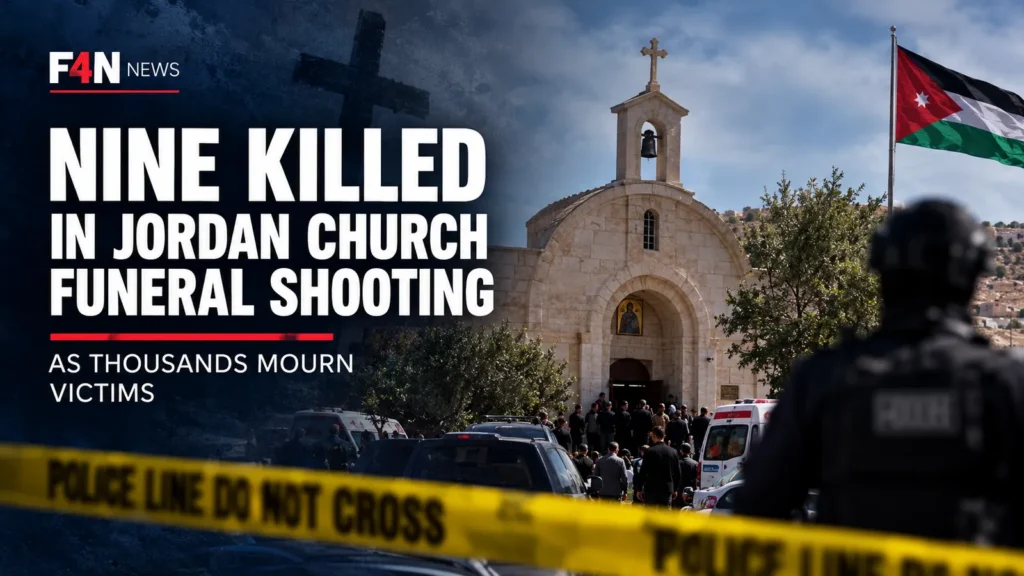
Nine people have been killed and dozens injured after gunmen opened fire on mourners attending a funeral at St George’s Greek Orthodox Church in Hamoud, southern Jordan. The attack on Friday, 23 October 2026, has prompted a nationwide security response, three days of mourning and a continuing manhunt for the perpetrators.
Gunmen opened fire during funeral service
The attack took place at St George’s Greek Orthodox Church in the village of Hamoud, in Jordan’s Karak governorate, southwest of the capital, Amman.
Witnesses described scenes of panic as gunmen opened fire while mourners were gathered at the church for a funeral.
Security camera footage broadcast by Jordanian state television appeared to show three armed men approaching the church from a nearby road, firing towards the building and moving towards its entrance.
Reuters independently verified the location shown in the footage by comparing identifiable features of the church and its surroundings.
Witnesses told Jordan’s state broadcaster, Al-Mamlaka, that the shooting continued for several minutes as people attempted to escape or take cover.
Emergency services and security forces were subsequently deployed to the scene, with ambulances transporting casualties to local hospitals.
Death toll rises from seven to nine
Initial reports on Friday said seven people had been killed, with dozens more injured.
However, Jordan’s Public Security Directorate confirmed on Saturday, 24 October, that the death toll had risen to nine after two people who had been seriously wounded died from their injuries.
The Jordan News Agency, Petra, reported nine deaths and 34 injured in its official update on Sunday.
Reuters has reported a higher figure of 40 people wounded, reflecting differences between published casualty totals.
Health officials said some of the injured required hospital treatment, with several initially reported to be in critical condition.
The rising death toll has intensified the shock surrounding an attack that targeted people attending a religious funeral.
Thousands gather to mourn victims
Thousands of Jordanians gathered in Hamoud on Sunday, 25 October, to pay their respects to those killed.
Eight of the nine victims were laid to rest beside the church where the attack occurred. According to reporting by AFP, the ninth victim, Mohammed al-Qasous, was expected to be buried on Monday.
Coffins draped in Jordanian flags were carried through the village as relatives, religious leaders, officials and members of the public attended the funeral ceremonies.
Prime Minister Jafar Hassan attended on behalf of King Abdullah II, alongside senior government and military representatives.
Crown Prince Al Hussein bin Abdullah II also attended and offered condolences to the victims’ families.
The Jordanian government declared three days of national mourning following the attack, ordering flags at government institutions and public buildings to be flown at half-mast.
The funerals brought together mourners from across Jordan in a public demonstration of solidarity with the victims and their families.
Survivor describes losing her cousin
Survivors have described the terror of being caught in the gunfire.
Speaking to Reuters, Sahar al-Halsa said she sheltered behind a pillar as shots rang out and people screamed.
When she emerged, she found her cousin Assem wounded outside the church.
She recalled calling his name and asking him to respond. He briefly opened his eyes before dying.
Reflecting on her own survival, she told Reuters:
My life starts now, because I was going to die.
Her account illustrates the personal devastation experienced by families who had gathered for one funeral, only to find themselves mourning further deaths.
King Abdullah orders security crackdown
Jordan’s King Abdullah II condemned the shooting and called for decisive action against those responsible.
During a National Security Council meeting on Saturday, the King instructed security authorities to respond with an “iron fist” and ensure the perpetrators were brought to justice.
According to a statement from the Royal Hashemite Court, the King stressed that the protection of Jordanian lives and national security must remain paramount.
He also directed authorities to review measures aimed at countering extremist ideology and preventing further attacks.
Security was subsequently strengthened at churches and other sensitive locations throughout Jordan.
Officials have urged the public not to spread rumours or unverified information that could inflame tensions or interfere with the investigation.
Who was responsible for the attack?
Jordanian Interior Minister Mazin Al Farrayeh described the shooting as an attack carried out by extremists.
However, authorities have not publicly established the identities or organisational affiliations of those responsible.
No organisation had claimed responsibility as of Sunday, 25 October, and security forces were continuing their search for the suspects.
Officials have said it remains too early to establish whether the perpetrators were connected to known extremist organisations operating inside or outside Jordan.
The motive for targeting the funeral has not been independently established.
Although Jordanian authorities have classified the shooting as terrorism, responsibility has not been attributed to a specific militant group.
Attack shocks Jordan’s Christian community
Jordan is a predominantly Muslim country with a longstanding Christian minority.
Christians account for approximately two to three per cent of the population, with the Karak region home to one of the country’s established Christian communities.
Jordan has generally maintained a relatively stable security environment despite regional conflicts and previous extremist threats.
Attacks targeting Christian places of worship are unusual, making the shooting at St George’s Church particularly significant.
The violence has prompted condemnation from political and religious figures who have emphasised the importance of protecting places of worship and preserving relations between Jordan’s religious communities.
The Greek Orthodox Patriarchate of Alexandria and All Africa also condemned the killings, expressing solidarity with the victims and their families.
Calls for unity following the attack
Despite the violence, religious leaders have urged the public to reject hatred and division.
Speaking before Sunday’s funerals, priest Yuhanna Hamati said the church wanted to send a message of peace and reassurance to people around the world.
Public expressions of solidarity have extended beyond Jordan’s Christian community, with representatives of different religious groups joining in mourning.
Jordanian officials have repeatedly stressed that the attack should not be allowed to undermine the country’s national unity.
As families bury their loved ones, the investigation remains ongoing.
Nine people are confirmed dead, dozens have been injured, and those responsible have yet to be publicly identified or brought to justice.
For the families in Hamoud, the immediate priority remains mourning those killed during what should have been a peaceful religious ceremony.
Sources
- Reuters: Survivor account and funerals, 25 October 2026
- Jordan News Agency (Petra): Official funeral ceremonies and casualty reports
- Royal Hashemite Court: Crown Prince attends the funeral
- Petra: Patriarchate of Alexandria condemns the attack
- Petra: Three days of national mourning
Watch: Footage from the Jordan church attack
The following News in 40 report, published on 23 October 2026, includes security camera footage and coverage of the initial incident.
Note: The video reports the original death toll of seven. Jordanian authorities subsequently confirmed nine deaths.