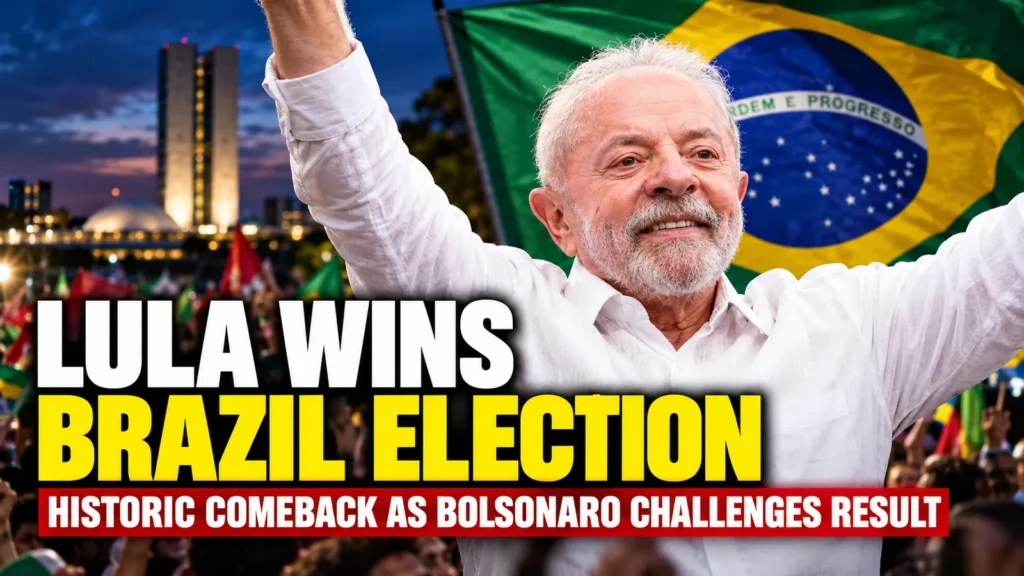
Brazilian President Luiz Inácio Lula da Silva has won a historic fourth term after defeating right-wing senator Flávio Bolsonaro in Sunday’s presidential election runoff on 25 October 2026. The 80-year-old Workers’ Party leader secured approximately 51.77% of valid votes against Bolsonaro’s 48.23%, overturning his opponent’s first-round advantage in an unprecedented electoral comeback. However, celebrations have been overshadowed by Bolsonaro’s announcement that he will seek to have the result annulled.
Lula Wins Brazil’s Presidential Election
Brazil’s electoral authorities confirmed Lula’s victory on Sunday evening, securing another four years in office for one of Latin America’s longest-serving political figures.
With approximately 99.9% of polling sections counted, the official figures showed:
| Candidate | Party | Vote share |
|---|---|---|
| Luiz Inácio Lula da Silva | Workers’ Party (PT) | 51.77% |
| Flávio Bolsonaro | Liberal Party (PL) | 48.23% |
At that stage, Lula had received approximately 64.2 million votes, compared with 59.8 million for Bolsonaro, a margin of roughly 4.4 million votes.
Lula’s running mate, Geraldo Alckmin, was also re-elected as vice-president.
The victory makes Lula the first person to win four presidential elections in Brazil’s democratic era. His new term will begin on 5 January 2027.
A Historic Election Comeback
Perhaps the most extraordinary aspect of Lula’s victory is that he entered the runoff trailing his opponent.
In the first round, held on 4 October, Flávio Bolsonaro secured 47.03% of valid votes, while Lula finished second with 45.16%.
That left Bolsonaro more than two million votes ahead, with just three weeks before the decisive second round.
Lula’s campaign subsequently intensified its mobilisation efforts, combining large public demonstrations with a substantial digital campaign intended to reach younger voters and undecided Brazilians.
The strategy coincided with a significant recovery in support.
For the first time since Brazil returned to civilian democratic rule in the 1980s, a presidential candidate who finished second in the opening round went on to win the runoff.
The reversal is particularly notable given Lula’s long political career and the widespread expectation of an exceptionally close result.
A former metalworker and trade union leader, Lula first became president in 2003 and served two consecutive terms until the end of 2010.
He returned to power in January 2023 after defeating Jair Bolsonaro in the 2022 presidential election.
His latest victory extends a political career that has already spanned several decades, multiple election campaigns and a period of imprisonment following corruption convictions that were subsequently annulled.
Flávio Bolsonaro Refuses to Concede
Although electoral authorities have declared Lula the winner, his opponent has challenged the circumstances surrounding the vote.
Flávio Bolsonaro, the 45-year-old senator and eldest son of former president Jair Bolsonaro, announced that he would seek to have the runoff election annulled.
According to Reuters, Bolsonaro described a judicial decision extending voting hours as “unacceptable”.
His objections relate principally to the extension of polling hours ordered during election day.
However, a declaration that a candidate intends to contest an election is not equivalent to a court finding that the result is invalid.
At the time of writing, the publicly declared election result remains Lula’s victory. No evidence has been established that would justify treating the official vote figures as overturned.
Any formal legal challenge will need to be assessed through Brazil’s judicial and electoral institutions.
Why Were Voting Hours Extended?
The controversy centres on an unusual decision by Supreme Court Justice Cristiano Zanin to extend voting by two hours at certain polling stations.
Voting had originally been scheduled to finish at 5pm local time.
Reports of transport difficulties, including disrupted bus services, and heavy rainfall prompted concerns that some voters would be unable to reach polling stations before closing.
Both presidential campaigns requested extensions in affected areas, although their requests were based on different circumstances.
The judicial decision created confusion because some polling stations had already closed and voting machines had been shut down before instructions reached election officials.
Electoral authorities subsequently clarified that the extension until 7pm applied to polling stations where voting had not yet concluded. It did not authorise reopening machines that had already been closed.
The confusion provides the context for Bolsonaro’s proposed legal challenge, but it does not itself demonstrate electoral fraud or establish that the declared winner is incorrect.
The circumstances of the extension and any subsequent legal proceedings are likely to remain under scrutiny.
What Does Lula’s Victory Mean for Brazil?
Lula’s re-election preserves the country’s existing left-of-centre presidency at a time of considerable economic and political division.
Throughout the campaign, he emphasised social welfare, workers’ rights, poverty reduction and the protection of Brazil’s national sovereignty.
His government has defended programmes intended to support lower-income households and has promoted policies addressing inequality and environmental protection.
Bolsonaro, by contrast, campaigned on public security, reductions in government spending and taxation, and closer political alignment with the United States.
The competing programmes reflected significant divisions among Brazilian voters over how the country should address inflation, living costs, crime and economic growth.
But winning the presidency does not guarantee Lula an easy path.
October’s congressional elections strengthened the right-wing Liberal Party and its allies, leaving the incoming president facing an increasingly conservative legislature.
That matters because significant spending proposals, legislative reforms and constitutional changes require support from Congress.
Lula may therefore face difficult negotiations with opposition parties and centrist lawmakers, even after securing a renewed presidential mandate.
Why the Result Matters for Donald Trump and the United States
The election also has consequences far beyond Brazil.
US President Donald Trump has sought to expand American influence throughout Latin America, while several governments in the region have moved towards closer relationships with Washington.
Flávio Bolsonaro presented himself as a candidate more closely aligned with Trump’s administration.
Lula, meanwhile, has repeatedly defended Brazil’s right to determine its own foreign policy and economic relationships.
The relationship between Brazil and the United States has become increasingly important amid disputes involving tariffs, trade, industrial policy and access to strategically valuable minerals.
Brazil also maintains substantial economic ties with China, presenting both opportunities and diplomatic challenges.
Lula’s re-election means the country is expected to continue pursuing a comparatively independent diplomatic course rather than automatically aligning with Washington.
However, the election result does not resolve existing trade disagreements, and relations between the two governments will continue to depend on negotiations and future policy decisions.
Brazil Remains Deeply Divided
Despite the scale of Lula’s political comeback, the final figures demonstrate how divided the electorate remains.
More than 48% of valid votes went to Flávio Bolsonaro, confirming that the political movement associated with his father continues to command substantial public support.
The result also demonstrates that support for the Brazilian right extends beyond Jair Bolsonaro himself.
The former president is serving a prison sentence following his conviction in connection with an attempt to overturn the outcome of the 2022 election.
His son has sought to consolidate that political support while broadening the Liberal Party’s appeal.
For Lula, the challenge is now to govern a country in which tens of millions of citizens voted against him, while negotiating with a Congress containing a powerful opposition bloc.
Brazil’s political divisions are unlikely to disappear simply because the presidential result has been declared.
What Happens Next?
Lula is due to begin his fourth presidential term on 5 January 2027.
Before then, attention will focus on whether Bolsonaro proceeds with a formal challenge to the election result and how Brazil’s courts respond.
Other significant developments to watch include the formation of the incoming Congress, Lula’s proposed economic programme and the reaction of international governments.
For now, the confirmed result represents an extraordinary achievement for a president who entered the runoff behind his opponent and emerged with a renewed mandate.
But the controversy surrounding the final hours of voting, together with Brazil’s closely divided electorate and conservative legislature, means Lula’s fourth presidency will begin under considerable political pressure.
The election is over. The contest over Brazil’s political direction is not.
Sources
- São Paulo Regional Electoral Court: official result
- Brazilian Senate: Lula’s fourth mandate and runoff figures
- Reuters: Bolsonaro refuses to concede and plans challenge
- Associated Press: election result and context
Watch: Lula Wins Brazil’s Presidential Election
Al Jazeera English’s breaking-news coverage of the election result and Lula’s victory.