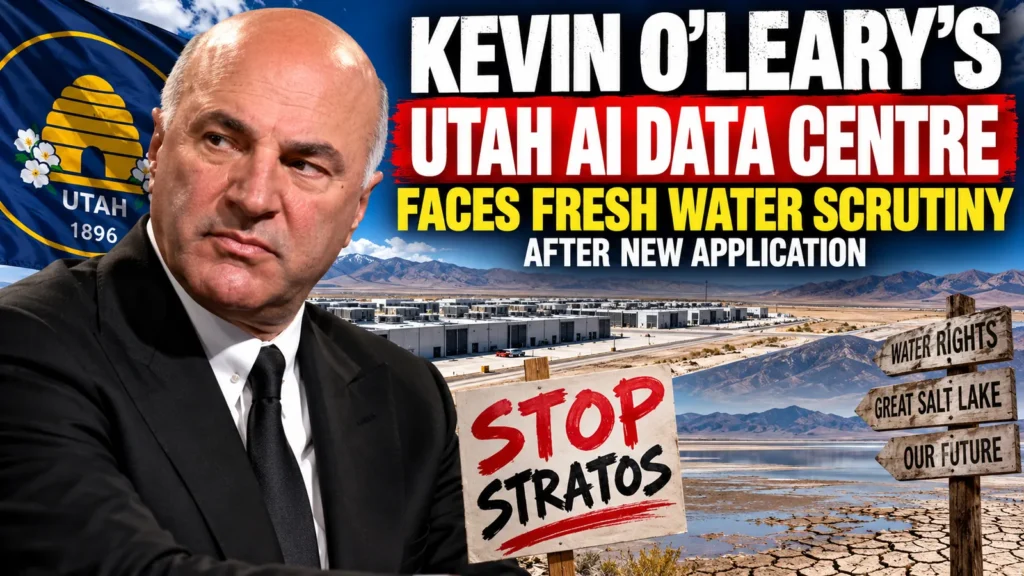
The Shark Tank investor’s proposed Stratos AI development has triggered renewed environmental concerns after a water-rights filing revealed plans for a vast data centre campus and a 7.5-gigawatt power generation facility.
A company associated with businessman and Shark Tank investor Kevin O’Leary has submitted a fresh water-rights application for the proposed Stratos AI data centre in Box Elder County, Utah. Filed on 15 October 2026, the application concerns a water right listed at 1,712 acre-feet — equivalent to approximately 558 million US gallons — and reveals plans for 11 data centre clusters supported by power generation facilities totalling 7.5 gigawatts. Environmental campaigners question whether the project can achieve the efficiency claimed by its developers.
What does the new water application reveal?
The change application was filed with the Utah Division of Water Rights on 15 October. It concerns shifting water use associated with existing agricultural operations to the proposed technology development in Hansel Valley.
The state lists the filing as a55167, linked to water right 13-2 and the Salt Wells Spring Stream. Its listed volume is 1,712 acre-feet, or approximately 558 million US gallons. This is a quantity associated with the requested water-rights change, not proof of the facility’s annual consumption after construction. The official application list names Bar H Ranch, Inc. in connection with the right; KSL reports the development-related change filing was made by O’Leary Digital Utah DC Sub I, LLC.
The October application has been filed, not approved. Utah’s public tracking system lists a protest letter, but as checked on 17 October it did not yet display an advertised date or a closing date for the new protest period.
According to documents examined by Utah broadcaster KSL, the proposal includes:
- Eleven clusters of data centre buildings.
- Fifteen natural-gas generation blocks rated at 500 megawatts each.
- A proposed total generating capacity of 7.5 gigawatts.
- A staffing estimate of 4,850 people across the proposed campus and generation facilities.
- A water recycling configuration described as 90% recovery and 10% fresh-water replacement.
The figures describe the project as proposed in its supporting assessments; they are not evidence that the facilities have been constructed or are operating.
Developers claim the project could conserve water
O’Leary Digital maintains that the proposed infrastructure would use less water than agricultural activity historically associated with the land. The application includes an engineering water-balance report by Beairsto & Associates and a hydrological assessment by Loughlin Water Associates.
The developers argue that their water-management configuration could reduce losses and potentially allow more water to reach the Great Salt Lake. Those are projected outcomes, not independently verified operational results.
Environmental expert challenges the figures
Ben Abbott, an ecologist and executive director of the environmental organisation Grow the Flow, has questioned whether the proposed power facilities could generate electricity on that scale using the water quantities described.
Speaking to KSL, Abbott said the implied water-to-power efficiency appeared substantially better than that of leading existing facilities, and questioned whether the engineering assumptions are realistic.
KSL reported that representatives of O’Leary’s development team had not immediately responded to its request for comment on his criticism.
Why the Great Salt Lake matters
The Great Salt Lake has undergone substantial water-level declines, exposing large areas of lakebed. Scientists and environmental authorities have expressed concern about dust from exposed sediments, including material containing potentially harmful metals such as arsenic.
That does not establish that the Stratos development has caused contamination or that its proposed water use will necessarily worsen dust pollution. The issue under scrutiny is how the development might affect regional water use, flows and environmental conditions.
Political controversy over the development
Utah Senate President J. Stuart Adams sought changes to the original plans in June 2026. In an official statement, the Utah Senate said O’Leary had agreed to commitments including a 75% reduction in the effective proposed project area, additional protection for open space and a commitment relating to water for the Great Salt Lake.
The Senate also stressed that the project would still have to undergo permitting and environmental review. Political support and agreements concerning land use do not constitute approval of the new water-rights application.
Box Elder County approved consent for the Military Installation Development Authority (MIDA) to create the Stratos project area in May, after collecting extensive public comment. County officials have described the action as the beginning, rather than the end, of oversight.
How can people formally object to the water application?
Residents and other interested parties who wish to challenge the water-rights change can use the Utah Division of Water Rights’ official protest process. The correct reference is change application a55167, associated with water right 13-2.
- Check the application and the advertised protest deadline in the official Change Application Tracker. As of 17 October, the tracker did not display a closing date for a55167. The Division told KSL that the filing will be publicly advertised and that a protest period will follow.
- Use the state’s online Protest of Application form. Enter a55167 to identify the filing, then provide the information requested by the state.
- Explain the specific grounds for objection and cite supporting evidence. Questions directly relating to water availability, existing water rights and the feasibility of the proposed change are particularly relevant to the State Engineer’s water-rights assessment. A request for a hearing can be included where appropriate.
- The official online process requires a non-refundable $15 protest filing fee and contact details including name, address, telephone number and email.
- Retain the payment receipt and protest letter. The state warns that a submission made after the formal protest period will be treated as a late protest.
A general objection to data centres or to Kevin O’Leary personally is not a substitute for evidence relevant to the particular water-rights decision. Other concerns, such as air emissions or wider land-use effects, may fall within separate planning and environmental permitting processes.
Other ways to take part in public scrutiny
The Box Elder County Stratos information page offers a public questions and feedback form, along with project documents, announcements and contact details. That is a route for raising concerns with county officials, but it is not the same as filing a formal protest with the Division of Water Rights.
People can also review meetings and decisions by the relevant local and state authorities, seek further documents through public-records procedures, and follow future public notices for any environmental permits. Participation rules and comment windows depend on the specific authority and decision.
For readers interested in organised opposition, Stop Stratos, run by Box Elder Accountability Referendum (B.E.A.R.), publishes information about its local campaign, public meetings and volunteering. It is an advocacy organisation opposed to the development, not a government regulator or official water-rights filing channel.
Project proponents argue that the development could bring investment, employment, new energy infrastructure and improvements in water efficiency. Those benefits, like the environmental objections, remain matters for evidence, assessment and public scrutiny.
What happens next?
The state must assess the water-rights change through its established process. The decisive questions include whether the requested change can legally be granted, whether its technical assumptions are supportable and what it would mean for other water users. Separate approvals may also be required for other aspects of the overall development.
The immediate development is the new application — not its approval. The next important date for potential objectors will be the official deadline when the state advertises this particular filing.
Sources and official information
- Utah Division of Water Rights – new applications, including a55167
- Utah Division of Water Rights – change application tracker
- Utah Division of Water Rights – online protest form and fee
- KSL – 16 October investigation
- Utah Senate – June statement on project changes
- Box Elder County – project documents and public feedback
- Utah Department of Environmental Quality – Great Salt Lake dust information
Watch: Caroline Gleich discusses the Stratos water application
Environmental campaigner Caroline Gleich discusses the new application and her concerns about the Great Salt Lake in the following video. This is commentary; claims should be checked against the application and other primary records.