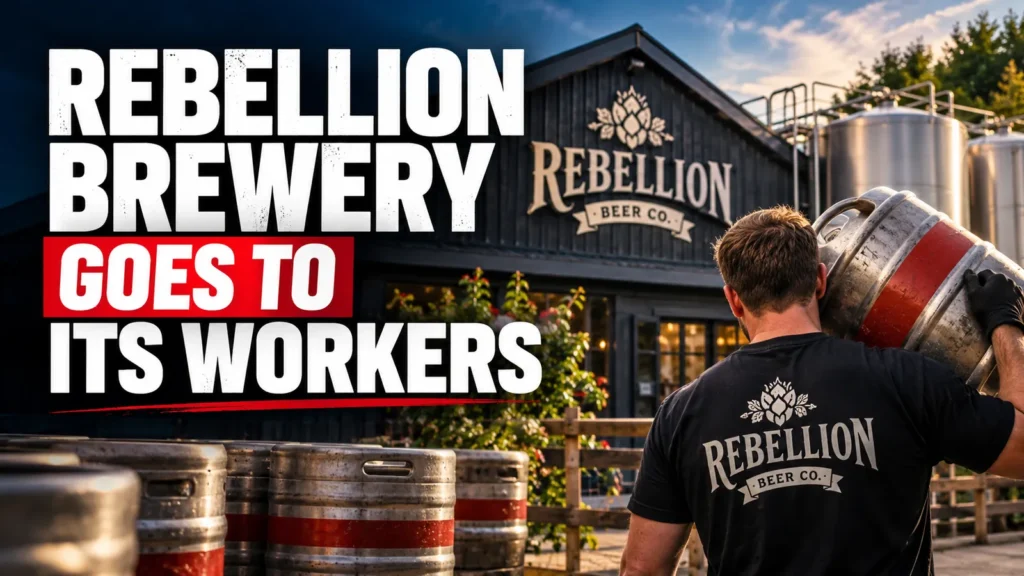
A British brewery founded more than three decades ago has transferred ownership to a trust benefiting its employees, aiming to protect more than 75 jobs and keep the business independent. Rebellion Beer Company, based in Marlow Bottom, Buckinghamshire, has moved into employee ownership as its founders prepare to hand over day-to-day control to the people who helped build the business.
The move comes at a difficult time for the British brewing industry, with other established breweries facing closure and hundreds of jobs under threat.
Founders Tim Coombes and Mark Gloyens, who established Rebellion in 1993, completed the transfer to an Employee Ownership Trust (EOT) on 13 October 2026. The company publicly announced the change the following day.
Both founders will remain involved over the coming years while an experienced management team drawn from existing employees gradually assumes greater responsibility.
The objective is to preserve the brewery’s independence, maintain local employment and secure its future at Bencombe Farm in Marlow Bottom.
A Different Direction for British Brewing
Rebellion’s decision contrasts sharply with developments elsewhere in the industry.
In September, Molson Coors confirmed that Sharp’s Brewery in Rock, Cornwall, would close in December 2026, with up to 40 jobs being lost. Production of brands associated with the site, including Doom Bar, is being moved elsewhere.
Meanwhile, Carlsberg Britvic announced on 8 October that it was proposing to close the historic Marston’s Brewery in Burton upon Trent, together with its main associated logistics operation, in summer 2027.
The Marston’s proposal remains subject to consultation.
Carlsberg Britvic cited declining demand for traditional cask ale as one factor behind its decision, saying UK cask ale volumes had more than halved in less than a decade.
Against that backdrop, Rebellion’s founders have chosen an ownership structure intended to keep the brewery operating independently rather than sell the business to an external corporate buyer.
However, employee ownership is not a guarantee against future financial difficulties or job losses.
What Does Employee Ownership Actually Mean?
An Employee Ownership Trust holds a controlling interest in a business for the benefit of its employees.
Rather than individual staff members automatically receiving personal shareholdings, the trust holds shares collectively for their benefit.
For Rebellion, the arrangement is intended to give its workforce a long-term stake in the business’s success while protecting the brewery’s identity and independence.
The company says employees will eventually benefit from distributions of available profits.
But those distributions are not immediate or guaranteed. They depend on the company’s financial position and the arrangements governing the trust.
Rebellion also intends to continue trading normally, with its existing staff, brewery shop, Tap Yard and brewing operations remaining in place.
A Brewery With Deep Local Roots
Rebellion was established in 1993 by friends Tim Coombes and Mark Gloyens, helping revive Marlow’s brewing heritage following the closure of the historic Wethered Brewery in 1987.
The business moved to Bencombe Farm in 1999 and subsequently expanded its brewing capacity, retail operations and local distribution.
According to its published history, by 2025 Rebellion was supplying more than 200 pubs within a 30-mile radius.
Its activities now extend beyond brewing to an on-site shop, drive-through service and the Tap Yard, which opened in 2021.
The brewery has also invested in environmental measures, including a borehole drawing water from the Chiltern Hills, reducing its reliance on mains water.
Crowdfunding Planned for Spring 2027
Employee ownership is only one part of Rebellion’s plans.
The company is preparing a community crowdfunding campaign for spring 2027, offering supporters an opportunity to invest in its future.
According to the brewery, the proposed investment programme could include additional fermentation and conditioning tanks, carbon-capture technology, solar panels, battery storage and further improvements to the Tap Yard.
It also plans to use some of the money raised to reduce outstanding debt owed to the founders as part of the ownership transition.
That could bring forward the point at which employees begin receiving profit distributions.
This is an important detail. Although ownership has transferred to a trust benefiting staff, the financial obligations associated with the transaction have not necessarily disappeared.
The full terms of the planned crowdfunding campaign, including how investments will be structured and the risks involved, have yet to be announced.
The brewery says registering interest does not commit anyone to investing.
Could Employee Ownership Offer an Alternative?
Rebellion’s decision raises a wider question about the future of independent British businesses.
When founders approach retirement or decide to step back, selling to a competitor or a larger corporate group is one possible route.
Employee ownership provides another.
In principle, it can preserve a company’s identity, reward employees for their contribution and keep decision-making closer to the business and its community.
But the structure is not a universal solution. Employee-owned companies still face the same pressures as other businesses, including rising costs, changing customer demand, competition and the need to remain profitable.
For Rebellion, the immediate significance is that an established independent brewery has chosen a route designed to preserve its local roots, with its existing workforce taking an increasingly important role in running the business.
Whether that approach delivers lasting security will depend on its performance in the years ahead.
For now, at a time when several historic British breweries face an uncertain future, Rebellion has offered a different example of what a change of ownership can look like.
Further information: Readers can find details of the ownership transfer and register their interest in the proposed 2027 crowdfunding campaign through Rebellion Beer Company’s official website.
Sources
Rebellion Beer Company | Society of Independent Brewers and Associates | ITV News – Sharp’s closure | Carlsberg Britvic – Marston’s proposal