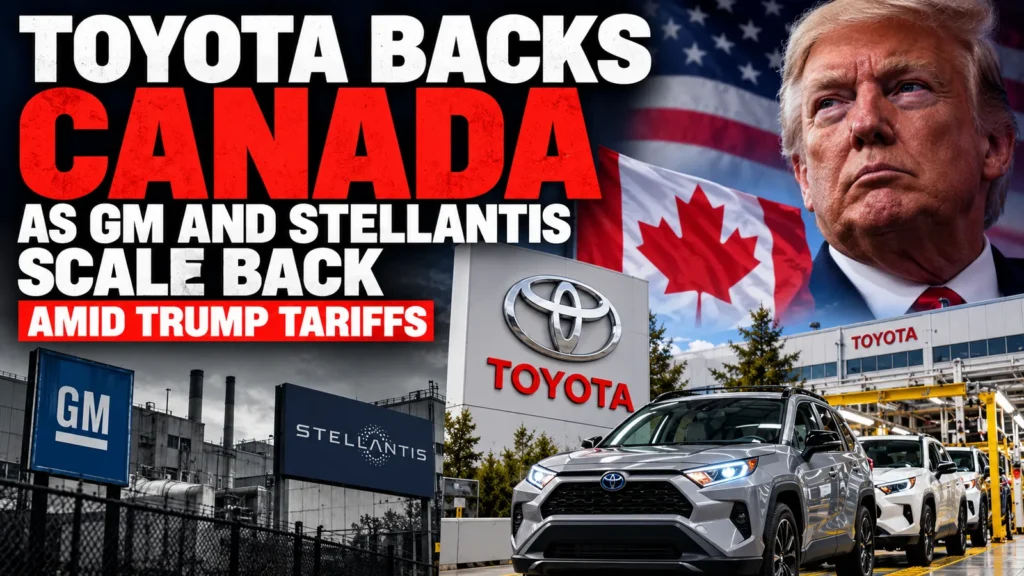
Japanese automotive giant Toyota is maintaining its manufacturing commitment in Ontario, Canada, following a C$1.1 billion investment in its operations, even as American manufacturers General Motors and Stellantis scale back production. The contrasting decisions come amid escalating trade tensions between Washington and Ottawa, raising questions about the future of North America’s integrated automotive industry.
Toyota strengthens its Canadian manufacturing position
Toyota assembled 537,518 vehicles at its Ontario facilities in 2025, making it Canada’s largest vehicle manufacturer by production volume. The company also sold 249,445 Toyota and Lexus vehicles in Canada during 2025, up 4.4% in a market that grew approximately 2.1%. Its Cambridge and Woodstock operations remain central to its North American strategy.
In January 2026, Toyota confirmed a C$1.1 billion investment associated with production of the sixth-generation RAV4 in Ontario. That investment was announced earlier in the year, not in October. Reporting on 16 October instead highlighted Toyota’s continued Canadian manufacturing commitment despite uncertainty surrounding American trade policy.
Toyota is also preparing to introduce an updated hybrid Lexus NX at Cambridge in December 2026. Its Canadian facilities have continued operating two shifts alongside regular overtime.
American manufacturers take a different approach
Toyota’s position contrasts with changes involving several Detroit manufacturers. General Motors has reduced Canadian production, while Stellantis has abandoned its previously announced vehicle production plans for Brampton, Ontario.
Ford has also revised its Canadian strategy, including changes at Oakville. These decisions are not identical: Ford’s plans include a shift towards heavy-duty trucks rather than a complete withdrawal from Canada.
The industry has developed around decades of cross-border trade. Vehicle components can cross the Canada–US border several times before a finished car reaches a dealership, meaning tariffs at different stages can increase manufacturing costs.
Ottawa responds to production cuts
In October 2025, Canada announced a 24.2% reduction in General Motors’ tariff-free vehicle import quota and a 50% reduction for Stellantis, responding to changes in their Canadian manufacturing commitments.
The measures illustrated Ottawa’s willingness to use trade policy to defend domestic production and employment. They also added uncertainty for manufacturers deciding where to build vehicles, allocate investment and source components.
The 85% figure that exposes Toyota’s vulnerability
Approximately 85% of vehicles produced at Toyota’s Cambridge manufacturing complex are exported, predominantly to the United States. This leaves the company exposed to changes in American import policy.
President Donald Trump has threatened tariffs of up to 50% on Canadian-built vehicles from January 2027 if the countries fail to reach an agreement. A threatened tariff is not an implemented policy, and its eventual scope and application remain uncertain.
Toyota’s continued commitment is therefore a commercial calculation, not evidence that its operations are insulated from trade tensions.
Why Toyota’s strategy matters
Moving automotive production across borders is neither quick nor inexpensive. Factories require substantial investment in equipment, specialist workers, supplier networks and production systems.
Manufacturers must consider whether tariffs will remain in place long enough to justify relocating established operations. Maintaining its existing Ontario facilities may make more commercial sense for Toyota than moving production in response to policies that could change.
That does not mean Toyota has committed to unlimited future investment. Demand, costs and trade negotiations will determine the longer-term outlook.
Canada faces a wider automotive challenge
Canadian vehicle production fell from approximately three million vehicles annually in 2000 to around 1.3 million in 2024. The automotive sector nevertheless supports approximately 125,000 direct jobs and many more across associated industries.
Decisions by Toyota, General Motors, Stellantis and Ford affect component suppliers, transport businesses and communities dependent on vehicle manufacturing. Competition from Chinese manufacturers, particularly in electric vehicles, adds another challenge.
A test of Trump’s tariff strategy
The Trump administration presents tariffs as a way to encourage investment in American production and protect domestic jobs. Supporters argue they can strengthen the US manufacturing base, while critics warn they can raise costs, disrupt supply chains and discourage investment.
Toyota’s Canadian operations show why the outcome is not straightforward. Some manufacturers are reducing Canadian activities, while Toyota continues to operate major facilities heavily dependent on American buyers.
The bigger question is whether Canada and the United States can preserve an integrated manufacturing industry while pursuing increasingly conflicting trade policies.
Watch: Toyota’s Canadian investment and the Detroit manufacturing divide
The following Canada Next video examines Toyota’s Ontario operations and the wider implications of US–Canada trade tensions. It is commentary rather than independent confirmation of every claim.
Watch the video directly on YouTube
Sources and further reading
- Toyota Motor Manufacturing Canada – manufacturing announcements
- Toyota Canada – 2025 vehicle sales results
- Government of Canada – automotive import quota measures
- Bloomberg – reporting on Toyota’s Canadian operations, 16 October 2026