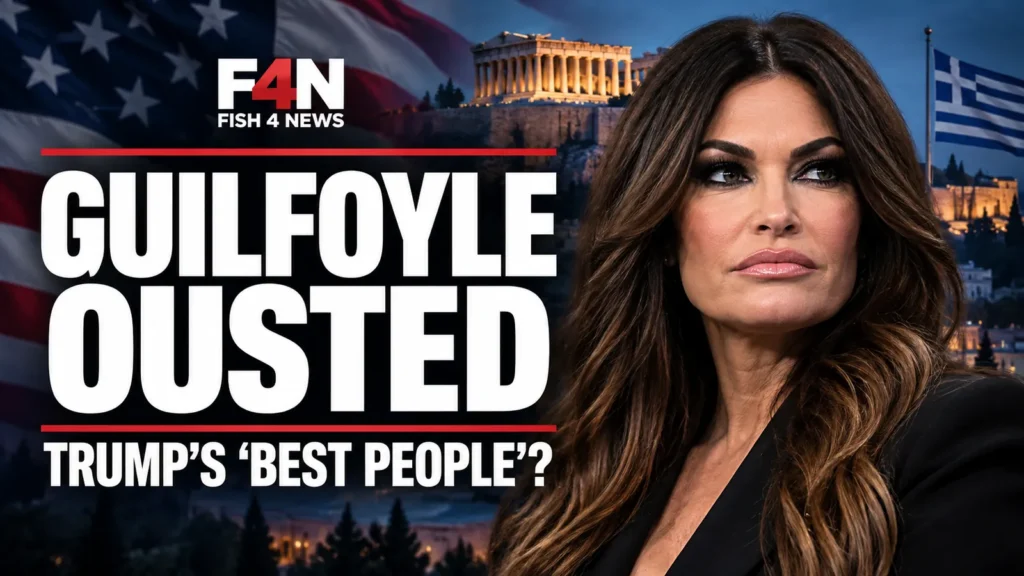
From a disputed $100,000 credit card request and allegations of influence-peddling to a multimillion-dollar Fox News settlement and controversial January 6 fundraising, Kimberly Guilfoyle’s departure from Greece raises questions about Donald Trump’s judgement and his choice of political appointees.
Donald Trump has forced Kimberly Guilfoyle to step down as US ambassador to Greece following allegations of financial misconduct and the misuse of political influence. But the disputed $100,000 credit card request that helped bring about her departure is only the latest controversy involving the former Fox News presenter and ex-fiancée of Donald Trump Jr. Her record includes allegations of diplomatic impropriety, a $60,000 payment for a brief speech before the January 6 Capitol attack and a reported multimillion-dollar Fox News sexual harassment settlement.
13 October 2026: Trump removes his former future daughter-in-law
Kimberly Guilfoyle’s diplomatic career came to an abrupt end on Tuesday when the White House confirmed that President Donald Trump had requested her resignation as US ambassador to Greece.
New White House press secretary Katie Zacharia announced the decision, thanking Guilfoyle for her service.
Trump subsequently told reporters:
“She was doing a good job, but we didn’t like what we were reading.”
The comments followed weeks of damaging reports about Guilfoyle’s conduct, including allegations that she sought personal financial assistance in return for access to senior Trump administration officials.
The former ambassador denied the allegations and confirmed she would leave her position.
In a statement published on X, Guilfoyle insisted the accusations were false and said she intended to defend her reputation. She also reaffirmed her loyalty to Trump and the America First movement.
Her departure follows reporting by Reuters and CBS News about growing dissatisfaction within the administration.
For a president who has repeatedly promised to surround himself with exceptional people, the episode presents an awkward question.
How did an appointee Trump personally praised as supremely qualified become such a political liability?
October 2026: Luxury jets, wealthy benefactors and questions over diplomatic ethics
Days before her resignation, The Wall Street Journal reported further allegations concerning Guilfoyle’s relationships with wealthy Greek businessmen.
According to the newspaper, recordings from January 2026 captured Guilfoyle discussing private jet travel and luxury accommodation reportedly paid for by prominent business figures.
The men identified in the reporting included Alexandros Exarchou, a leading figure at Greek energy and construction business Aktor Group, and shipping businessman Nikolas Tsakos.
The concern was not simply that an ambassador had socialised with wealthy individuals.
It was whether she had accepted benefits from people with commercial interests potentially affected by American diplomatic decisions.
The reporting also raised questions about her attempts to gain access to a World Economic Forum dinner in Davos honouring Eric Trump.
The Wall Street Journal’s investigation contributed to scrutiny of whether private commercial relationships had become entangled with official US diplomacy.
The State Department’s Office of Inspector General has reportedly begun investigating Guilfoyle’s conduct, including allegations involving gifts and staff complaints.
Guilfoyle and her representatives deny wrongdoing.
No public criminal conviction or finding of corruption has been established against her in connection with these allegations.
October 2026: The disputed $100,000 American Express request
Perhaps the most immediately damaging revelation involved Republican donor and businessman Eric Deters.
In early October, The Wall Street Journal published details of messages purportedly exchanged between Guilfoyle and Deters in July 2025, before she received Senate confirmation.
The messages appeared to show Guilfoyle asking Deters to transfer $100,000 directly to her American Express account.
According to Deters, the proposed arrangement was designed to prevent the money appearing in her financial disclosures.
Deters has alleged that Guilfoyle offered to use her political connections to assist him with matters involving senior administration officials, including the Department of Justice and the Internal Revenue Service.
He characterised the arrangement as an attempt to exchange financial assistance for political favours.
Deters has said he did not make the $100,000 payment, although he claims to have previously paid Guilfoyle substantial sums.
Guilfoyle’s lawyer disputed the authenticity of the messages and maintained that any money sought related to legitimate compensation for earlier speaking engagements or appearances.
CBS News reported that White House officials had been told the messages were authentic, but the competing accounts have not been resolved through a public court finding.
The distinction matters.
The allegations suggest possible influence-peddling. They do not, by themselves, establish that Guilfoyle accepted a corrupt payment or committed a criminal offence.
Nevertheless, the political damage was substantial.
By 12 October, Trump was openly considering her removal. The following day, the White House acted.
October 2026: Allegations of mistreating embassy staff
Separate reports raised questions about Guilfoyle’s management of the American embassy in Athens.
The Daily Mail reported complaints involving allegedly aggressive behaviour towards staff, threats of dismissal and demands associated with the ambassador’s personal lifestyle.
Some claims included the alleged punishment of staff members over relatively minor incidents.
Reuters subsequently reported that the State Department’s internal watchdog was looking into complaints from embassy personnel.
These allegations have not been established by a published official finding, and the more sensational individual accounts remain disputed.
However, they added another dimension to the concerns surrounding Guilfoyle: whether someone appointed to represent the United States was maintaining appropriate professional standards inside the embassy itself.
September to October 2026: A Greek energy company and a lobbyist with unusual access
Guilfoyle’s diplomatic conduct had already attracted scrutiny before the credit card allegations became public.
A September investigation by The Wall Street Journal examined her promotion of energy projects involving Aktor Group.
American energy exports were a legitimate part of US policy in southeastern Europe. However, the newspaper questioned the unusual access apparently enjoyed by Christos Marafatsos, a registered lobbyist working for Aktor.
Marafatsos reportedly attended meetings involving Guilfoyle and senior foreign officials, sometimes without participants understanding that he was representing private commercial interests.
According to information later cited by US lawmakers, Aktor paid Marafatsos $160,000 through June 2026 for lobbying activities involving American government institutions.
On 1 October, Democratic Congressman Gregory Meeks, the ranking member of the House Foreign Affairs Committee, formally requested answers from Secretary of State Marco Rubio.
Meeks questioned whether Guilfoyle had used her position to advance private business interests and called for her removal if the allegations proved accurate.
The distinction is important: promoting US energy exports is ordinary diplomacy. Providing a private lobbyist with inappropriate access or favouring a particular company for personal reasons would raise a different set of ethical concerns.
Neither improper financial benefit nor corruption has been established by the publicly reported evidence.
March 2026: Did Guilfoyle threaten Greece’s government?
Another allegation reported in September concerned remarks Guilfoyle allegedly made during a dinner involving American and Greek officials in March.
According to The Wall Street Journal, Guilfoyle referred to political developments in Romania and suggested that the United States could influence similar political change in Greece.
The reported remarks generated concern about the sovereignty of an American NATO ally.
Congressman Meeks cited the allegation in his October letter, asking whether the ambassador had suggested that American influence could be used to undermine Greece’s democratically elected government.
Guilfoyle disputed the account.
There is no established evidence from this episode that the United States orchestrated Romania’s political upheaval or attempted to remove Greece’s government.
Even so, the alleged comments were sufficiently serious to prompt formal congressional questions about American diplomacy.
November 2025: A diplomatic confrontation over China’s Greek port interests
Shortly after taking up her post in Athens, Guilfoyle publicly suggested that China should sell its controlling stake in the Greek port of Piraeus.
The Chinese state-owned company COSCO holds a majority interest in the port, making it a strategically significant commercial asset.
Guilfoyle’s intervention reflected Washington’s concerns over Chinese influence in important European infrastructure.
China’s ambassador to Greece criticised the remarks, accusing the United States of adopting a hegemonic approach.
Unlike the allegations involving personal financial benefit, this was a dispute over official foreign policy.
Nevertheless, it illustrated how rapidly Guilfoyle’s high-profile diplomatic approach generated controversy.
December 2024 to September 2025: Trump appoints his son’s former fiancée
The origins of Guilfoyle’s ambassadorship are especially revealing.
On 10 December 2024, Trump announced that Guilfoyle would be his choice for US ambassador to Greece.
He described her as a close friend and political ally, praising her experience in law, media and politics.
Most notably, Trump declared her “supremely qualified” for the position.
The announcement coincided with public reporting that Guilfoyle’s engagement to Donald Trump Jr. had ended.
Trump Jr. had begun a relationship with socialite Bettina Anderson.
The timing prompted speculation that the diplomatic nomination might provide Guilfoyle with a prestigious role away from the immediate Trump family circle.
There is no established evidence that the appointment was made as compensation for the breakup.
Guilfoyle was subsequently confirmed by the US Senate on 18 September 2025 and took up the position in Athens that November.
She became the first woman to serve as US ambassador to Greece.
Her tenure would last less than a year.
June 2022: $60,000 for a speech lasting less than three minutes
Years before becoming an ambassador, Guilfoyle attracted scrutiny over a payment connected to the rally preceding the 6 January 2021 attack on the US Capitol.
During the House January 6 investigation, Democratic Representative Zoe Lofgren discussed evidence that Guilfoyle had received $60,000 for her brief rally appearance.
The speech, which introduced Donald Trump Jr., lasted less than three minutes.
The Washington Post subsequently reported that the money was channelled through Turning Point Action, a conservative organisation then associated with Charlie Kirk.
The reported funding was linked to Julie Jenkins Fancelli, an heiress to the Publix supermarket fortune.
At approximately two-and-a-half to three minutes, Guilfoyle’s speaking fee amounted to roughly $20,000 or more per minute.
Lofgren described the payment as a grift while explicitly stopping short of alleging that it was a crime.
The larger concern was how political donations were being used while Trump and his allies promoted claims that the 2020 presidential election had been stolen.
The payment was reported, but it was not established to be illegal.
March 2022: The January 6 committee subpoenas Guilfoyle
Guilfoyle’s involvement with the January 6 rally also brought her into contact with the congressional committee investigating the Capitol attack.
In February 2022, she participated in a voluntary interview by video conference.
The meeting ended prematurely after Guilfoyle and her lawyers objected to the presence of committee members.
Her lawyer argued that the meeting arrangements had violated an understanding about who would participate and raised concerns about confidentiality.
On 3 March, the committee issued a subpoena requiring her cooperation.
Committee chairman Bennie Thompson said the subpoena followed her withdrawal from the voluntary interview.
The subpoena was part of a congressional investigation, not a criminal charge against Guilfoyle.
January to November 2021: Claims of raising $3 million for the January 6 rally
Guilfoyle’s connections to January 6 extended beyond her paid appearance.
In November 2021, investigative newsroom ProPublica published messages in which Guilfoyle appeared to boast that she had helped raise $3 million for the rally that preceded the Capitol attack.
The messages, reportedly sent on 4 January 2021 to rally organiser Katrina Pierson, included references to wealthy donor Julie Jenkins Fancelli.
ProPublica also reported discussions about proposed rally speakers, including controversial far-right political figures.
Guilfoyle’s lawyer denied that she had been responsible for fundraising or approving speakers and disputed the interpretation of the messages.
ProPublica could not independently establish precisely how much money had been raised or how all of it had been spent.
The reporting nevertheless raised important questions about the extent of involvement by Trump’s inner circle in financing and organising the rally.
The subsequent assault on the Capitol was an attack on the constitutional process of certifying the presidential election.
That does not mean Guilfoyle personally planned, encouraged or participated in the violence. Such a claim has not been established by the evidence described here.
August 2020: False claims at the Republican National Convention
During the 2020 presidential election campaign, Guilfoyle became one of Trump’s most prominent political supporters.
She served as a senior campaign fundraiser and delivered a highly charged speech at the Republican National Convention.
Among her claims was that Joe Biden, Kamala Harris and their political allies wanted open borders.
Independent fact-checking organisation FactCheck.org found that characterisation false.
Biden supported changes to immigration policy, including pathways to citizenship, but also supported border security and enforcement measures.
The organisation also challenged other misleading claims made during the convention.
Guilfoyle’s speech formed part of an aggressive campaign narrative portraying Democrats as a fundamental threat to American institutions.
July 2018: The Fox News departure and allegations of sexual harassment
Long before her diplomatic appointment, Guilfoyle’s career at Fox News ended under controversial circumstances.
In July 2018, she departed the network, where she had been a prominent presenter on The Five.
Guilfoyle publicly maintained that she had left voluntarily to pursue political opportunities.
However, investigative reporting subsequently challenged that account.
On 1 October 2020, journalist Jane Mayer published a detailed investigation in The New Yorker concerning allegations made by a former female assistant.
The assistant alleged that Guilfoyle subjected her to repeated inappropriate behaviour, including exposing herself, displaying sexually explicit photographs and engaging in humiliating or sexually charged conversations.
She also alleged that Guilfoyle attempted to secure her silence during an internal workplace investigation.
The reporting said Fox News had investigated the allegations and that the assistant’s complaint contributed to Guilfoyle’s negotiated departure.
According to two knowledgeable sources cited by The New Yorker, Fox News agreed to pay the former assistant more than $4 million in an out-of-court settlement.
The magazine reported that it had independently corroborated aspects of the assistant’s allegations.
Guilfoyle denied any workplace misconduct.
The reported payment was made by Fox News. It was not a criminal penalty against Guilfoyle, and the settlement did not constitute a judicial finding that the allegations were true.
Nevertheless, the reporting raised serious questions about behaviour that had allegedly occurred while Guilfoyle occupied a position of considerable influence within the network.
Trump promised to surround himself with the best people. What happened?
In August 2015, when Donald Trump was still campaigning for the presidency, he made a memorable promise about the people he would recruit.
“I’m going to surround myself only with the best and most serious people.”
He also spoke of wanting top professionals rather than individuals interested primarily in personal publicity.
The remarks, made during an interview with The Washington Post, became a defining element of Trump’s political sales pitch.
Nine years later, Trump personally praised Guilfoyle’s qualifications when nominating her to represent the United States in Greece.
Less than two years after that nomination, he was asking her to leave.
The contrast is difficult to ignore.
An ambassador’s responsibilities extend far beyond representing a president’s political movement. They include protecting American interests, maintaining diplomatic relationships, observing ethical rules and exercising sound judgement on behalf of the United States.
The allegations concerning Guilfoyle span very different areas: personal financial dealings, relations with private businesses, treatment of colleagues, political fundraising and longstanding workplace misconduct complaints.
Some events, including her removal, Senate confirmation, congressional subpoena and reported January 6 speaking payment, are documented facts.
Other accusations remain disputed or unproven.
But Trump’s responsibility for the appointment is not disputed.
He chose Guilfoyle. He publicly endorsed her qualifications. His administration supported her diplomatic role.
And on 13 October 2026, he asked her to resign.
What happens next?
Guilfoyle’s resignation ends her ambassadorship, but it does not automatically resolve the allegations.
Several questions remain unanswered.
Will the State Department’s inspector general continue examining complaints about gifts, travel and embassy management?
Will congressional investigators obtain the correspondence and financial records surrounding the alleged $100,000 request?
Will there be further scrutiny of relationships between American diplomats, private lobbyists and companies seeking influence in southeastern Europe?
And what responsibility should the White House accept for appointing an individual whose professional history had already attracted substantial public controversy?
Guilfoyle has promised to defend her reputation and maintains that the current allegations are false.
She is entitled to that defence, and accusations must be tested against evidence rather than treated as established guilt.
But the public is equally entitled to ask whether the vetting, appointment and oversight of a senior American diplomat met the standards that Trump himself promised.
Donald Trump’s repeated claim that he surrounds himself with the best people is now part of the story of Kimberly Guilfoyle’s removal. The question is not simply why she was asked to go, but why she was appointed in the first place.
Sources
- Reuters: White House requests Guilfoyle’s resignation, 13 October 2026
- CBS News: Guilfoyle asked to resign amid $100,000 allegations
- The Guardian: US ambassador asked to step down
- The Wall Street Journal: Private jet and luxury accommodation investigation
- House Foreign Affairs Committee Democrats: Gregory Meeks’ questions about conduct
- The Washington Post: January 6 rally speaking payment
- CBS News: January 6 committee subpoena
- ProPublica: January 6 fundraising messages
- FactCheck.org: Republican convention opening night
- The New Yorker: Fox News sexual harassment allegations and reported settlement
- The Washington Post: Trump’s 2015 ‘best and most serious people’ promise