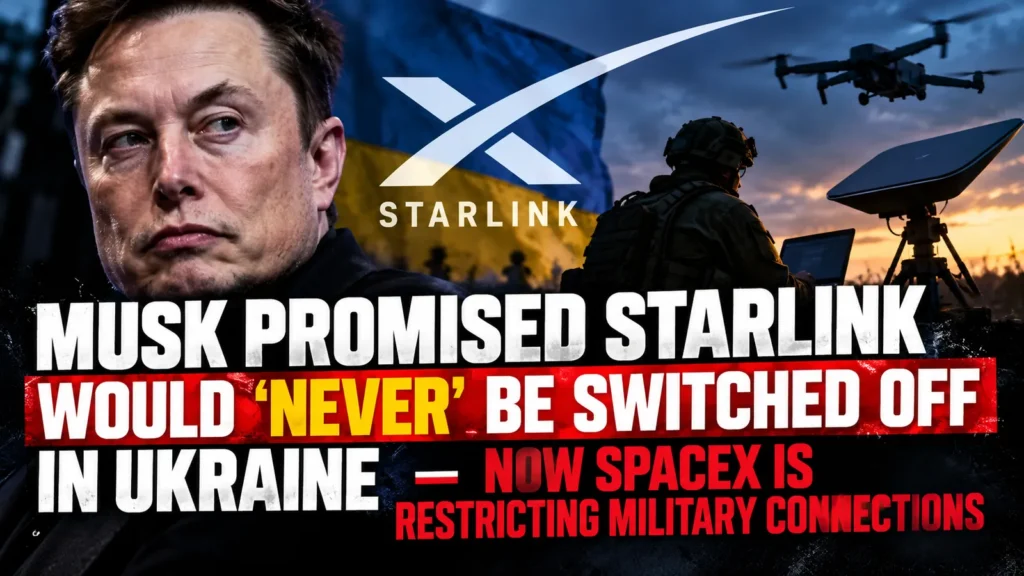
Elon Musk’s assurance that Starlink would never be switched off in Ukraine is facing fresh scrutiny after SpaceX restricted military satellite connections without advance warning, disrupting Ukrainian drone operations. The restrictions emerged just days after Musk publicly criticised President Volodymyr Zelenskyy, prompting renewed questions about the reliability of a communications service that Ukraine depends on to defend itself against Russia’s invasion.
Musk’s promise was clear: Starlink would never be a bargaining chip
On 9 March 2025, Elon Musk made a public commitment about the future of Starlink in Ukraine.
Writing on X, the billionaire businessman insisted the service would continue operating regardless of his personal disagreements with Ukrainian policy.
He said Starlink would “never turn off its terminals” and promised that the company would not “use it as a bargaining chip.”
The assurance followed an extraordinary public argument over whether Ukraine could safely depend on communications technology supplied by a company controlled by Musk.
Earlier that day, Musk had claimed that Ukrainian defensive lines would collapse if Starlink were withdrawn.
Polish Foreign Minister Radosław Sikorski challenged the suggestion, pointing out that Poland was helping pay for Ukraine’s access to the service.
Musk subsequently issued his categorical assurance.
Nineteen months later, the issue has returned — not because Starlink has been completely withdrawn, but because important military capabilities have reportedly been restricted.
That distinction matters. So does the question of how much practical protection Musk’s original assurance provides when a service can remain technically available while particular military uses are curtailed.
SpaceX restrictions disrupt Ukrainian drone missions
On Wednesday, 14 October, Ukrainian presidential adviser Serhii Beskrestnov reported that SpaceX had introduced restrictions affecting Starshield, the military-grade version of its satellite communications technology.
The changes reportedly took effect overnight on 13–14 October.
According to Ukrainian officials, terminals operating while moving above approximately 160 kilometres per hour — equivalent to 100 miles per hour — were affected.
Ukraine’s 7th Rapid Reaction Corps subsequently reported connection interruptions lasting between 10 and 20 seconds at speeds as low as 110–120 kilometres per hour.
The military said some missions had to be cancelled.
Beskrestnov confirmed that Ukrainian forces had not received advance warning of the restrictions.
These are not minor inconveniences. Satellite communications allow Ukrainian drone operators to maintain control of aircraft, conduct reconnaissance, coordinate battlefield operations and move supplies.
The loss of connectivity at a critical moment can make a mission impossible to complete.
The restrictions are especially important because Ukraine’s military has increasingly integrated satellite communications into systems designed to operate despite Russian electronic warfare.
However, the reports do not indicate a nationwide shutdown. Stationary Starlink terminals remain operational, and the limitations principally affect certain equipment used while moving at speed.
Days earlier, Musk attacked Zelenskyy
The timing has inevitably attracted attention.
On Saturday, 10 October, Musk responded to a White House video featuring President Donald Trump criticising Ukrainian attacks against Russian oil facilities.
Musk wrote:
“Zelensky has gone too far.”
Four days later, Ukrainian forces were reporting serious disruption to their military communications. Our follow-up report examines the disruption alongside Russia’s attacks, missing missile warnings and questions about possible war crimes.
The developments occurred against a backdrop of mounting pressure from Washington on Kyiv to suspend attacks against Russian energy infrastructure.
Trump has publicly criticised those operations, while Reuters has reported concerns in Ukraine about the possible withholding of American intelligence support.
However, an important distinction must be made.
The Ukrainian drones attacking oil facilities inside Russia use other communications systems. The reported Starlink restrictions therefore should not be presented as directly preventing those specific strikes.
Nor has evidence emerged establishing that Musk ordered the restrictions because of his disagreement with Zelenskyy, or that the Trump administration instructed SpaceX to impose them.
The timing raises legitimate questions. It does not, by itself, establish a political motive.
Poland challenges Musk over Starlink
The response from Poland has been particularly pointed.
On 14 October, Foreign Minister Radosław Sikorski publicly challenged Musk over the restrictions.
Sikorski asked whether Musk was again playing politics with his products and warned that European customers were watching.
The intervention carries considerable significance because Poland has helped fund Ukraine’s Starlink subscriptions.
It also revives the argument between the two men in March 2025, when Sikorski raised concerns about the consequences of depending on a single commercial provider for essential military communications.
Musk rejected those concerns at the time.
Now, Poland is once again questioning whether the service can be relied upon without political interference.
At the time of the initial reports on Wednesday, neither Musk nor SpaceX had provided Reuters with a public explanation for the latest restrictions.
This is not the first Starlink controversy involving Ukraine
The latest disruption also revives questions surrounding an earlier decision by Musk.
In 2022, Ukraine requested Starlink coverage to support a planned naval drone operation against Russian forces near Crimea.
Musk refused to activate the necessary coverage, saying he feared that supporting the operation could contribute to a major escalation of the war.
The incident became public in September 2023 following reporting based on Walter Isaacson’s biography of Musk.
Early accounts incorrectly suggested that Musk had actively switched off an existing connection during the operation.
Isaacson subsequently corrected that account, explaining that the relevant coverage had not been enabled and that Musk had refused Ukraine’s request to activate it.
The distinction is important.
Musk had not disconnected an existing service during the attack. However, the episode demonstrated that decisions about the availability and permitted use of commercially supplied satellite technology could directly affect Ukrainian military planning.
The same underlying issue has resurfaced in October 2026.
What does this mean for trust in Musk’s companies?
The controversy extends beyond the immediate military consequences.
Starlink is a commercial service sold to consumers, businesses and governments. It is also part of an increasingly important communications infrastructure used in remote communities, disaster response and national security.
Those customers need to understand the limits of the service they are purchasing, the circumstances under which restrictions may be imposed and the contractual protections available if access changes.
The same questions of corporate accountability and confidence in public commitments can matter when consumers consider other businesses led by Musk, including Tesla.
There is no evidence that these Starlink restrictions indicate a technical problem with Tesla vehicles or that ordinary Starlink customers face equivalent limitations.
Nevertheless, the episode provides a concrete reason for customers to examine what a company actually guarantees, rather than relying solely on statements made by its leadership.
For governments, the stakes are substantially higher.
An unexpected interruption to a consumer internet connection is an inconvenience. An unexpected change affecting battlefield communications can disrupt military operations during an active invasion.
Commercial technology has helped Ukraine defend itself. Starlink has provided substantial and valuable communications capabilities since Russia launched its full-scale invasion in February 2022.
That contribution should be acknowledged.
But its importance also explains why unexpected restrictions attract such serious scrutiny.
Musk’s promise now faces a practical test
SpaceX has not completely disconnected Ukraine, meaning Musk’s March 2025 promise cannot simply be described as having been broken in the literal sense of a nationwide shutdown.
What has happened is more specific: Ukrainian military officials say the company imposed restrictions without warning that disrupted operations involving equipment essential to their defence.
The reason for those restrictions has not been publicly established.
There may be an operational, technical, contractual or security explanation. Any explanation from SpaceX deserves examination against the evidence.
Until then, three questions remain unanswered.
Why were these restrictions imposed? Why was Ukraine apparently not warned? And how far does Musk’s promise actually extend when access to particular military capabilities can be changed without notice?
For a company whose technology is deeply embedded in Ukraine’s defence, those questions deserve clear answers.
And for customers assessing the promises made by powerful technology companies, the distinction between what is publicly assured and what is contractually guaranteed has rarely appeared more consequential.
Sources
- Reuters — SpaceX limits Starlink operations in Ukraine (14 October 2026)
- Reuters — Poland’s Sikorski challenges Musk (14 October 2026)
- Ukrainska Pravda — Musk’s March 2025 assurance
- Euronews — Ukrainian adviser reports restrictions (14 October 2026)
- Associated Press — Crimea coverage decision (2023)
- The Guardian — Correction to earlier Crimea reporting (2023)
- ABC News — Zelenskyy interview transcript (11 October 2026)