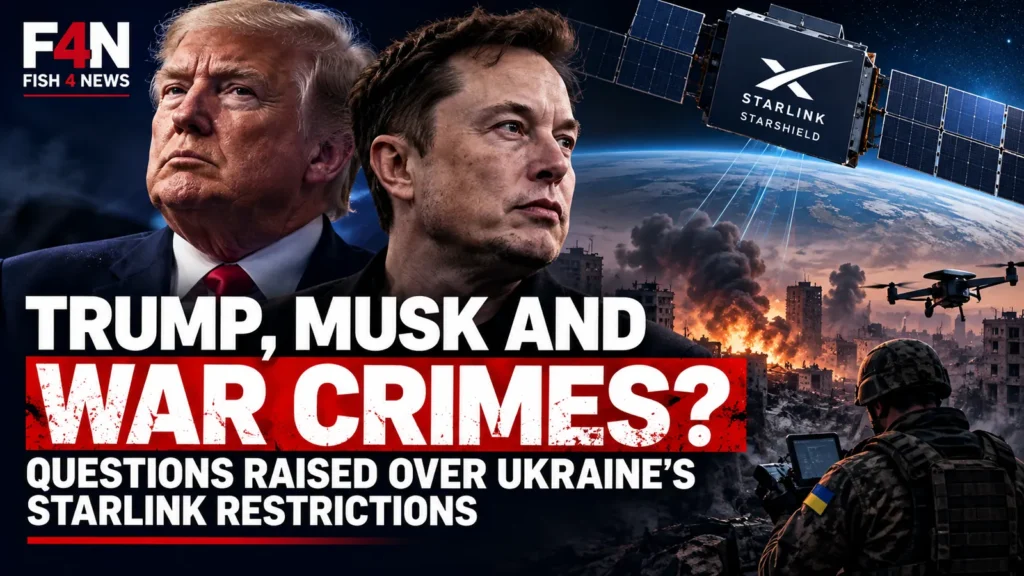
Ukrainian military forces were left without full access to vital Starshield satellite communications on 14 October 2026 after unexpected restrictions disrupted drone operations during a major Russian attack. The service, developed by Elon Musk’s SpaceX for military users, suffered restrictions as Russian missiles struck Ukrainian cities, killed civilians and left at least 600,000 people without electricity. The developments have raised urgent questions about decisions involving President Donald Trump’s administration, SpaceX and the protection of Ukrainian civilians.
Ukraine’s Military Communications Restricted Without Warning
Ukrainian officials say SpaceX’s Starshield service, a military-grade version of the Starlink satellite communications system, was subjected to unexpected restrictions overnight on 13–14 October.
The changes reportedly caused terminals mounted on moving equipment to lose connectivity at speeds exceeding approximately 160 kilometres per hour (100 mph). Some Ukrainian units reported interruptions at considerably lower speeds.
The restrictions disrupted operations involving reconnaissance drones, longer-range strike systems and interceptor drones used to protect Ukrainian territory against Russian attacks.
Serhiy Beskrestnov, a radio technology specialist and adviser to Ukrainian President Volodymyr Zelenskyy, confirmed that the restrictions had affected military missions without advance notification.
Ukraine’s 7th Rapid Reaction Corps also reported connection losses lasting between 10 and 20 seconds, making some drone operations impossible.
Ukraine’s Defence Ministry has contacted the United States, SpaceX and NATO partners while investigating the disruptions and establishing alternative communications.
Russian Missiles Strike as Ukraine’s Defences Are Disrupted
The communications restrictions coincided with one of Russia’s largest recent attacks on Ukrainian energy infrastructure.
According to Ukrainian authorities, Russian forces launched more than 39 ballistic missiles and more than 120 drones overnight, targeting infrastructure in and around Kyiv and Kharkiv.
Energy installations suffered substantial damage, leaving more than 600,000 people without electricity. Civilian deaths and injuries were reported across the affected regions.
The strikes came as Ukraine approached winter, making damage to electricity generation and heating infrastructure particularly serious.
Although the timing of the Starshield restrictions has raised concerns, there is currently no independently verified evidence that they caused any specific civilian deaths or were coordinated with Russia’s attacks.
Did the Trump Administration Order the Restrictions?
The central unanswered question is who authorised the changes to Starshield and why they were introduced without warning Ukraine.
Ukrainian volunteer and drone supplier Serhii Sternenko has suggested that SpaceX acted following a request from the Trump administration. That allegation has not been independently established.
The distinction between Starlink and Starshield is important. Starlink is SpaceX’s commercial satellite internet network, while Starshield provides services designed for government and military use.
Musk has stated that the relevant Starshield network is operated by the US government rather than controlled by SpaceX. His account has not established which person or institution authorised this particular change.
Neither a direct order from Donald Trump nor a personal decision by Elon Musk has been independently demonstrated.
The restrictions came amid disagreements between Washington and Kyiv over Ukrainian attacks on Russian oil facilities and Trump’s demands for an agreement to halt attacks on energy infrastructure.
The timing has intensified scrutiny, but political tensions alone do not establish who ordered the technical changes. The controversy also recalls Musk’s earlier promise that Starlink would “never” be switched off in Ukraine. The reported military restrictions do not amount to a nationwide shutdown.
Questions Over Missing US Missile Warnings
A separate development has added to Ukraine’s concerns. CBS News reported on 14 October that US authorities may have intentionally withheld early warnings about incoming Russian missile attacks.
Sources told CBS that Ukrainian officials were informed that the American missile detection system had experienced difficulties because of bad weather. Some Ukrainian officials questioned that explanation.
Zelenskyy has separately criticised the failure of allied early-warning information to reach Ukraine ahead of attacks on Kyiv.
Trump has denied that the United States stopped sharing intelligence with Ukraine. Other reporting indicates that broader intelligence cooperation remains in place, meaning the missing warnings may have involved particular incidents rather than a complete suspension of intelligence sharing.
Nevertheless, the combination of military satellite restrictions and missing missile warnings has raised serious questions about the reliability of American defence support at a critical moment.
Zelenskyy Warns Lives Are at Risk
Speaking to British broadcaster Piers Morgan on 14 October, President Zelenskyy criticised the disruption to Starlink services. He described the move as a serious mistake and warned that further loss of communications could cost Ukrainian lives.
Polish Foreign Minister Radosław Sikorski also publicly challenged Musk over the restrictions, questioning whether political considerations were affecting services critical to Ukraine’s defence.
Poland has helped finance Starlink services used by Ukraine, giving Warsaw a direct interest in the system’s reliability.
Some Starlink Connectivity Being Restored
Later on 14 October, former Ukrainian defence minister Mykhailo Fedorov reported that Starlink connectivity at speeds up to 160 km/h was being restored.
He said that removing the Starshield speed restriction entirely remained necessary for Ukrainian defence operations.
The reported restoration is a significant development, but it does not explain why the original restrictions were introduced, who authorised them or why Ukrainian forces received no warning.
Could Deliberately Withholding Military Support Constitute a War Crime?
The events have prompted discussion about potential legal accountability, including in commentary by American journalist Aaron Parnas.
However, describing the restrictions as war crimes requires considerably more evidence than the timing of the events.
Under international humanitarian law, intentionally attacking civilians or civilian infrastructure can constitute a war crime, subject to the applicable legal tests. The International Criminal Court has already investigated Russian attacks against Ukraine’s energy infrastructure.
In June 2024, the ICC issued arrest warrants for former Russian defence minister Sergei Shoigu and military chief Valery Gerasimov over alleged war crimes and crimes against humanity connected to attacks on Ukrainian electrical infrastructure.
Those proceedings concern the alleged conduct of Russian officials. They do not establish criminal liability for American officials or SpaceX executives.
Whether restrictions on communications or intelligence could amount to criminal assistance in an international crime would depend on evidence of knowledge, intent, involvement and the underlying offence.
There is no verified finding that Trump or Musk committed war crimes in connection with these restrictions, and no confirmed ICC proceedings against either man over this incident.
Questions That Washington and SpaceX Must Answer
- Who authorised the changes to Starshield’s operating limits?
- Did the Trump administration request or approve the restrictions?
- Why were Ukrainian forces not warned before critical systems were affected?
- Were the interruptions connected in any way to the separate failures in missile-warning intelligence?
- What safeguards exist to prevent future disruptions to systems used for civilian protection?
For Ukraine, the immediate priority is restoring reliable communications and air defences.
For the United States and SpaceX, the unresolved issue is accountability for decisions affecting technology on which Ukrainian military operations depend.
Russia remains responsible for its own military attacks. Determining whether decisions elsewhere contributed to Ukraine’s vulnerability requires evidence rather than assumptions.
Until the authorities responsible for the restrictions explain what happened, significant questions will remain.
Sources
- Reuters: SpaceX limits Starlink operations in Ukraine
- Associated Press: Ukrainian drones hit by Starlink restrictions
- CBS News: US may have withheld missile warnings
- Ukrainska Pravda: Ukrainian forces report Starshield restrictions
- Ukrinform: Mykhailo Fedorov on partial restoration of Starlink
- International Criminal Court: Shoigu and Gerasimov arrest warrants
Watch: Aaron Parnas Discusses the Starlink Restrictions and War-Crimes Allegations
American political commentator Aaron Parnas discusses the Starlink disruption, the Russian missile attacks and the allegations concerning Musk and the Trump administration. His commentary includes claims and interpretations that have not all been independently established.