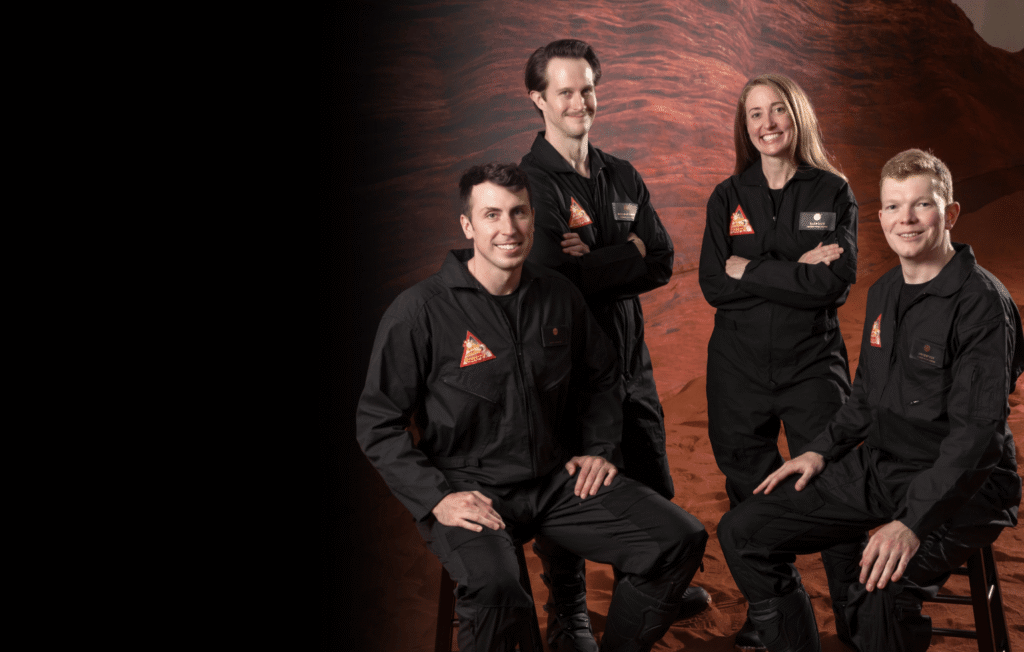
Four volunteers have emerged from a NASA research habitat in Houston after spending 378 days living as though they were on Mars, completing the agency’s second year-long CHAPEA isolation experiment.
Mission commander Ross Elder, medical officer Ellen Ellis, science officer Matthew Montgomery and flight engineer James Spicer left the Mars Dune Alpha habitat at NASA’s Johnson Space Center on Saturday, 31 October 2026. They entered it on 19 October 2025.
The volunteers were not in space. They lived inside a 3D-printed, 1,700-square-foot (approximately 158-square-metre) facility on Earth while scientists studied how a small crew manages the restrictions, responsibilities and stresses of a long-distance mission.
What the crew experienced
NASA’s Crew Health and Performance Exploration Analog (CHAPEA) programme recreates selected challenges of an extended journey to the Red Planet. Crew members carried out simulated Mars walks, equipment and habitat maintenance, physical exercise, plant cultivation, robotic tasks and scientific work.
The experiment also placed limits on resources and introduced communications delays to mimic the time it takes signals to travel between Earth and Mars. This made routine conversations with mission controllers and family members very different from immediate contact on Earth.
NASA said the crew communicated with their families by email during their isolation, with Mars-like delays. During the mission, the team also rehearsed working independently through a simulated two-week communications blackout.
What the volunteers said
Speaking after the crew emerged, Ellis described the experience as “a hell of a year”. Elder acknowledged the risks involved in a future human Mars mission while expressing confidence that it remains achievable.
Vanessa Wyche, director of Johnson Space Center, said the volunteers had managed limited supplies, maintained their surroundings and adapted to delayed contact with mission control, developing skills that will be needed when astronauts cannot rely on immediate guidance from Earth.
Watch the crew emerge
NASA broadcast the crew’s departure and the mission-completion ceremony at Johnson Space Center on 31 October.
Watch NASA Johnson’s original CHAPEA Mission 2 exit ceremony on YouTube (the replay may not be available in all locations).
If the recording is unavailable, NASA’s official CHAPEA mission update provides background and the original broadcast link.
What NASA hopes to learn
The study focuses on human health, performance and teamwork. NASA wants to learn how crews respond to isolation, confinement, heavy workloads and delays, and how food, exercise, medical support and limited supplies affect their ability to carry out a mission.
The participants will undergo approximately two weeks of post-mission examinations and debriefings. The findings have not yet been fully analysed or published, so it is too early to claim that the experiment has proved humans can safely live on Mars.
There are also important limits to the simulation. The volunteers remained on Earth, where they experienced normal gravity and did not face the radiation environment of deep-space travel. CHAPEA can help answer some practical and psychological questions, but cannot reproduce every risk of a journey to Mars.
The next steps towards Mars
This was NASA’s second CHAPEA mission. The first four-person crew completed a comparable 378-day stay between 2023 and 2024. NASA says information from these studies will inform planning for future Moon and Mars missions, including how astronauts manage food systems, communication and medical care when far from home.
The latest mission’s completion provides a new set of observations, rather than a finished verdict on the feasibility of sending people to the Red Planet.