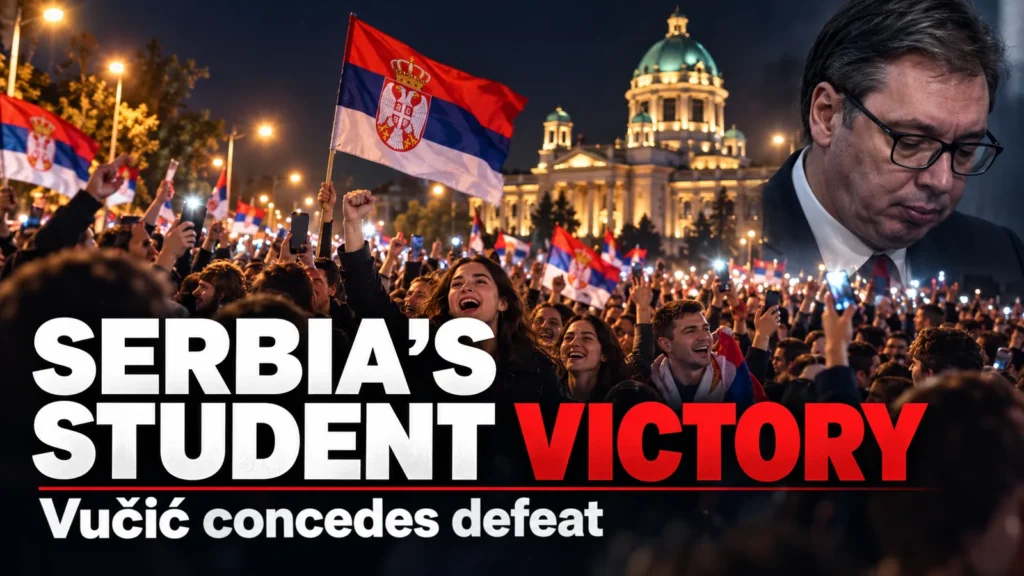
Serbia’s student-led opposition has won a historic parliamentary election, with former president Aleksandar Vučić conceding defeat on Sunday, 25 October 2026. The Student List is projected to win an outright majority in Serbia’s 250-seat parliament, ending more than a decade of political dominance by Vučić and his Serbian Progressive Party following nearly two years of anti-government demonstrations.
Vučić Admits Defeat as Students Secure Parliamentary Majority
In a televised election-night address, Aleksandar Vučić acknowledged that his Serbian Progressive Party (SNS) had lost to the student-backed opposition movement.
“It is clear that we have lost these elections, the Student List has won,” he said, according to Reuters.
Vučić estimated that the Student List would secure between 135 and 140 parliamentary seats, compared with approximately 105 for his political camp.
Separately, an Ipsos/CeSID projection reported by Serbian public broadcaster RTS put the Student List on 52.7% of the vote and 140 seats, against 38.9% and 104 seats for the Vučić-backed United Serbia list. That projection was based on 80.8% of the polling sample.
A later projection reported by The Guardian suggested 141 seats for the Student List.
All these estimates put the student-backed movement above the 126 seats required for an absolute parliamentary majority.
Final certified results were still outstanding in the early hours of Monday, 26 October.
Turnout was estimated at close to 70%, one of the highest levels recorded in Serbia in decades.
Celebrations Erupt Across Belgrade
Within minutes of Vučić acknowledging defeat, thousands of people poured onto the streets of Belgrade.
Supporters waved Serbian flags, sounded car horns and celebrated across the capital’s main streets. Similar scenes were reported in Novi Sad and other cities.
For many participants, the result represented the culmination of an extraordinary campaign that began with public demands for accountability and developed into a nationwide movement seeking political change.
Radomir Sajčić, a university professor speaking on behalf of the Student List, told supporters:
“Tonight we celebrate victory, tomorrow we build the future.”
The celebrations also included relatives of victims of the tragedy that originally sparked the demonstrations.
Dijana Hrka, whose son died in the Novi Sad railway station disaster, told N1 television that she had waited two years for the moment.
The scenes were a dramatic contrast to the previous two years, during which student demonstrations repeatedly brought large parts of Serbia to a standstill.
How a Railway Station Disaster Sparked a Political Revolution
The origins of the movement lie in the collapse of a concrete canopy at Novi Sad railway station on 1 November 2024.
Sixteen people died in the disaster, which occurred at a station that had undergone renovation work.
The tragedy triggered widespread public anger and questions about construction standards, public procurement, corruption and government accountability.
Students demanded the publication of relevant documents and accountability for those responsible.
As demonstrations grew, the movement broadened its demands to include stronger democratic institutions, independent investigations, media freedom and the rule of law.
Vučić and his allies repeatedly denied accusations of corruption, political repression and wrongdoing.
The demonstrations expanded beyond universities, drawing support from teachers, farmers, professionals, pensioners and other members of the public.
Student organisers travelled across Serbia, including rural communities where the ruling party had traditionally enjoyed considerable support.
Rather than relying on established opposition politicians, the movement developed its own grassroots networks and decision-making structures.
The result was an opposition force capable of challenging a political organisation that had dominated Serbian government since 2012.
Who Are the Student List Candidates?
Although the movement was organised by university students, its parliamentary candidates are not themselves primarily students.
The electoral list consists of academics, doctors, artists, farmers, professionals and other candidates, many without previous high-level political experience.
Its leading candidate is cardiologist Ilija Srdanović.
The movement deliberately avoided the conventional political structure built around one dominant leader.
Instead, it presented itself as a collective effort focused on restoring public accountability and strengthening Serbia’s institutions.
Its campaign priorities included tackling corruption, improving education and public services, and addressing concerns about the independence of state institutions.
However, winning an election and governing a country present different challenges.
The movement must now decide who will become prime minister, how ministerial responsibilities will be distributed and how its broad coalition will translate campaign commitments into policy.
What Happens to Aleksandar Vučić?
Vučić has been one of Serbia’s most influential political figures for more than a decade.
He became prime minister in 2014 and president in 2017, maintaining substantial influence over the country’s political direction throughout that period.
In September 2026, he called early parliamentary elections and resigned the presidency to campaign as his party’s candidate for prime minister.
He transferred presidential responsibilities to parliamentary speaker Ana Brnabić, who became acting president on 28 September.
Serbia’s caretaker prime minister is Đuro Macut, whose administration remains responsible for government business during the transition.
Vučić’s election defeat therefore does not constitute the immediate removal of a sitting prime minister. Instead, it prevents his anticipated return to that office and is expected to bring an end to SNS-led government once a new administration is formed.
Serbia must also hold a separate presidential election following his resignation.
Vučić blamed his defeat partly on alleged outside interference and hostile media coverage, including claims about foreign governments and political interests in the United States.
Those allegations have not been independently established.
Despite conceding defeat, Vučić indicated that his political movement would remain active in opposition.
European Union Welcomes Election Result
Serbia’s election has implications extending beyond its borders.
The country is a candidate for European Union membership but has maintained close political and economic relationships with Russia and China.
Vučić’s governments pursued a balancing strategy between those relationships and Serbia’s European ambitions.
Following the election, European Commission President Ursula von der Leyen congratulated the Student List and expressed support for reforms involving democratic institutions, media freedom, anti-corruption measures and the rule of law.
European Council President António Costa also welcomed the result and Serbia’s high electoral participation.
However, the Student List’s foreign policy programme is less clearly defined than its domestic reform agenda.
The new government will face difficult decisions over EU integration, relations with Russia, Chinese investment and wider regional issues.
An electoral victory does not automatically resolve those questions.
Election Observers to Report on Voting Irregularities
The election took place amid concerns over electoral fairness, intimidation and the influence of state institutions.
Independent election monitors reported alleged irregularities, including attempted vote buying, pressure on voters and the photographing of ballot papers.
Some incidents of unrest were also reported in Belgrade during election night.
These reports require careful examination, and individual allegations should not be treated as established findings without further investigation.
The Organisation for Security and Co-operation in Europe’s Office for Democratic Institutions and Human Rights deployed an international election observation mission.
Its preliminary findings are scheduled for publication on Monday, 26 October, with a press conference at 14:00 UK time.
Those findings will be important in assessing the conduct of the election and identifying potential areas requiring further investigation.
From Student Protests to Government: What Happens Next?
The scale of the Student List’s projected victory represents a major political transformation.
What began as a demand for accountability after 16 deaths has developed into a movement capable of securing a parliamentary majority and challenging Serbia’s established political order.
However, the next stage is likely to be more complicated than the election campaign.
A new administration will face expectations of institutional reform, credible anti-corruption investigations, improved public services and a different approach to political accountability.
It will also inherit Serbia’s economic pressures, international relationships and longstanding regional disputes.
The movement’s decentralised structure, which proved effective in mobilising supporters, will now be tested by the demands of parliamentary government.
For supporters celebrating in Belgrade, the election marks the achievement of a goal pursued through almost two years of demonstrations.
For Serbia, it marks the beginning of a political transition whose longer-term consequences are still uncertain.
The central question is no longer whether Serbia’s student movement can defeat the governing party at the ballot box, but how it will use the parliamentary majority it is projected to command.