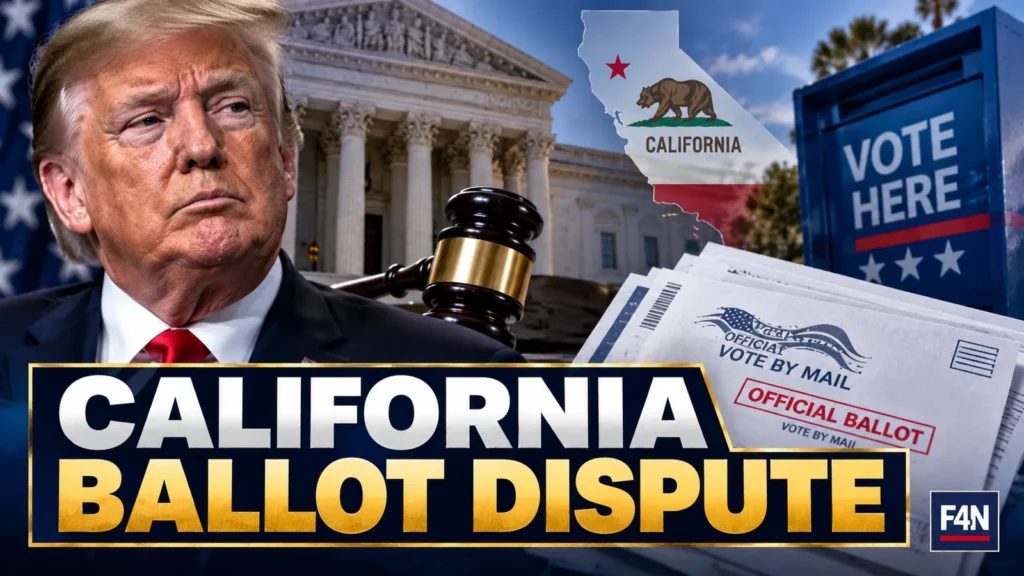
A federal judge appointed by Donald Trump has questioned whether the president’s administration can force California to set aside potentially thousands of postal ballots during the 2026 midterm elections.
Judge Mark Bennett challenged both the legal basis and timing of the US Justice Department’s emergency request during an unusual Sunday hearing at the Ninth Circuit Court of Appeals on 25 October. The dispute involves a federal list of more than 20,000 registered voters whom the administration suspects may not be US citizens.
That figure does not mean 20,000 illegal votes have been identified or cast. California disputes the accuracy of the list, and the judges had not ruled on the emergency application by the end of the hearing.
What is the Trump administration asking for?
The Justice Department sued California on 15 October, after federal agencies compared voter-registration records with immigration data and identified more than 20,000 people they described as likely noncitizens.
The government wants ballots associated with people on that list separated from other mail votes and withheld from counting until their citizenship has been checked. Federal prosecutors argue that counting ballots from ineligible voters would undermine legitimate votes and that any harm could be difficult to reverse once ballots are separated from their identifying envelopes.
It is already unlawful for noncitizens to vote in federal elections. The legal dispute is about the reliability of the government’s evidence, how it can be used during an ongoing election, and whether federal officials can compel California to take the requested action.
Why did a Trump-appointed judge object?
The three-judge appeals panel included Bennett and Judge Patrick Bumatay, both appointed by Trump, and Judge Gabriel Sanchez, appointed by Joe Biden.
Bennett questioned whether the appeals court could intervene before the district court had actually ruled. The lower-court judge, David O. Carter, had scheduled a hearing for Tuesday 27 October. Rather than waiting, government lawyers filed an appeal on 22 October, treating the absence of an immediate decision as an effective refusal of emergency relief.
That reasoning is set out in the government’s notice of appeal. Bennett also raised the Constitution’s Elections Clause, under which states administer congressional elections subject to rules made by Congress.
Sanchez questioned whether the federal demand improperly compelled state officials to enforce federal law. Bumatay was more receptive to the government’s concern that ballots from ineligible voters should not be counted. Questions at a hearing do not themselves amount to a ruling.
How reliable is the list of 20,000 voters?
Los Angeles County election staff examined a preliminary sample of 200 names from the federal list. According to reporting on declarations filed with the court, 112 of those records involved cancelled or inactive registrations and around 70% had no voting history.
Among records where birthplace was meaningfully recorded, 38.9% indicated a birthplace in the United States. That percentage applies only to the subset with usable birthplace information, not automatically to all 200 people or the wider 20,000-name list. Birthplace information is also not, on its own, a complete citizenship determination.
California officials say the findings cast doubt on the list’s reliability and warn that attempting to match ballots against it so close to polling day could disrupt the election and wrongly affect eligible voters. The review was preliminary and does not establish the citizenship status of everyone listed.
Has the Justice Department found any suspected unlawful voting?
Yes. In a separate action on 19 October, the Justice Department announced charges against 28 lawful permanent residents who it said were on the wider list, alleging offences involving voter registration, voting or citizenship-related statements. Some accusations concern elections in previous years.
Those are criminal allegations, not convictions, and each defendant is presumed innocent unless proved guilty. Even if individual cases are established, they do not automatically validate the remaining thousands of flagged records or show that 20,000 votes were cast illegally in this election.
Why is the timing important?
California’s election is already under way ahead of the 3 November 2026 midterms. State and county lawyers argue that a last-minute order requiring election workers to identify, isolate and examine ballots could be extremely disruptive.
The administration argues the opposite: delaying action could allow an ineligible ballot to be counted before anyone can establish the voter’s status. The judges must weigh those competing concerns alongside the court’s power to intervene at this stage.
What happens next?
As of Monday 26 October, the Ninth Circuit panel had not announced a decision following Sunday’s hearing. The district court hearing was scheduled for Tuesday 27 October. Either development could change how ballots linked to the disputed list are handled.
The central question remains unresolved: can the federal government justify an emergency restriction affecting potentially eligible voters on the strength of its current evidence, and does it have the legal authority to require California to impose it?
Sources: US Justice Department complaint announcement; federal notice of appeal; DOJ statement on 28 defendants; Associated Press hearing report; NPR report on Los Angeles County’s preliminary review.