The UK Government and Rolls-Royce have announced plans for a joint £2.5 billion, ten-year programme to develop next-generation jet engine technology. The agreement could strengthen British aerospace manufacturing, although future funding and the largest job projections remain conditional.
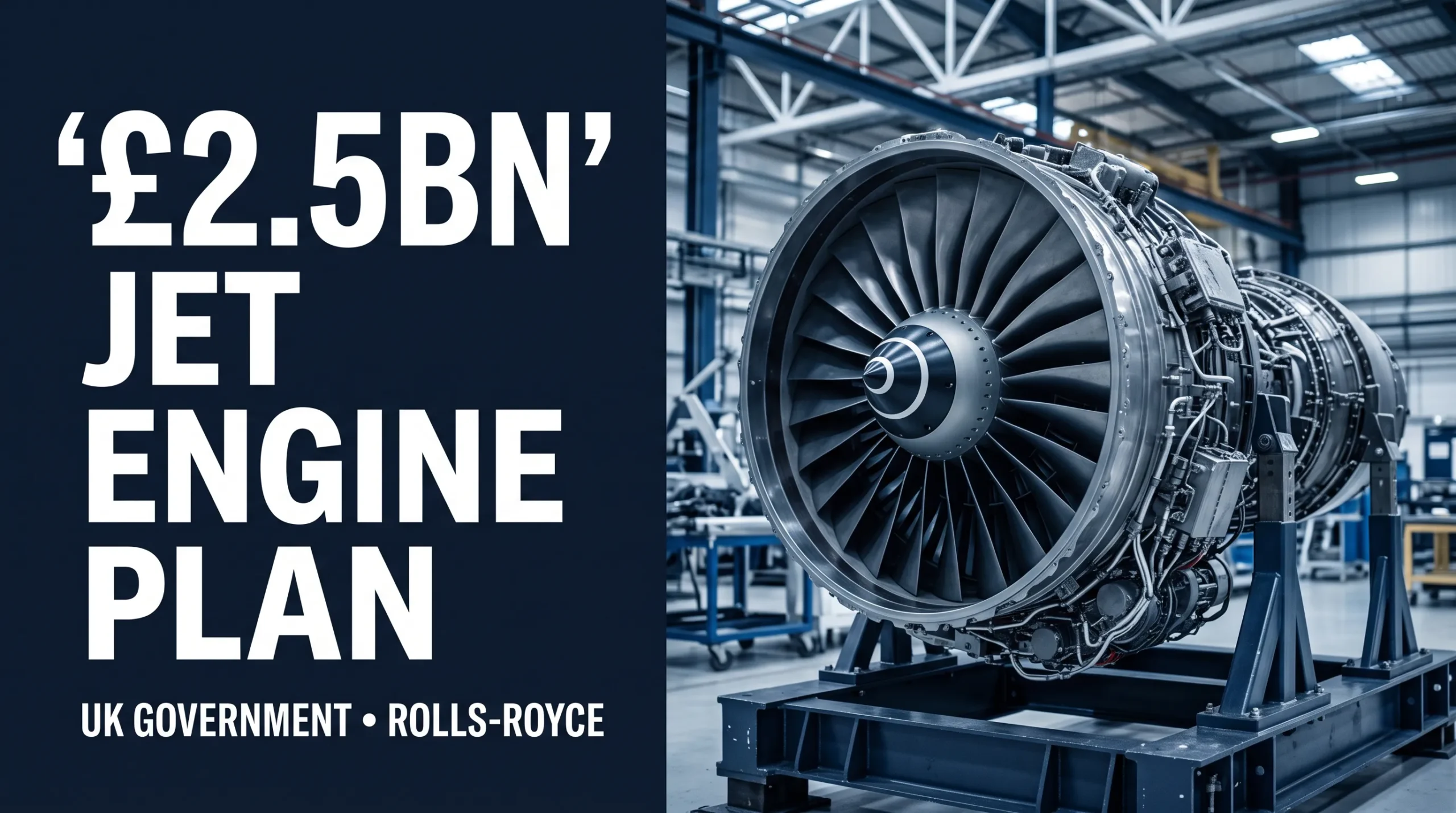
The agreement, announced on 28 October 2026, is intended to advance more efficient jet engine technologies for both civilian and military aircraft. A central ambition is to help Rolls-Royce compete to supply engines for the next generation of single-aisle passenger planes.
It represents a potentially substantial industrial opportunity. But the agreement is a framework for future cooperation, not a completed engine order or an unconditional award of £2.5 billion in government grants.
What has actually been agreed?
The Government and Rolls-Royce have outlined a proposed research and technology programme worth £2.5 billion over ten years, with investment from both sides. Work would cover advanced turbine technology, new materials, digital systems and manufacturing techniques, including robotics and artificial intelligence.
The Department for Business, Innovation, Science and Trade says the agreement establishes the framework for future state support. No new grants have yet been awarded under it. Any future public funding must still pass legal, affordability, value-for-money and subsidy-control checks, with final terms to be agreed.
Rolls-Royce says it expects to invest significantly more than the Government across its proposed narrowbody engine programme.
How many jobs could be created?
The distinction between jobs supported now and jobs that might be created later is important.
According to the Government, the initial investment is expected to support 3,300 existing UK jobs by the end of 2029. These are not 3,300 confirmed new vacancies. They cover Rolls-Royce and its supply chain.
Both the Government and the company say that successfully winning a place on future single-aisle aircraft programmes could eventually create tens of thousands of additional skilled jobs in engineering, research and manufacturing. That outcome depends on Rolls-Royce securing future business.
Rolls-Royce also estimates that such success could add £120 billion to the UK economy over the programme’s lifetime. This is a conditional company projection, not a confirmed economic return.
Why the single-aisle aircraft market matters
Single-aisle, or narrowbody, aircraft are widely used on short- and medium-haul routes. Current examples include the Airbus A320 and Boeing 737 families. Their engines are a huge market, currently dominated by CFM International and Pratt & Whitney.
Rolls-Royce sold its stake in the International Aero Engines consortium in 2012, leaving that major part of the commercial engine market. It now hopes technology developed through its UltraFan programme will help it compete again, potentially through a partnership.
The manufacturer says aircraft builders may choose partners for their next-generation narrowbody programmes over the coming years, with new aircraft expected to enter service in the mid-to-late 2030s.
What happens next?
A research programme does not guarantee production contracts. Rolls-Royce will need to demonstrate its technology, secure an aircraft manufacturer’s selection and agree the investment required for manufacturing and testing facilities.
If those steps succeed, the company says it intends to select UK locations for new assembly and testing facilities, with additional factories and investment potentially needed across its supply chain. No specific sites or construction dates have been confirmed as part of this announcement.
The Government has presented the agreement as part of its broader industrial strategy, while Rolls-Royce chief executive Tufan Erginbilgic described it as a landmark for the UK’s aerospace industry.
The position on 29 October: the ten-year development plan has been announced and the commercial opportunity is significant. But the major new-job figures, £120 billion economic projection, further public funding and eventual engine manufacturing all depend on decisions that have yet to be made.