A string of technology failures has disrupted US flights, banks, online services and court portals. The FBI has separately documented attacks on water utilities in at least seven states. There is no verified evidence that these events form one coordinated operation, but together they raise questions about infrastructure resilience and public confidence in official explanations.
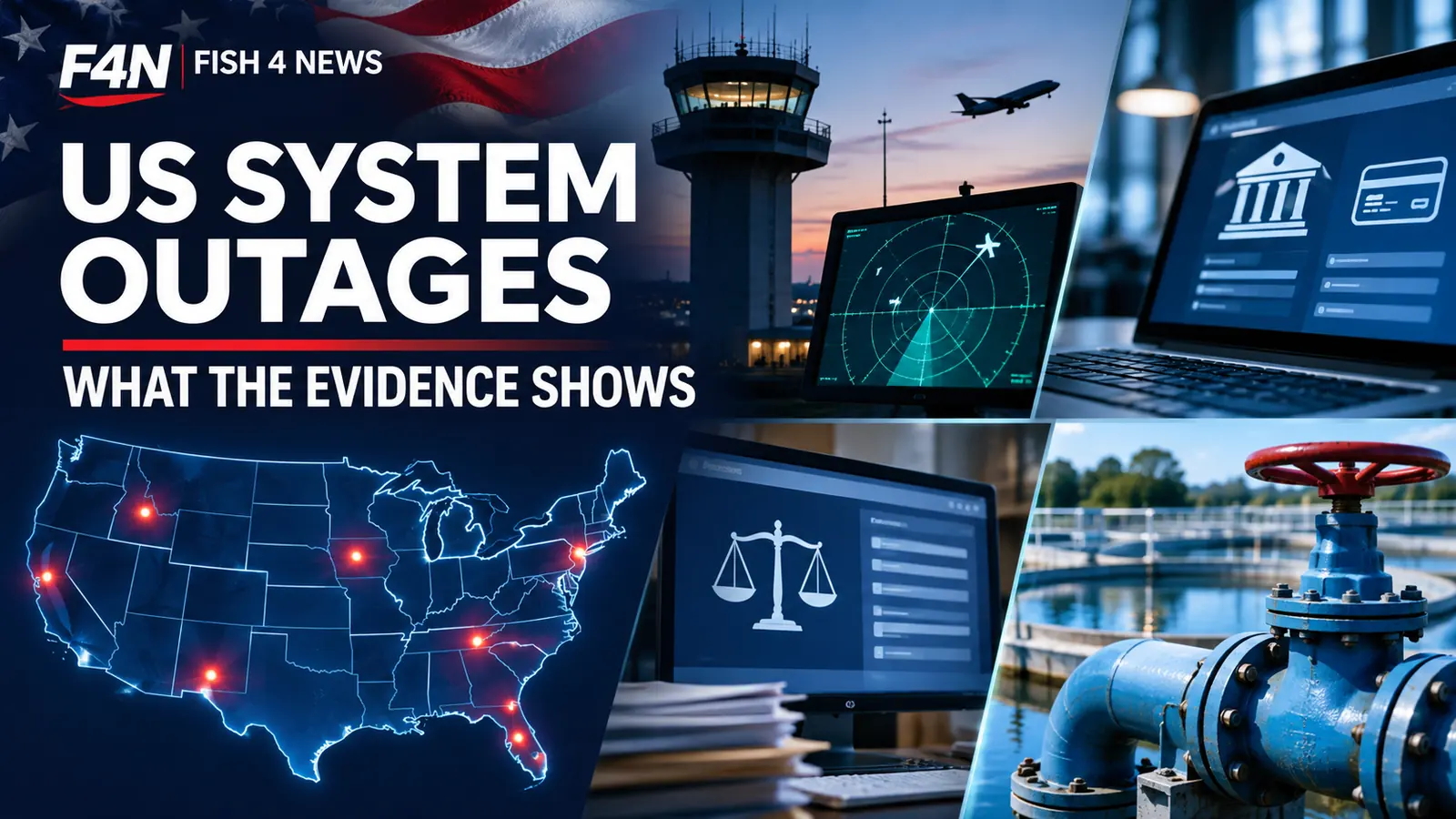
The distinction matters. Some November incidents have documented technical explanations, one involves suspicious activity targeting a court technology provider, and the water-system intrusions began in July. Combining them into a single alleged attack would be misleading. Ignoring the vulnerabilities exposed by each incident would be equally unhelpful.
What US officials have actually said
Speaking in Manila on 17 November, Secretary of State Marco Rubio said the government had found no evidence that the Microsoft, Federal Aviation Administration (FAA) and banking disruptions were connected or the work of hackers or hostile governments. He acknowledged that the succession of failures was unsettling.
At a House Homeland Security Committee hearing on 18 November, Director of National Intelligence Jay Clayton, Homeland Security Secretary Markwayne Mullin and FBI Deputy Director Christopher Raia gave similar assessments. Clayton described separate outages associated with technical changes and maintenance. Raia said investigators had found no indication of malicious cyber activity connecting those incidents. That is the current official assessment, not a promise that every technical investigation is finished.
November outages: several events, different evidence
- 12 November, Microsoft: A major Microsoft 365 disruption affected Outlook and other business services. The company’s preliminary technical findings point to a dormant software defect, server overload and reduced capacity, not a confirmed cyberattack. Read F4N’s earlier Microsoft report.
- 13 November, aviation: The FAA halted departures nationwide after instability spread through parts of its air traffic communications and radar network. It says abnormal connection traffic overwhelmed older equipment. Read F4N’s investigation of the router work.
- 13 November, courts: Journal Technologies reported suspicious automated activity targeting public court portals. Courts in California suspended online access as a precaution while the supplier investigated and applied security updates.
- 16 November, banking and airlines: JPMorgan Chase and United Airlines reported technology disruptions, prompting wider concern about unrelated services failing in quick succession.
- 17 November, national security: The National Security Agency acknowledged disruption to internal systems during scheduled maintenance, while saying mission-critical capabilities remained operational.
The NSA’s own statement confirms a temporary degradation but does not publicly provide a full technical incident report. That distinction between a stated explanation and an independently established root cause should remain clear.
The FAA failure has a specific technical account
The FAA says its older network equipment became unstable when it received around 1,000 connection attempts every four to five seconds. Its published questions and answers identify possible sources in Amarillo, Texas and El Dorado, Arkansas. Contractor L3Harris had been working at the Arkansas site, including deploying a new router. Functions on similar routers were disabled as a precaution, and installations were paused.
The agency says 17 of its 22 air route traffic control centres experienced instability, though the network did not go completely dark. It reported roughly 12,462 flight cancellations on 13 November, while warning that not every cancellation was directly caused by the ground stop. Investigators have not completed a final public root-cause determination or established that contractor negligence caused the incident.
That leaves a legitimate question even if there was no cyberattack: why did a problem associated with limited network locations disrupt a system used nationwide? Democratic senators have demanded evidence about safeguards, failover arrangements and testing before further router deployments.
The FBI water attacks happened in July, not this week
A separate FBI and Environmental Protection Agency warning, dated 30 July 2026, confirms malicious activity against water and wastewater utilities in at least seven states beginning on 27 July. Attackers accessed internet-facing industrial controllers and altered settings. Some utilities experienced loss of water pressure or flooding.
These were genuine cyber intrusions affecting operational technology, not merely customers being unable to open a website. Investigators examined whether Iranian-linked actors were involved, but that possibility was not a final public attribution in the initial reporting. Crucially, the seven-state figure refers to the July campaign. It is not evidence that seven states suffered a new coordinated water attack during November’s IT failures.
The water incidents demonstrate that essential services face real cyber threats. They cannot, without new forensic evidence, be used to reclassify the FAA, Microsoft or NSA failures as hostile operations.
Court portals: a security incident, but not proof of a wider attack
Journal Technologies said on 16 November that it had identified suspicious automated activity affecting public-facing portal technology on Friday 13 November and advised customers to suspend access while it contained the issue. California’s Alameda Superior Court confirmed that eCourt services remained offline on 17 November, delaying some court filings.
The company said its investigation had found no evidence at that stage that criminal justice information had been exposed. That finding remained under validation. The existence of a suspected security incident at a shared court software provider does not establish a common perpetrator behind the week’s other outages.
What the $50 billion funding row can and cannot tell us
Following the FAA shutdown, Transportation Secretary Sean Duffy called for $50.1 billion in additional aviation infrastructure funding. The proposal includes airport terminals and towers as well as air traffic control equipment. Congress had already approved $12.5 billion for air traffic control improvements in 2025, and lawmakers have questioned the pace at which existing funds are being used.
The bipartisan scrutiny should not be reduced to a claim that one party alone caused decades of ageing infrastructure. A September 2026 Government Accountability Office report found that the FAA’s accelerated modernisation programme lacked an integrated master schedule covering 11,389 individual projects and a comprehensive lifecycle cost estimate. Those are independently documented management risks. See F4N’s earlier examination of the funding request.
Why public trust belongs in this story
The public’s willingness to accept official reassurance is a separate issue from whether a cyberattack occurred. In an October 2026 Gallup survey, 26% of Americans said they trusted the federal government at least somewhat to act in society’s best interests. That result measures general institutional confidence, not belief about these particular outages. Trust also differs between political groups and changes with the party in power.
This helps explain why official statements may not settle public argument. But suspicion, political history and the coincidence of several outages are not forensic evidence. The responsible test is whether each organisation publishes a credible account of what failed, how the explanation was established, what was affected and what safeguards have changed.
A common weakness is not necessarily a common attacker
The episodes raise questions about ageing equipment, shared software suppliers, overextended infrastructure and the risks of making changes to critical networks. Software maintenance and security patching can themselves create failures; at the same time, failing to patch exposes systems to exploitation. Neither observation proves that a single technical cause lies behind all these incidents.
A better measure of resilience is whether a local fault stays local, whether backup systems operate as designed, whether third-party suppliers are adequately supervised and whether operators can restore essential services without unacceptable disruption.
What remains unknown
- Whether the FAA’s full final investigation will identify equipment defects, installation error, inadequate testing or a combination of factors.
- Exactly how the NSA maintenance disruption unfolded and how long all affected internal functions took to recover.
- The full scope and origin of the court-portal security incident, including whether any information was accessed.
- Whether new evidence will emerge linking any November incident to another. None has been established by the officials or primary documents reviewed here.
The evidence so far does not justify presenting the outages as one coordinated attack. It does justify asking why so many widely used services can be disrupted, how quickly independent investigators can verify the explanations and whether the public receives enough information to judge the answers.
Watch: public reaction to the official explanations
The following Keith Edwards video reflects commentary and concern about the official assurances. It is included to illustrate the public debate, not as evidence that the incidents share a cause.
Sources
- US State Department: Marco Rubio remarks, 17 November 2026
- CBS News: national security officials’ congressional testimony, 18 November
- Federal Aviation Administration: nationwide ground stop questions and answers
- National Security Agency: statement on network issues, 17 November
- FBI and EPA: water and wastewater warning, 30 July
- Journal Technologies: court portal statement, 16 November
- Superior Court of California, Alameda: 17 November court service notice
- Microsoft: preliminary Microsoft 365 post-incident report, 15 November
- US Government Accountability Office: FAA modernisation report, September 2026
- Gallup: confidence in federal government, October 2026