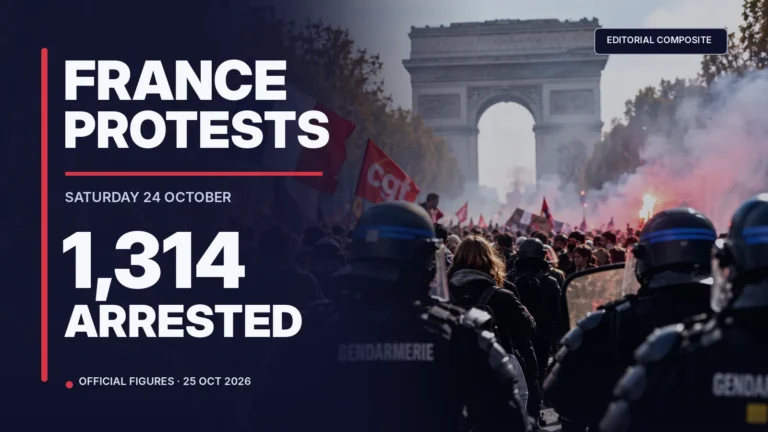
France is preparing one of its largest recent protest security operations, with 70,000 police and gendarmes mobilised for demonstrations on Saturday 24 October. President Emmanuel Macron’s restrictions on protests are also facing fresh legal challenges amid growing concerns over civil liberties.
France is preparing to deploy 70,000 police officers and gendarmes across the country on Saturday 24 October 2026, following widespread unrest during the previous weekend’s demonstrations. Interior Minister Laurent Nuñez announced the expanded security operation on Friday as President Emmanuel Macron’s government faced legal challenges over restrictions on public protests.
The deployment represents an increase of 10,000 security personnel compared with Saturday 17 October, when demonstrations in several French cities were accompanied by serious violence, looting and attacks on businesses.
The announcement comes as France faces increasing pressure over the government’s handling of protests sparked initially by student concerns about education, before expanding into broader demonstrations over living costs and public services.
70,000 Security Personnel Mobilised Across France
According to Reuters, Interior Minister Laurent Nuñez confirmed the nationwide operation on Friday 23 October, saying authorities were preparing to respond firmly to renewed violence.
The deployment will involve regular police and gendarmerie officers, specialist intervention units and mobile riot-control teams.
Additional resources will include:
- Armoured police and gendarmerie vehicles.
- Water cannon vehicles.
- Helicopters and surveillance drones.
- Anti-drone equipment.
- Mounted police and specialist intervention teams.
The French Interior Ministry has also confirmed that specialist resources, including RAID, BRI and GIGN units, will be available as part of the security preparations.
Nuñez said authorities had identified online messages encouraging attacks on public buildings and further disorder, attributing some of those calls to groups on the radical left.
Those allegations concern particular groups and individuals, rather than the wider population of people planning to demonstrate peacefully.
The government says the increased deployment is necessary to protect members of the public, businesses and public buildings after the events of 17 October.
Macron’s Protest Restrictions Face Legal Challenge
The security operation is unfolding alongside a dispute over President Macron’s approach to demonstrations.
Following a security meeting on Thursday 22 October, Macron recommended that demonstrations should generally not take place over the following days.
He indicated that protests organised by groups other than recognised trade unions could be prohibited wherever authorities considered it possible, while union-organised demonstrations could be offered alternative routes.
The announcement prompted immediate criticism from organisations defending civil liberties.
On Thursday evening, the Association for the Defence of Constitutional Freedoms (Adelico) and the Magistrates’ Union, known in France as the Syndicat de la magistrature, lodged an emergency application with the Council of State, France’s highest administrative court.
The organisations argue that the president exceeded his legal authority by seeking to direct restrictions on demonstrations and by differentiating between trade unions and other organisers.
They contend that freedom of assembly cannot depend solely on the identity or status of those organising a demonstration.
Their application seeks to suspend the implementation of the president’s proposed restrictions and any instructions issued to enforce them.
The Council of State normally considers this type of urgent application within 48 hours.
As this article was prepared, no ruling on the latest application had been verified.
Seven Political Parties Launch Separate Court Action
A second legal challenge was announced on Friday 23 October.
Seven left-wing and environmentalist political parties jointly lodged an emergency application with the Council of State, separately from the action brought by Adelico and the Magistrates’ Union.
The participating parties include Les Écologistes, La France Insoumise, the Socialist Party, the French Communist Party, L’Après, Debout and Génération.s.
They argue that restrictions must be justified by genuine public-order risks rather than the political or organisational identity of those seeking to demonstrate.
The challenge also questions whether the president has the constitutional authority to give the instructions attributed to him.
The court proceedings could clarify the legal limits of the government’s approach, although their existence does not automatically suspend restrictions already imposed by local authorities.
What Does the French Government Say?
In an official statement published on 23 October, the French Interior Ministry instructed regional prefects to examine planned demonstrations particularly carefully.
The ministry identified several factors to consider before imposing restrictions.
These include the reliability of organisers, their ability to manage demonstrations safely, the proposed routes and the risks to businesses or public buildings.
Prefects were also instructed to consult local mayors when considering restrictions or alternative routes.
Government spokesperson Maud Bregeon has said that decisions concerning demonstrations not organised by trade unions would be taken on a case-by-case basis.
This is an important distinction between Macron’s broad political recommendations and the actual administrative measures being applied in individual cities.
French authorities maintain that their overriding responsibility is to prevent a repeat of the violence and destruction witnessed during the previous weekend.
Civil liberties organisations argue that restrictions must nevertheless remain proportionate and protect the right to demonstrate peacefully.
Marseille Allows Trade Union Demonstration After Earlier Ban
The southern city of Marseille has already seen a significant change to its planned restrictions.
Authorities originally introduced measures that would have prevented demonstrations across parts of the Bouches-du-Rhône department on Saturday.
Following discussions with trade union representatives, officials agreed to permit a union-organised procession in Marseille.
The demonstration is scheduled to begin at 2pm local time on 24 October, with a route agreed with authorities to reduce risks around commercial districts.
The decision represents a limited exception to the earlier restrictions, rather than a complete removal of all controls on demonstrations in the area.
It also illustrates how local authorities are applying and modifying restrictions differently across France.
Paris Students Have Already Won a Separate Court Challenge
The latest national legal dispute follows a separate court decision in Paris on Thursday 22 October.
A Paris administrative court suspended a police order prohibiting a demonstration organised by the student collective Interfac Île-de-France.
Thousands subsequently gathered peacefully near the Pitié-Salpêtrière hospital under police supervision, although the event did not proceed as the originally proposed march.
That ruling concerned a specific Paris demonstration. It did not invalidate restrictions imposed elsewhere or determine the legality of Macron’s wider recommendations.
Fish 4 News previously reported the decision and the circumstances surrounding the student protest.
Related coverage: Paris Students Protest Peacefully After Court Overturns Demonstration Ban.
Businesses and Cultural Venues Prepare for Disruption
The prospect of renewed demonstrations has prompted extensive preparations beyond the police operation.
Several major Paris cultural institutions, including the Louvre and Musée d’Orsay, announced that they would close on Saturday.
Businesses have also been urged to consider closing following widespread damage during the previous weekend’s unrest.
Authorities have imposed or proposed restrictions on demonstrations in several cities, including Paris, Lyon and Orléans.
In Orléans, officials are particularly concerned about possible confrontations involving counter-demonstrators during a gathering associated with Marine Le Pen’s National Rally party.
Meanwhile, student groups have indicated that protests will continue despite the increased security presence.
Following a meeting with President Macron on Friday, student representatives said they were still waiting for concrete government proposals addressing their concerns.
What Happens Next?
Saturday’s demonstrations are likely to test both the French government’s security preparations and its handling of the right to peaceful protest.
Three developments will be particularly important:
- The security operation: Whether the additional 10,000 officers and specialist equipment prevent a repeat of the previous weekend’s disorder.
- The legal challenges: Whether the Council of State intervenes over the government’s proposed restrictions and the distinction between different protest organisers.
- The demonstrations themselves: Whether students, trade unions and other groups can protest peacefully within the restrictions imposed by local authorities.
There is a fundamental distinction between preventing criminal violence and restricting otherwise peaceful demonstrations.
French authorities argue that additional precautions are necessary following serious disorder. Those challenging the restrictions maintain that public safety measures must not disproportionately interfere with the right to protest.
For now, the 70,000-person deployment remains an announced security operation, and the outcome of the pending legal proceedings has not been established.
The events of Saturday 24 October will provide a clearer picture of how those decisions affect protesters, police and the wider public.
Sources and Further Reading
- Reuters, 23 October: France boosts police presence ahead of weekend protests
- French Interior Ministry, 23 October: Security instructions for 24 October
- Anadolu Agency, 23 October: Organisations challenge Macron’s restrictions
- Les Écologistes, 23 October: Seven parties confirm joint legal action
- Le Monde, 23 October: Police resources and deployment details