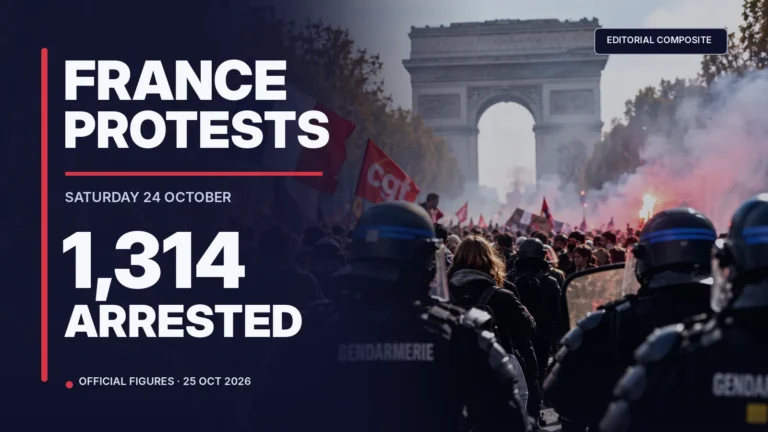
Thousands of protesters gathered peacefully in Paris after a French administrative court suspended a police ban on a student demonstration. The decision comes as President Emmanuel Macron’s government prepares tougher security measures ahead of nationwide protests on Saturday.
Thousands of protesters gathered peacefully in Paris on Thursday 22 October 2026 after an administrative court suspended a police order banning a student demonstration. The ruling allowed the gathering organised by Interfac Île-de-France to proceed under heavy police supervision, despite French authorities warning of a risk of renewed violence following serious unrest the previous weekend.
Paris Court Suspends Student Protest Ban
The Paris Police Prefecture had issued an order on Wednesday prohibiting a demonstration organised by Interfac Île-de-France, a collective representing students from universities across the Paris region.
The demonstration was scheduled to begin at 2pm local time near the Pitié-Salpêtrière hospital, with protesters originally intending to march towards Place de la Bastille.
Police justified the prohibition by citing risks to public safety and property following violent disturbances during demonstrations on 17 October.
However, organisers challenged the decision before the Paris Administrative Court.
In an emergency hearing on Thursday, a judge suspended the police order, allowing the demonstration to proceed.
According to Anadolu Agency, the judge announced that the order had been suspended without immediately setting out the detailed reasons for the decision.
The ruling represented a significant setback for the authorities’ attempt to prohibit the gathering.
Thousands Gather Without Reported Violence
Following the court’s intervention, thousands of protesters assembled in south-eastern Paris.
Associated Press journalists reported that the demonstration remained peaceful, with participants chanting under the supervision of a substantial police presence.
Although the original plan involved marching through the capital, the gathering remained near the Pitié-Salpêtrière hospital. Le Monde reported that the Police Prefecture issued a second prohibition at around 3pm, despite the court having suspended the first order. Separately, Associated Press reported that organisers signed a police document providing for a stationary gathering because of concerns about possible disorder.
The demonstration therefore went ahead, but not as the originally proposed procession through central Paris.
This distinction is important.
The court suspended the prohibition on the student demonstration, but the organisers still accepted restrictions on how the gathering would take place.
There were no reports of significant violence at the gathering in the Associated Press account.
Why Had Police Banned the Demonstration?
French authorities introduced several protest restrictions following widespread disturbances on Saturday 17 October.
The violence included clashes with police, attacks on businesses, looting and damage to public property.
The government argued that restrictions were necessary to prevent further disorder and protect residents, businesses and public buildings.
However, the decisions have raised concerns about the right to peaceful assembly.
In France, public demonstrations are protected by law, although authorities can impose proportionate restrictions where there are sufficiently serious public-order concerns.
Police decisions can also be challenged before administrative courts.
The Paris ruling demonstrates that a police prohibition is not necessarily the final decision on whether a demonstration can take place.
It does not, however, establish that all restrictions imposed elsewhere are unlawful.
Macron Government Maintains Tough Position
President Emmanuel Macron has defended stronger restrictions following the previous weekend’s violence.
Speaking after a security meeting on Thursday, Macron indicated that demonstrations organised by groups without what he considered legitimate authority could face prohibition.
Recognised trade unions, he suggested, could instead be offered alternative routes.
Student organisations have criticised the restrictions, arguing that they interfere with the right to demonstrate.
The Paris court’s intervention adds another dimension to that disagreement, particularly because the gathering subsequently remained peaceful.
Nevertheless, a peaceful outcome at one demonstration does not establish that authorities had no grounds for concern when assessing public-order risks.
Further Protests Expected on Saturday
The developments come ahead of another planned day of nationwide demonstrations on Saturday 24 October.
Trade union groups and activists associated with the Yellow Vest movement are expected to participate. Paris police have authorised a march from Bastille to Nation, organised with trade union involvement, while the separate route proposed by Interfac and Yellow Vest organisers from Bastille to Opéra has been prohibited.
Authorities have announced further restrictions in several French cities, including Lyon, Marseille and Montpellier.
Prime Minister Sébastien Lecornu has promised a major security operation to prevent a repeat of the previous weekend’s violence.
Meanwhile, the City of Paris has begun removing potentially hazardous street equipment and preparing municipal services for possible disruption.
More than 1,000 cleaning staff are expected to be available over the weekend, while a municipal crisis coordination team will be activated on Saturday.
The government faces pressure both to maintain public safety and to respect the rights of demonstrators wishing to protest peacefully.
Thursday’s events in Paris demonstrated that a police ban can be overturned through the courts and that a prohibited demonstration can subsequently proceed peacefully under agreed conditions. Whether similar legal challenges emerge ahead of Saturday’s planned protests remains to be seen.
Update: Further Court Safeguard Reported on 23 October
In a separate legal development, Le Monde reported on Friday 23 October that three students had successfully challenged the Paris Police Prefecture over the timing of demonstration bans. The court’s decision on Thursday requires the prefecture to publish such orders at least 12 hours before they come into effect, allowing time for legal challenges. This was a separate case from the suspension of the Interfac prohibition described above.
Related F4N Coverage
Latest coverage, 24 October: France to Deploy 70,000 Security Personnel as Protest Restrictions Face Legal Challenge.
Paris Court Lifts Student March Ban as France Tightens Protest Restrictions
Sources and Further Reading
- Le Monde, 23 October: Protest bans and requirement for 12 hours’ advance notice
- Le Monde, 22 October: Second police prohibition and stationary demonstration
- Associated Press: Thousands gather in Paris after court lifts protest ban
- Anadolu Agency: Paris court suspends Interfac protest prohibition
- Le Parisien: Original police prohibition of Interfac demonstration
- City of Paris: Security preparations for 24 October