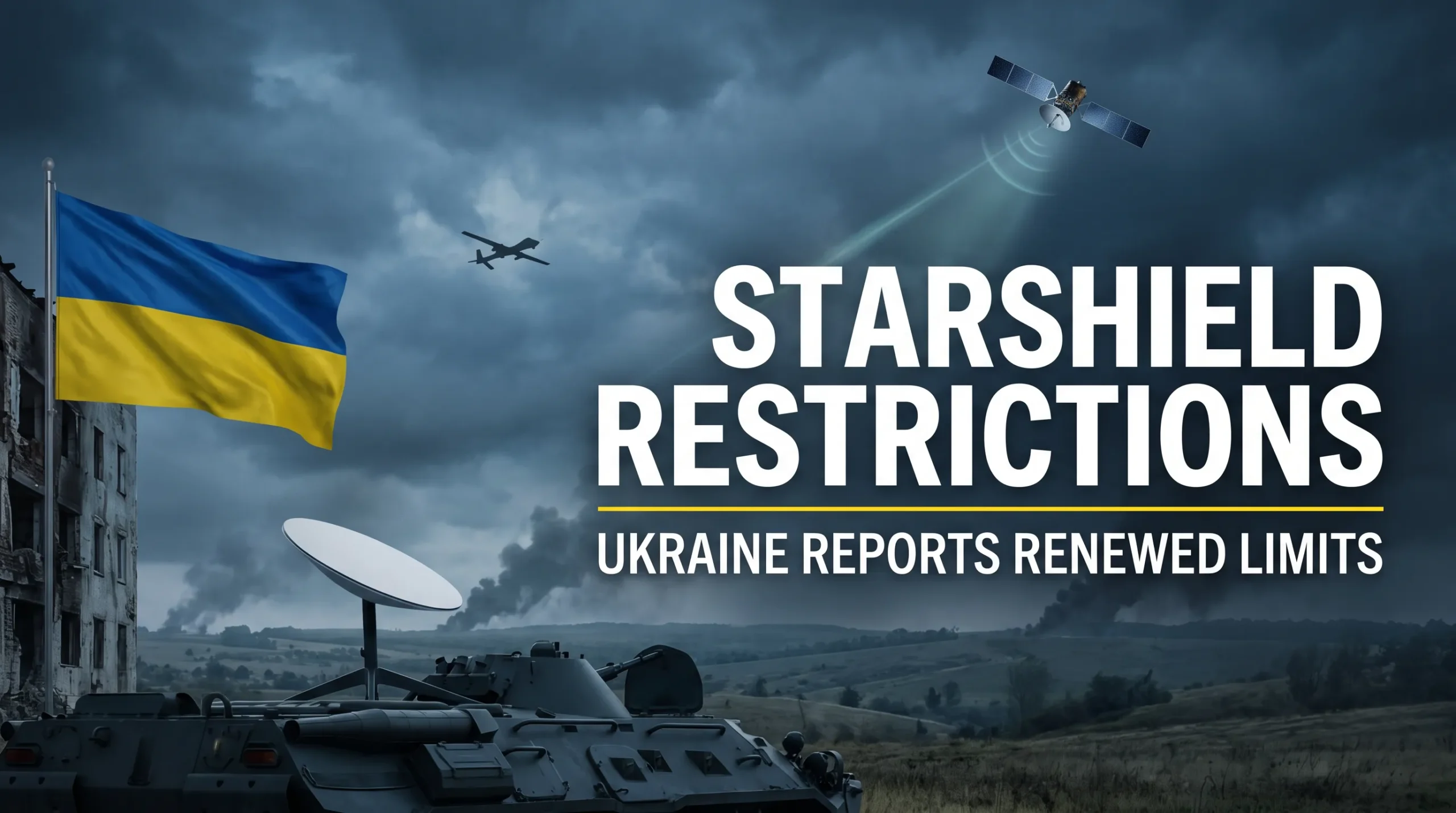
Ukraine says speed restrictions have returned to SpaceX’s military-focused Starshield satellite service, disrupting some drone operations used to defend against Russian attacks. President Volodymyr Zelenskyy says the reported 100 mph limit is hindering attempts to intercept fast-moving Russian drones, but SpaceX denies that any change has been made. The cause of the disputed disruption and who, if anyone, authorised it remain unresolved.
Zelenskyy raised the issue on Thursday, 12 November 2026 at the European Political Community summit in Dublin. On Friday, 13 November, further accounts from Ukrainian officials and a frontline commander indicated continuing operational problems. The latest reports follow a similar episode in October, when Ukraine said full-speed access had been restored. Reuters first reported the renewed allegations.
What did Zelenskyy say about Starshield?
In the official text of his 12 November address, Zelenskyy said Ukrainian personnel had detected the return of speed restrictions in Russian-occupied areas of Ukrainian territory. “The speed limit is back at 161 kilometers per hour,” he said, equivalent to 100 mph.
The president argued that such restrictions were especially damaging against Russia’s jet-powered Shahed-type attack drones. Near the front line, he said, interceptor drones are often needed because crewed aircraft cannot safely operate there. If an interceptor’s satellite link becomes unusable at higher speeds, it may be unable to pursue its target as planned.
Zelenskyy also said Ukraine was trying to obtain details from the US. In a later meeting with NATO Secretary General Mark Rutte, he again described service problems along the front and in occupied territory as a serious obstacle to air defence.
SpaceX denies making any changes
SpaceX rejected the account when asked by Axios, saying: “This is false. There has been no change.” Ars Technica also reported the denial. Reuters said SpaceX declined to comment when it approached the company, while the Pentagon and White House did not immediately respond to its enquiries.
These different responses need to be understood carefully. SpaceX’s denial is a public statement about whether a new change occurred. It does not, by itself, establish why Ukrainian forces say their connections are failing. Equally, Ukraine’s reported operational problems do not prove that the company deliberately restricted access.
On 13 November, The Washington Post reported that Ukraine’s Defence Ministry had approached both SpaceX and the US Department of Defense for clarification. It also quoted a commander from the Lazar’s Group unit saying his operations in the south had been affected. The ministry described the present speed cap as applying to Russian-occupied Ukrainian territory, a more geographically specific description than some accounts of front-wide disruption.
What does the 100 mph Starshield speed limit actually mean?
This is a reported limit on how fast connected equipment can move, not a limit on internet download speed. The threshold is approximately 161 kilometres per hour. A drone carrying a compatible satellite terminal may need that link to receive instructions or transmit data while in flight.
If the terminal stops communicating when the aircraft exceeds a set movement speed, the drone itself does not necessarily slow down or fall from the sky. What happens next depends on the design of the aircraft and its control system. It might continue autonomously, attempt to reconnect, return to base or be unable to complete the planned interception.
The effects therefore vary between different Ukrainian aircraft and communications arrangements. It would be inaccurate to suggest that all Ukrainian drones, or Ukraine’s entire air-defence network, have stopped working. Independent technical logs establishing the extent of the latest failures have not been published.
Starlink and Starshield: what is the difference?
According to SpaceX, Starlink is its consumer and commercial satellite communications service. Starshield builds on Starlink technology but is intended for government and national-security customers. The Starshield programme encompasses secure communications, Earth observation and specialised hosted payloads.
In Ukraine, commercial Starlink has been used widely for frontline communications, logistics and other military functions. The US government also supplies access to military-oriented Starshield capabilities. Some of those services rely on underlying Starlink technology. The precise contractual and technical boundaries between the services are important because each may be governed by different permissions and authorities.
SpaceX founder Elon Musk previously said Starshield was controlled by the US government and that government authorities set operational limits. Separately, he accused Ukrainian forces of violating commercial Starlink terms by using the service for offensive drone strikes. Ukrainian officials disputed that allegation. Neither statement identifies who, if anyone, made a fresh decision in November.
What happened during the October restrictions?
Ukrainian forces reported similar problems from mid-October, when terminals on faster-moving equipment were reportedly limited to roughly 100 mph. US media investigations subsequently produced conflicting accounts about whether the restrictions originated with Elon Musk or inside the White House. Those reports are evidence of an unresolved dispute about the earlier episode, not proof of responsibility for the latest one.
On 24 October, the Ukrainian Defence Ministry announced restored connectivity on equipment moving faster than 400 km/h. Fish 4 News previously examined Musk’s account of the October restrictions and the growing threat from Russia’s faster drones. The reported return of restrictions in November therefore represents a fresh development after an earlier restoration.
Who ordered the restrictions?
For November, there is still no independently established answer. Ukraine says it is seeking information from the American side. SpaceX denies making a change. Reuters said it received no immediate explanation from the Pentagon or White House.
The October dispute had already prompted a US Senate inquiry into Starlink and Starshield. Senator Richard Blumenthal asked SpaceX and the Department of Defense who could activate, restrict or withdraw access, whether Ukraine had been warned and what contractual safeguards were in place. The bipartisan Congressional Ukraine Caucus has also sought an accounting of the new reports.
It is possible to question those decision-making arrangements without asserting that the November problems were deliberately engineered to favour Russia. The renewed disruption has occurred during US-brokered talks involving Kyiv and Moscow, but no verified evidence has established a causal link between the talks and the reported connectivity problems.
What happens next for Ukraine?
The immediate issue is whether the US government and SpaceX can give Ukraine a verifiable explanation of service permissions and operational performance, and whether affected units regain reliable connectivity. Reuters reports that Ukraine’s existing Starshield arrangement with the US government expires in 2027, making renewal another question.
The dispute also strengthens the case for alternative suppliers. The European Commission said on 12 November that it was in talks with Ukraine about participation in European satellite communications programmes. Its official press briefing addressed Starshield and GOVSATCOM. Separately, Ukraine has begun exploring a sovereign network with Nokia and ICEYE, as Fish 4 News reported in October. Those efforts are longer-term possibilities, not immediate replacements for today’s operational service.
What we know and what remains unclear
- Confirmed: Zelenskyy publicly reported renewed Starshield speed restrictions on 12 November and tied them to problems intercepting Russian drones.
- Confirmed: SpaceX denied that a new change had been made.
- Confirmed: Ukraine said access had been restored after October’s previous restrictions, and has sought US clarification over the latest episode.
- Not established: who initiated any November restriction, whether it was a deliberate policy decision or the full technical and geographical extent of the problems.
- Not established: that the latest disruption was ordered to influence peace negotiations or intentionally assist Russian attacks.
Follow this story: Ukraine Starshield restrictions.
Sources
- Office of the President of Ukraine: 12 November summit address
- Office of the President of Ukraine: Zelenskyy and Mark Rutte meeting
- Reuters: 12 November Starshield reporting
- Axios: SpaceX response
- The Washington Post: 13 November update
- Ukraine Defence Ministry: 24 October restoration
- SpaceX: Starshield programme overview
- US Senate: congressional inquiry
- European Commission: 12 November briefing