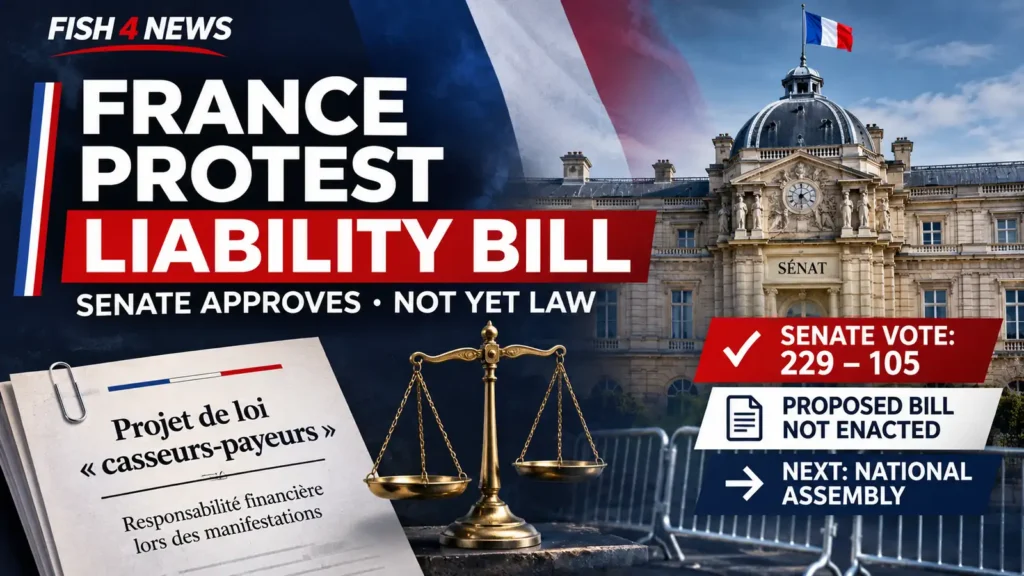
France’s Senate has approved a bill that could make some people financially liable for damage committed by others during violent gatherings, but the proposals have not become law and are awaiting scrutiny in the National Assembly.
The measure, commonly called the casseurs-payeurs bill, passed by 229 votes to 105 overnight on 27–28 October 2026. Its most contested provision would allow civil compensation claims of up to €10,000 against a person who knowingly participated in certain violent groups or remained in a violent gathering despite police dispersal warnings. The precise conditions matter: the bill does not say that everyone attending a peaceful march is automatically liable for damage. The Senate’s official vote record and its adopted text establish the result and wording.
What Has the French Senate Approved?
The formal title is Projet de loi relatif à la réparation des dommages résultant de violences ou de dégradations commises dans l’espace public et au recouvrement des dommages et intérêts, a government bill concerning compensation for violence or damage in public spaces and recovery of damages awards.
It was introduced by the government on 16 September 2026 as Senate bill no. 952 (2025–2026), with Interior Minister Laurent Nuñez, Justice Minister Gérald Darmanin and Stéphanie Rist named on the Senate filing. The Senate’s first-reading version is text no. 22 (2026–2027). It was registered in the National Assembly as bill no. 3424 on 28 October. The government has invoked an accelerated legislative procedure, but the National Assembly has not approved the measure. Senate legislative dossier; National Assembly legislative record.
The original five-article government bill was substantially expanded in the Senate. Alongside compensation, the adopted version contains proposed changes involving protest restrictions, surveillance, some criminal penalties, online content and social housing. These are proposals for the next parliamentary stage, not existing powers created by this vote.
Who Could Be Made to Pay?
Article 1 proposes two routes to what French law calls responsabilité civile solidaire, or joint civil liability. Under the first, a person who knowingly takes part in a group formed to prepare violence or damage could be liable for harm committed by another member of that group at the relevant time and place. It refers to an already-defined criminal offence concerning participation in a group preparing violence or criminal damage.
The second route concerns a gathering that can legally be dispersed. It would apply to someone who voluntarily remains after the required police warnings, knowing that members are committing violence, theft or damage. It covers qualifying offences committed after the warnings, in the relevant circumstances. The text expressly excludes someone who stays for a legitimate reason. Senate rapporteurs cited journalists and independent observers as examples of people for whom this exception could matter.
For example, if two people knowingly join a group preparing to smash shop windows, and one carries out the damage, the proposal could expose the other to a civil claim even without proof that they broke the glass themselves. Conversely, a shopper merely walking near a lawful march, or a peaceful protester unaware of violence elsewhere, does not automatically satisfy Article 1’s conditions. Any disputed knowledge, conduct and connection to the damage would be questions for legal proceedings, not assumptions based on proximity.
Under the proposal, a civil claim would still need to be assessed by a court. A defendant could dispute the evidence about their knowledge, conduct, presence, the identity of the group and the connection between that group and the damage; ordinary legal review and appeal procedures would apply. Article 1 does not expressly require a prior criminal conviction for this civil liability, whereas Article 4’s proposed benefit-recovery mechanism specifically requires a final judgment awarding damages. Separate proposed administrative bans would require a reasoned prefectural order and, except in urgent cases, notification at least 72 hours beforehand. The order in Article 1 bis A, barring someone from specified public places, could last no more than 24 hours. Article 1 bis B instead concerns attendance at a particular demonstration and includes an express route for an urgent court challenge without having to establish the normal urgency condition.
The €10,000 limit is per person under this proposed joint-liability mechanism. It is not a fixed or immediate fine, nor a general €10,000 penalty for protesting. The article does not separately impose automatic liability on a march organiser or an association just because it organised a demonstration. Any liability under other existing civil or criminal rules must be assessed separately. Read the final Senate wording of Article 1.
What Does French Law Already Say?
Damaging property, theft and violence are already offences under French law. Civil Code Article 1240 already makes a person responsible for damage caused through their fault. Penal Code Article 222-14-2 already criminalises knowingly participating in a group preparing violence or damage. Those provisions are not created by this bill. Civil Code Article 1240; Penal Code Article 222-14-2.
Under Interior Security Code Article L211-10, the French state is already civilly responsible in specified circumstances for damage caused by violent crowds and can seek reimbursement from perpetrators. The proposed change would extend recovery to people who meet the new joint-liability tests, even if they did not personally perform the damaging act. The state and local authorities would also have broader routes to identify suspected individuals for civil claims, including certain cases without a criminal prosecution. Identification is not itself proof of liability. Existing Article L211-10.
France previously enacted an anti-rioters law in 1970, subsequently repealed in 1981. A separate 2019 public-order law strengthened authorities’ existing powers. Those precedents are relevant to the present debate, but the 2026 text should be judged on its own conditions rather than described as restoring the 1970 legislation wholesale.
Why Supporters Want the Changes
Interior Minister Laurent Nuñez and supporters in the centre and right argue that victims, local councils and taxpayers should not bear the costs of damage while those involved in violent collective actions escape payment. Senate rapporteurs Olivier Bitz and David Margueritte maintain that the measure targets knowing involvement in unlawful violence rather than lawful, peaceful protest.
Supporters also point to practical difficulty identifying exactly who broke individual windows, damaged vehicles or attacked property during a moving crowd. The government says the proposed route to joint civil compensation and recovery after payment by the state could help victims obtain redress. Marine Le Pen’s National Rally supported the final text but criticised the €10,000 cap as too low. Senate committee report and Public Sénat’s account of the debate explain the supporting case.
Why Opponents Are Concerned
The central civil-liberties objection is that people who did not personally cause damage could nonetheless be required to pay for it. Amnesty International France warns of a chilling effect on peaceful assembly. The CGT trade union, in a statement on 28 October, argues that the rules could deter ordinary protesters and expose families to financial hardship. Nathalie Tehio, president of the Ligue des droits de l’homme (LDH), has also warned of a deterrent effect on the right to demonstrate. Left-wing senators criticised the principle of imposing compensation on people who are not the direct perpetrators. These are concerns about how the provisions might operate, not proof that every peaceful demonstrator would be liable. Amnesty’s objections; CGT statement; LDH interview.
In a 3 September advisory opinion on the original government proposal, France’s Conseil d’État accepted that a carefully limited fault-based civil mechanism could pursue legitimate public-interest aims. But it required a stronger link between the group and the damage, and considered a per-person cap important to proportionality. It also criticised the original impact assessment for insufficient data about current damage costs and how effective the changes might be. The opinion was not a blanket endorsement of the expanded Senate text. Conseil d’État advisory opinion.
Article 4 would allow recovery of civil damages from specified welfare and housing payments following a final court judgment. The Senate extended the original approach to additional benefits, including the RSA and activity-related assistance. Recovery would be subject to limits intended to preserve minimum living resources, while some prior payment obligations would take precedence. Critics argue that this could affect dependants and families who committed no offence. Importantly, these welfare provisions have a wider scope than protest-specific damage, as the Conseil d’État itself observed.
Other Senate additions include proposed administrative protest bans in defined circumstances, increased penalties for some offences, investigative drones, experiments in algorithmic video analysis and a procedure affecting online incitement to violence. For example, Article 1 quinquies would raise the maximum punishment for knowingly joining a group preparing violence or damage from one year and €15,000 to three years and €45,000. Under Article 1 septies, participating in a prohibited public demonstration could become punishable by six months’ imprisonment and a €7,500 fine, with a €500 fixed-penalty route also proposed. Disobeying either new individual administrative protest ban could carry six months’ imprisonment and a €3,750 fine. Article 1 would create a civil route to compensation, but the expanded bill also contains new or increased criminal sanctions. They must not be conflated. Measures restricting gatherings or online expression would face separate legal scrutiny concerning necessity, proportionality and the ability to challenge official decisions.
What Happens Next?
As of 3 November 2026, the National Assembly’s official dossier records the Senate-approved bill at first reading in the lower house. No final parliamentary approval or enactment is recorded, and Fish 4 News has not verified a fixed date for an Assembly floor vote. MPs can amend, reject or approve provisions. Under the accelerated procedure, a joint parliamentary committee could subsequently be asked to reconcile differences; the bill would still have to complete the legislative process before taking effect.
The bill predates the major demonstrations of 17 October: the government filed it on 16 September, and the Conseil d’État examined an earlier version before that. However, the October disorder influenced the Senate debate and the addition of wider measures. Our earlier report examined the grievances and wider unrest surrounding the 17 October demonstrations. The further demonstrations of 31 October and the 3 November student protests sharpen the political argument without changing the legislation’s legal status. Fish 4 News also reported on the 24 October demonstrations.
The unresolved question is not whether people who personally destroy property can be held responsible; they already can. It is how far financial responsibility should extend to someone who did not damage anything, what evidence should be required and whether the safeguards in the final law, if one is passed, would adequately protect peaceful assembly.
Watch: Parliamentary Debate
A 27 October Senate contribution by Senator Loïc Hervé on YouTube offers a participant’s view of the debate. It should be read alongside the full official Senate proceedings and the Public Sénat video review.